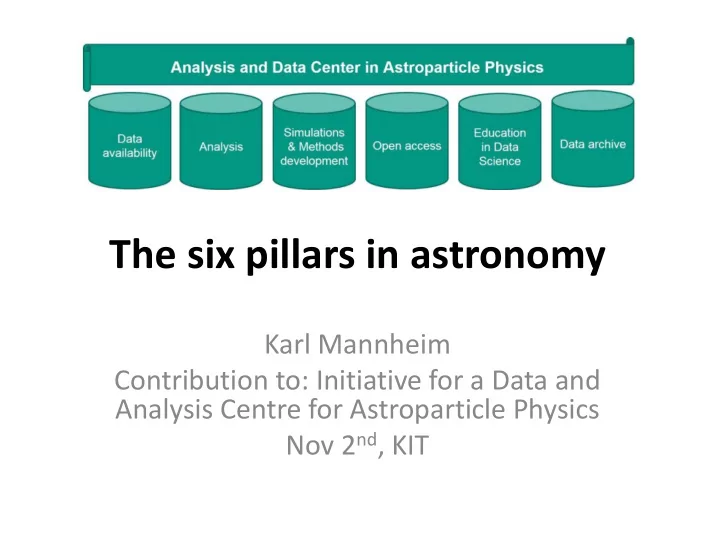
The six pillars in astronomy Karl Mannheim Contribution to: - - PowerPoint PPT Presentation
The six pillars in astronomy Karl Mannheim Contribution to: Initiative for a Data and Analysis Centre for Astroparticle Physics Nov 2 nd , KIT General ROOTS: Define data products transmitted via gateway from central computing facilities of
General
- ROOTS: Define data products transmitted via gateway from central
computing facilities of hosted telescopes
- FLEXIBILITY: diversity of data pipelines
- MANPOWER: developing and maintaining data pipelines
- COMPUTING: processing of raw data to generate high-level data
- ARCHIVE: Long-term cost-efficient raw data storage
- DISSEMINATION: Storage and secure external access to high-level data
- HPC: Monte Carlo/numerical simulations (interface to specialized HPCs?)
- R&D: evolutionary approach to optimize modus operandi
- SUSTAINABILITY
- TRAINING
- VIRTUAL OBSERVATORY: ( external partners such as CDS or GAVO)
– Overlay images and c ross-identifications – Multi-wavelength spectra (correlations in energy space) – Statistical analysis (spatial correlations) – Time-domain studies (temporal correlations, transients) – Source classification (machine learning) – Pretty pictures and movies (public outreach)
Examples
- Examples of data/HPC center support:
– Jülich Supercomputing Centre: LOFAR/SKA data-pipeline support – Rechenzentrum Garching: EUCLID collects >500,000 images during 6 years of operation (30 Pbytes). Combine with hybrid data from ground-based spectroscopy (e.g. DES, KIDS). RZG provides: 36 compute nodes with 576 kernels and 500 TB storage realized as GPFS, external data access using gridFTP or Globus Online and external access to computing by globus GRAM. – LRZ: SuperMUC (2 Pflops/s) for numerical simulations (MHD, PIC)
- Education: Hands-on-Universe, robotic telescopes (MONET), citizen
science (SETI, Panstarrs, galaxy zoo of SDSS)
- Upcoming: Euclid, eROSITA, Athena, LSST, ELT, CTA, LOFAR, SKA
- Denkschrift 2017 & Strategiepapiere (RDS)
– Information Science and E-Infrastructure Challenges in Astronomy (Polsterer et al.) – Computational Astrophysics (Röpke et al.) www.denkschrift2017.de
SKA1-LOW: 50 – 350 MHz Phase 1: ~130,000 antennas across 65km SKA1-Mid: 350 MHz – 24 GHz Phase 1: 200 15-m dishes across 150 km
SKA: HQ in UK; telescopes in AUS & RSA
Data Flow through the SKA
Footer text
SKA1-LOW SKA1-MID
~2 Pb/s 8.8 Tb/s 7.2 Tb/s ~50 PFLOPS ~5 Tb/s ~250 PFLOPS
beamforming
~300 PB / year
- Pre-analysis in near-realtime and strong data reduction (~ 105)
Raw data processing is extremely challenging
- Science data products = large objects (up to ~ 1 Petabyte / 3D image)
- To be “improved” in Regional Data Centers
SKA Regional Centres –
- utside SKAO scope
RSA AUS
- Required
- capacity for reprocessing data
and their analysis
- storage for a long-term
archive
- local user support
- Intent
- SKA partner countries
planning SKA regional Centres
- National super-computing
centres
- Provide local support to
scientists
- Development of new
techniques, new algorithms
- Deliver SKA science
South Africa Australia
SKA Regional Centre
merging individual
- bservations of long
term projects
SKA Regional Centre
SKA Regional Centre
Discovery of the un-knowns in semi-raw visibility data
Data Cubes: 36.600 x 36.600 x 250.000 Pixel up to PetaByte / Cube
SKA - telescope
SKA Regional Centre Opportunity for new developments that can feedback into the science data processing scheme
Integration Lab
National SKA Data Centre
Pulsars Lab 1 Surveys Lab 2 Transients Lab 3 Magnetic Fields Lab 4 Cosmic Rays Lab 5
5 Key Science Labs
- The SKAO has compiled a list of 13 High Priority Science Objectives (HPSO)
- HPSO require different approaches in data analytics due to different nature of data.
1 Integration Lab (general support)
- Basic services: Network, HPC, system integration
- Theory: Information theory, algorithms for Big Data analytics, Machine Learning, …
In total: approx. 50 people required
- How to set this up properly ?
Think big enough!
- SKA national center could host all other
experiments/observatories
- Amazon-type of investment: civil playground for future big data
analytics developers
- Part of European science cloud based on CERN-SKA cooperation:
Each of the current HGF centers is way too small!
- Data archive
– Ten-ExaByte-scale mass storage with fast access – Responsibility for part of SKA central computing facility – Sustainable design (power supply /waste heat for green houses)
- Analysis and data science competence center
– Ten-PFLOPS-scale compute power – 50 data scientists – Software implementations of data pipelines – Algorithms for data analysis and visualisation – User support
- Master-supplement „data scientist/engineer“