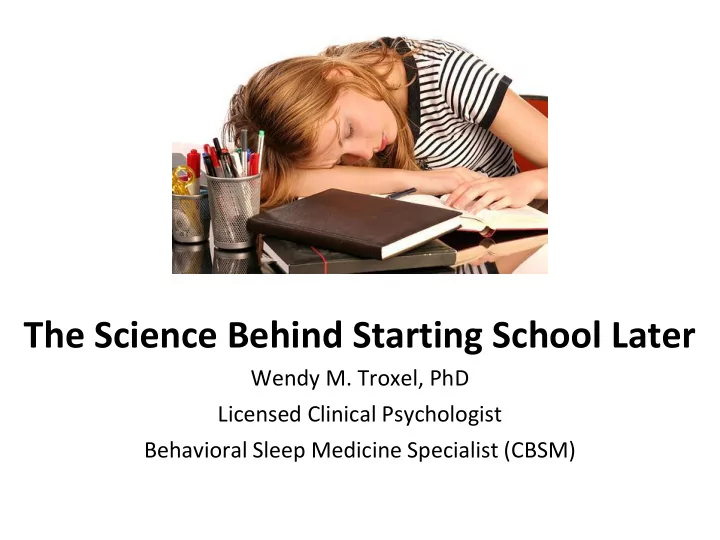
The Science Behind Starting School Later Wendy M. Troxel, PhD - - PowerPoint PPT Presentation

the science behind starting school later
SMART_READER_LITE
LIVE PREVIEW

The Science Behind Starting School Later Wendy M. Troxel, PhD - - PowerPoint PPT Presentation

The Science Behind Starting School Later Wendy M. Troxel, PhD Licensed Clinical Psychologist Behavioral Sleep Medicine Specialist (CBSM) Agenda Why is sleep important? How does sleep and circadian biology change in adolescence? What


slide-1
SLIDE 1

The Science Behind Starting School Later

Wendy M. Troxel, PhD Licensed Clinical Psychologist Behavioral Sleep Medicine Specialist (CBSM)

slide-2
SLIDE 2

Agenda

▪Why is sleep important? ▪How does sleep and circadian biology change in adolescence? ▪What are the consequences of sleep loss? ▪What are the benefits of later school start times?

slide-3
SLIDE 3

Why is Sleep Important?

  • Food for the brain – produces

alertness, enhances memory and our ability to learn

  • A biological requirement – helps us

perform effectively and safely

  • Essential for development –

particularly during growth and maturation

  • A key to our health – as important as

good nutrition and regular exercise

Getting sleep helps prevent illness and is critical for healthy bodies and healthy minds.

slide-4
SLIDE 4

Teens Experience a Shift to a Later Sleep-Wake Cycle

  • Teens need 8-10 hours of sleep per night.
  • Biological clocks shift during adolescence

towards later bedtimes and later wake-up times.

  • Delayed melatonin release also leads to

increased alertness in the evening and decreased alertness prior to 9 a.m.

  • This delayed phase occurs with a concurrent

shift towards earlier school start times

slide-5
SLIDE 5

Teens Are Chronically Sleep-Deprived

  • Less than 15% of teens achieve the minimum

recommended hours of sleep per night (8 hours)

  • Early school start times also have a selective impact
  • n rapid eye movement sleep
  • Compromises memory consolidation and learning of

new tasks

  • In laboratory studies, teens show levels of

sleepiness that are comparable to that of narcoleptics (sleep-disordered population)

slide-6
SLIDE 6

Consequences of Sleep Loss: Academic Functioning and Mental Health

  • Sleep loss in adolescents is associated with

increased risk of:

  • Poorer grades/ scores on standardized tests
  • Truancy and dropouts
  • Reduced problem-solving/ attention
  • Irritability, difficulty getting along with others
  • Depression
  • Anxiety
  • Substance Use
  • Suicide
slide-7
SLIDE 7

Consequences of Sleep Loss: Physical Health and Performance

  • Shorter sleep duration predicts increased risk of
  • besity, cardiovascular risk, and type 2 diabetes
  • Sleep loss is associated with increased sports-related

injuries in high school students

  • Sleep loss impairs healing and recovery
  • According to Harvard Study: “Applying principles of

sleep physiology to competitive sports has the clear potential to yield a significant and natural athletic performance advantage”.

slide-8
SLIDE 8
  • Drowsy driving:
  • Over 100,000 motor vehicle crashes per year are caused by

drowsy driving

  • Over 50% of drowsy-driving crashes are caused by drivers aged

16-25 years

  • National poll: 68% of high school seniors have driven while

drowsy; 15% at least 1x/wk

  • Sleep loss impairments are equal or greater than those

due to alcohol intoxication (i.e., 3-4 beers)

Consequences of Sleep Deprivation: Safety

slide-9
SLIDE 9

American Academy of Pediatrics Recommendation (2014)

  • Middle and High School starts “no earlier than 8:30”.
  • The American Academy of Pediatrics “strongly supports

the efforts of school districts to optimize sleep in students and urges high schools and middle schools to aim for start times that allow students the opportunity to achieve optimal levels of sleep (8.5–9.5 hours) and to improve physical and mental health, safety, academic performance, and quality of life.”

slide-10
SLIDE 10

With later start times, will teens actually sleep more or just stay up later?

  • Evidence from districts around the country

shows that when schools delay start times:

  • Teens get an additional hour of sleep per night on

average

  • Bed times remain the same
  • More morning sleep (when REM is most likely to
  • ccur)
  • The later the start time, the more sleep they get
  • But even a 30 minute delay results in

improvements

slide-11
SLIDE 11

BENEFITS OF DELAYED SCHOOL START TIMES: EVIDENCE FROM DISTRICTS AROUND THE COUNTRY

slide-12
SLIDE 12

Benefits of Later School Start Times: School Performance

  • Attendance improves
  • Tardiness rates drop
  • Drop-out rates decline
  • Standardized test scores improve

– In one study SAT scores for the top 10% of students increased by more than 200 points

  • Grades improve
  • Disadvantaged students and highest achieving both benefit

– “Early school start times reduce performance among disadvantaged students by an amount equivalent to having a highly ineffective teacher.“ – This reduced performance, translates into roughly $17,500 in reduced lifetime earnings per student. (Brookings Institute)

slide-13
SLIDE 13

Benefits of Later School Start Times: : Health & Safety

  • Delayed start times are associated with

improvements in:

– Mood (fewer report feeling unhappy, depressed) – Health (decreased health center visits) – Safety

  • Teton County School District: the number of car crashes for

teen drivers was significantly reduced by 70% when a school shifted start times from 7:35 AM to 8:55 AM.

slide-14
SLIDE 14

Summary

  • Sleep is vital for healthy minds and bodies.
  • The conflict between teens’ biological clocks

and early school start times sets the stage for chronic sleep loss for most adolescents.

  • Delaying school start times is a modifiable

target to reduce the epidemic of teen sleep deprivation.

  • Evidence shows benefits of later school start

times for academic performance, health, and safety.

slide-15
SLIDE 15

Obstacles & Solutions

  • Three start times vs. two start times
  • Traffic (Highway 248)
  • Athletics
slide-16
SLIDE 16

Bell Times

slide-17
SLIDE 17

Traffic Study

Source: Transportation Demand Management Study Existing Conditions, January 2016 GPCTMA meeting

slide-18
SLIDE 18

Q & A

  • 2 minutes for anyone who wants to speak
  • Further questions/commentary?

Email Molly Miller: MMiller@pcschools.us (Community Relations Specialist)

slide-19
SLIDE 19

What’s Next?

Surveys & stay involved:

Facebook: www.facebook.com/parkcityschools/ Instagram: ParkCitySchoolDistrict Twitter: @ParkCitySchools Pinterest: pinterest.com/ParkCitySchools/

Website: www.pcschools.us