
SLIDE 1
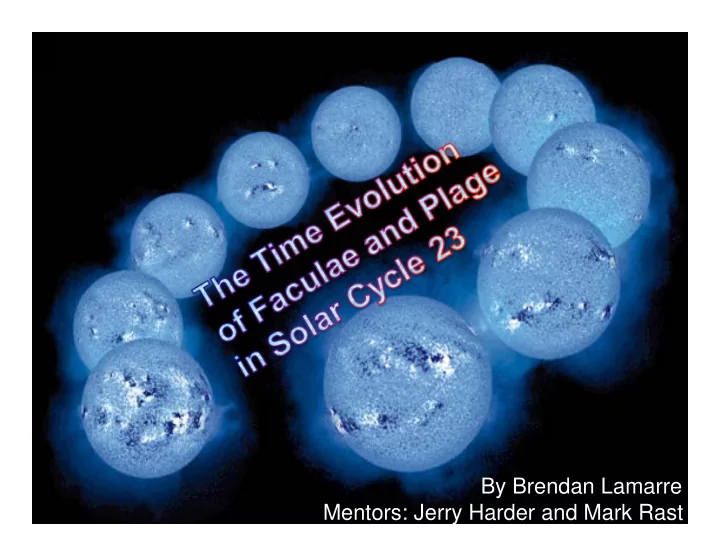
By Brendan Lamarre Mentors: Jerry Harder and Mark Rast Irradiance - - PowerPoint PPT Presentation
By Brendan Lamarre Mentors: Jerry Harder and Mark Rast Irradiance Trends (Harder et al., 2010) Jan 15 th , 2005 Ca II K (393.45nm) Jan 15 th , 2005 Red (607.095nm) Jan 25 th , 2009 Ca II K (393.45nm) Jan 25 th , 2009 Red (607.095nm) Jan 15th,
(Harder et al., 2010)
Jan 15th, 2005 Ca II K (393.45nm) Jan 25th, 2009 Ca II K (393.45nm) Jan 15th, 2005 Red (607.095nm) Jan 25th, 2009 Red (607.095nm)
Jan 15th, 2005 Ca II K (393.45nm) Jan 15th, 2005 Red (607.095nm) Jan 25th, 2009 Ca II K (393.45nm) Jan 25th, 2009 Red (607.095nm)
photosphere
wavelength
(Harder et al., 2010)
(Topka et al., 1997)
Creating a Mask Image
A Mask image is the combination of the dark pixels of sunspots in the red wavelength and the bright pixels of active regions in Ca II K 7 models are used to place the pixels in bins corresponding to active features
1 Internetwork 2 Network 3 Active Network 4 Plage 5 Facula 6 Sun Spot Penumbra 7 Sun Spot Umbra
Mask Ca II K Red
Find all Ca, Red, Blue, and Mask images
Read in fits file, throw out edge of solar disk, and remove clv and align images
For all images
Determine which pixels are dark and bright Determine which pixels are dark and bright Where the mask image = 6 (Faculae) Where the mask image = 5 (Plage)
Integrate from =.2 -> 1 in steps of .1
Plot % of dark facula and plage to total facular and plage area Plot % of dark facula to total facular area Plot % of dark plage to total plage area
determined from Ca II histogram (blue curve)
do this pixels lay on the Red Image histogram (red curve)?
Dark Bright
Dark Faculae Bright Faculae Dark Plage Bright Plage All Faculae and Plage
When progressing to solar minimum:
area causes increase in irradiance
in facular area means little irradiance change due to bright faculae
decreasing solar activity
(Harder et al., 2010)
Faculae and plage cannot completely account for the magnitude of the change in the increasing irradiances. This suggests that the internetwork and network may similarly influence the irradiance change. However, unlike changes in faculae and plage, the network is too big and diffuse to contribute observable changes.
With High Solar Activity Larger areas of faculae and plage Larger fraction of dark faculae
Suppression of irradiance
With Low Solar Activity Smaller areas of faculae and plage Larger fraction of bright faculae
Irradiance from bright faculae is about constant due to smaller facular area
conflicting with larger fractional area of bright faculae
In conclusion, the evolution of faculae and plage in the descending phase
Harder, J., Fontenla, J., Rast, M., Merkel, A., Pilewskie, P., and Richard, E. “What the SORCE SIM
In Text Citation: (Harder et al., 2010) Topka, K. P., Tarbell, T. D., & Title, A. M. 1997, The Astrophysical Journal, 484, 481 In Text Citation: (Topka et al., 1997)