SLIDE 1
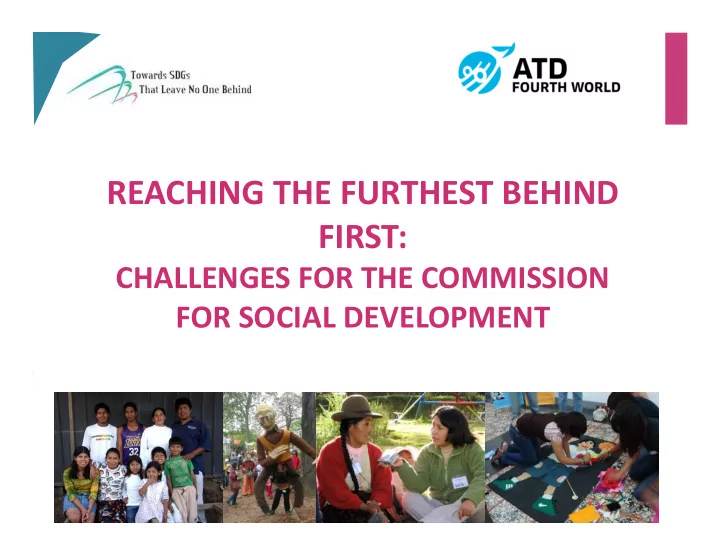
REACHING THE FURTHEST BEHIND FIRST:
CHALLENGES FOR THE COMMISSION FOR SOCIAL DEVELOPMENT
SLIDE 2 Agenda 2030 is about social development because it is about the eradication of poverty, leaving no
- ne behind and reaching the
furthest behind first Social development needs economic development and environmental policies and MOI
SLIDE 3
- The economic framework in which we start
the implementation of the SDGs
- Innovative practices for social inclusion
- Follow-up and review
Main points
SLIDE 4 The world economy stumbled in 2015 and only a modest improvement is projected for 2016/17
World Economic Situation and Prospects 2016 published by DESA
A new financial crisis is possible before 2020
Gaël Giraud, Chief Economiste of the French Agency for Development AFD
Economic framework
SLIDE 5
Continuing high rates of unemployment worldwide and chronic vulnerable employment
ILO’s World Employment and Social Outlook – Trends 2016
Unemployment: 2015 - 197.1 million 2016 - 199.4 million 2017 – 200.5 million
Economic framework
SLIDE 6 A new adjustment shock in 2016: According to IMF
- Budget reductions are expected to impact 132
countries in 2016 in terms of GDP until 2020.
- 81 developing countries are projected to cut
public spending
- 45 high-income countries.
- Expenditure contraction is expected to affect
more than six billion persons or nearly 80 per cent of the global population by 2020
Policy Brief based on The Decade of Adjustment: A Review of Austerity Trends 2010- 2020 in 187 Countries – ILO
Economic framework
SLIDE 7
- The Commission should create the space and
conditions to talk honestly about these issues
- The Commission should have
recommendations for the International Financial Institutions
Macroeconomic issues = social issues
SLIDE 8
Report of the SG on follow up and review
Steps for functional commissions to support the HLPF “they should reflect on their ability to convene and engage the critical actors relevant to their contributions to the 2030 Agenda, including scientists, local governments, business, and representatives of the most vulnerable people”
Innovative practices for social inclusion
SLIDE 9
Commitment 4 We commit ourselves to promoting social integration by fostering societies that are stable, safe and just and that are based on the promotion and protection of all human rights, as well as on non-discrimination […], and participation of all people, including disadvantaged and vulnerable groups and persons.
World Summit for Social Development
SLIDE 10
Where are they?
SLIDE 11
The Commission should lead the way
Proposal The Commission should mandate DSPD to invite people experiencing poverty, social exclusion and the worse effects of environmental degradation to the expert group meetings.
SLIDE 12 The Commission should lead the way
Proposal In the same way as women are part of official delegations for CSW, people experiencing poverty, social exclusion and the worse effects
- f environmental degradation should be part of
- fficial delegations to CSocD
.
SLIDE 13
ENGLISH bit.ly/handbook-ATD FRENCH bit.ly/manuel-ATD
Based on the UN Guiding Principles on Extreme Poverty and Human Rights
SLIDE 14
- Not forced
- Clear intentions
- Adequate time
- Designed with people
- Unite people without
judgment
presence
report back to communities
inequalities (reach the most excluded)
- Regular evaluations
- Avoid marginalizing
language
Participation Done Correctly
SLIDE 15
How are we suppose to believe that the SDGs will bring results if no accountability mechanism is built into them?
Follow-up and review
Maryann Broxton, Civil Society Forum
SLIDE 16
- Measure 169 targets – The IAEG-SDGs in the
context of the Statistical Commission
- Lack of available data for the poorest and
most excluded people
Challenges
SLIDE 17
- In 2013 Unicef’s report: one third of the
world’s children under the age of five are not registered.
Every child’s birth rights. Inequities and trends in birth registration
- Significance for the measure of MDG target 4a
Reduce by two-thirds, the under-five mortality rate MDG Report 2015: Global under- five mortality rate has declined by more than half
The value of data
SLIDE 18
The Commission should lead the way
Proposal In the context of monitoring Agenda 2030, the Commission should mandate DSPD to work with people living in poverty to measure progress on the dimensions more relevant to their lives, to identify gaps in implementation and to make proposals.
SLIDE 19 The Commission should lead the way
Proposal The Commission could ask DSPD to include qualitative and perception based data when monitoring progress about the social dimension
SLIDE 20
Credibility
SLIDE 21
Thank you!
SLIDE 22
- Social Protection Floors
- We should add, participation of people living
in poverty in design, implementation, monitoring and evaluation of SP schemes
Social Protection
SLIDE 23
- Eliminate discrimination in schools
“It is not easy for a child to express herself or to study hard due to the mockery of a classmate or even of the teacher because of where you live. Even though we are living in the cemetery, we have the same dreams of becoming a teacher, doctor, lawyer, etc. as everyone else.”
Improve Education
SLIDE 24
- Create a conducive environment for parents—
including those who live in poverty– to be partners in their children’s education.
Improve Education
SLIDE 25
- Take the community’s context into account:
“In May, I take my children out of school to help
- n the farm. I do it because we must be able to
eat in order to send the children to school the following year.”
Improve Education
SLIDE 26
- Eliminate hidden costs to education:
–Transportation –Uniforms –Supplies
Improve Education
SLIDE 27 “That people disrespect us by calling us names like ‘social case’, ‘bad mother’, ‘incapable’, ‘good for nothing’ demonstrates how they are judging us and do not know the reality we face. We experience the violence of being discriminated against, of not existing, not being part of the same world, not being treated like other human beings.”
- Person Living in Poverty, France
Address Discrimination and Stigmatization Against People Living in Poverty
SLIDE 28 “Stigma supplies the world view for marginalization by ‘legitimizing' the process of setting up and perpetuating an ― ‘us and them’ divide, and through the devaluation and dehumanization of those seen as being outside the ―us… Stigma gives rise not only to discrimination, but also to a range of other human rights violations, both of economic, social and cultural rights as well as civil and political rights, underscoring the indivisibility of all human rights.”
- Catarina de Albuquerque, UN Special
Rapporteur on the right to safe drinking water and sanitation
SLIDE 29 “Why didn’t you shower you pig?”
- Person Living in Poverty, Bolivia
SLIDE 30 “Extreme poverty engenders a fear, a shame in people, doubts that stop them from expressing themselves when they should.”
- Person Living in Poverty, Madagascar
SLIDE 31 Discrimination
- 1. Prevents access to available resources and
services
- 2. Silences people and preventing their
participation