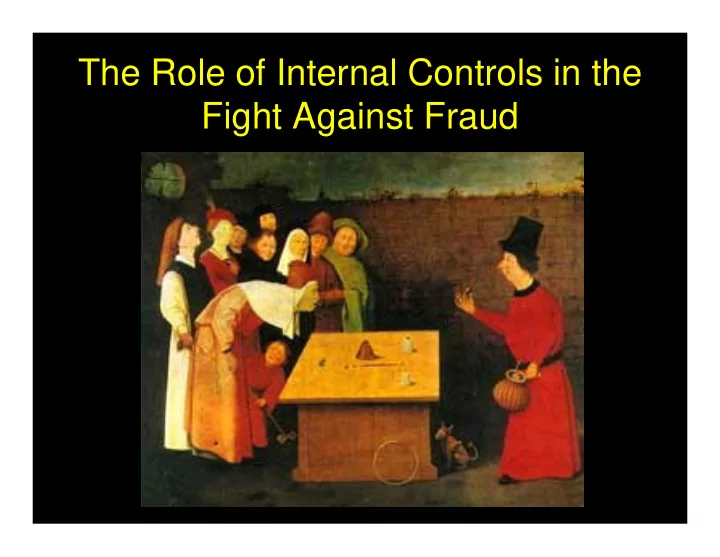
SLIDE 1
The Role of Internal Controls in the Fight Against Fraud
SLIDE 2 A Tale of Fraud!
- Payroll manager makes $2.25MM disappear!
It must be Magic!
SLIDE 3 Fraud Statistics
- 5% of GWP lost to employee fraud & abuse
- More than $3.5 Trillion per year
- Median loss $140,000
- More than 1 in 5 losses in excess of $1 MM
- Median 18 months before detection
Source: Association of Certified Fraud Examiners' Report to the Nations.
SLIDE 4 Fraud Statistics
- Men perpetrate 65% of frauds
- Men cause losses more than
twice those caused by women
Source: Association of Certified Fraud Examiners' Report to the Nations
SLIDE 5 Fraud Statistics
- Half of all frauds were committed by
someone over 40
- Fraudsters 51-55 caused median
losses of $600,000.
– More than twice as much as any age group below them – Six times as much as employees below the age of 35
Source: Association of Certified Fraud Examiners' Report to the Nations
SLIDE 6 Fraud Statistics
- High school graduates commit 25%
- f all frauds
– Median losses are $75,000
- College graduates commit 37% of all
frauds – Median losses are $200,000
- Perpetrators with post-graduate
degrees commit 17% of all frauds – Median losses are $300,000
Source: Association of Certified Fraud Examiners' Report to the Nations
SLIDE 7 Fraud Statistics
– Median loss $95K
– Median loss $250K
– Median loss $850K
- Multiple perpetrators caused median
losses twice as high as perpetrators acting alone
Source: Association of Certified Fraud Examiners' Report to the Nations
SLIDE 8 Fraud Statistics
- 85% never charged or convicted for
a fraud related offense
Source: Association of Certified Fraud Examiners' Report to the Nations
SLIDE 9 Why should we care?
- Fraud losses come straight
- ut of your bottom line
SLIDE 10 To Minimize Fraud Risk, You Must Understand
- How fraud happens
- Why fraud happens
SLIDE 11 How Fraud Happens
- 1. Asset Misappropriation:
87%; median loss $120K
Kick-backs, illegal gratuities, conflicts of interest: 33%.; median loss $250K
- 3. Fraudulent Statements: 8%;
median loss $1 MM
Source: Association of Certified Fraud Examiners' Report to the Nations
SLIDE 12 Asset Misappropriations: Cash Is #1 Target = 85%
Billing Schemes – 25%
Skimming – 15%
Check Tampering – 12%
Expense Reimbursements – 15%
Cash on Hand – 12%
Source: Association of Certified Fraud Examiners' Report to the Nations
SLIDE 13 U.S. Asia Europe Latin America & Caribbean
Billing 26% 15% 23% 21% Corruption 25% 51% 44% 47% Check Tampering 15% 6% 3% 5% Skimming 16% 14% 10% 13% Non-Cash 15% 20% 21% 21% Expense Reimbursements 17% 14 % 10% 8% Cash on Hand 11% 12% 10% 8% Payroll 12% 4% 9% 10% Cash Larceny 11% 13% 9% 3% Financial Statement Fraud 7% 9% 12% 8% Register Disbursements 3% 3% 5% 3%
Fraud Schemes by Country
Source: Association of Certified Fraud Examiners' Report to the Nations
SLIDE 14 Non-Cash Targets
Inventory/information – 17%
Source: Association of Certified Fraud Examiners' Report to the Nations
SLIDE 15 Why Fraud Happens
Immediate Need Opportunity Rationalization
SLIDE 16 Immediate Need
Un-sharable Problem
- Living beyond one’s means
- Drugs, alcohol, gambling
- Romantic involvement
- Financial emergency
SLIDE 17
Opportunity
In the absence of trust there can be no fraud.
SLIDE 18 “Ability to Rationalize”
- “The company owes me”
- “It’s just a loan, I’ll pay it back”
- “Everybody else is doing it”
- “The rules don’t apply to me”
SLIDE 19 How Do We Find Fraud?
- Tip – 43% - $144,000
- Mgmt. Review – 15% - $123,000
- Internal Audit - 14% - $81,000
- Accident – 7% - $166,000
- External Auditors – 3% - $370,000
- Police – 3% - $1,000,000
- IT Controls - 1% - $110,000
Source: Association of Certified Fraud Examiners' Report to the Nations.
SLIDE 20 Effective Internal Controls Reduce Fraud Risk
The presence of anti-fraud controls is notably correlated with significant decreases in the cost and duration of occupational fraud schemes.
Source: Association of Certified Fraud Examiners' Report to the Nations
SLIDE 21
Obstacle #1
Ignorance
SLIDE 22
1987 COSO Model
SLIDE 23
1992 COSO Integrated Framework
SLIDE 24
2004 COSO Enterprise Risk Management Model
SLIDE 25
2013 COSO Enterprise Risk Model
SLIDE 26
1987 COSO Model
SLIDE 27
Obstacle #2
“Tone at the Top”
SLIDE 28
Compliance Mentality
Effective internal controls result in compliance. Compliance does not necessarily result in effective internal controls.
SLIDE 29
Weak Internal Controls: An Open Door to Fraud
SLIDE 30 Segregation of Duties
complete a transaction without involving someone else
SLIDE 31
Meaningless Approvals
SLIDE 32
Internal Controls
SLIDE 33
Preventive Controls
– What you do to ensure that the right things happen; wrong things don’t happen
SLIDE 34 Control Types
– Completeness – Accuracy – Authorization – Segregation of Duties – Security
SLIDE 35 IT Security
– Administrative Users
SLIDE 36 Segregation of Duties
initiate and complete a transaction without involving someone else
– “Cannot” vs. “Should Not” – Collusion
SLIDE 37 Detective Controls
the things that preventive controls didn’t prevent
SLIDE 38 Detective Controls
Verification
- Reconciliations
- Management
reviews
SLIDE 39 #1 Expect Fraud
- Cannot be eliminated;
- nly managed!
- If you don't expect it
– you won't look for it – you might not recognize it when you see it
SLIDE 40 #2 Assess Risk
– Look at it like a fraudster would – What have you got that someone else would want? – How would you get your hands on it?
SLIDE 41 #3 Know Who You’re Hiring
contain false statements.
confirm only dates of employment.
SLIDE 42 #4 Internal Controls
- Targeted, cost-effective
- Preventive
– Segregate duties – Meaningful approvals
– Reconciliations – Independent verification – Whistle-blower hotline
SLIDE 43 #5 Have a Plan
time to learn from your mistakes.
going to do before you have to do it.
SLIDE 44
Questions