1
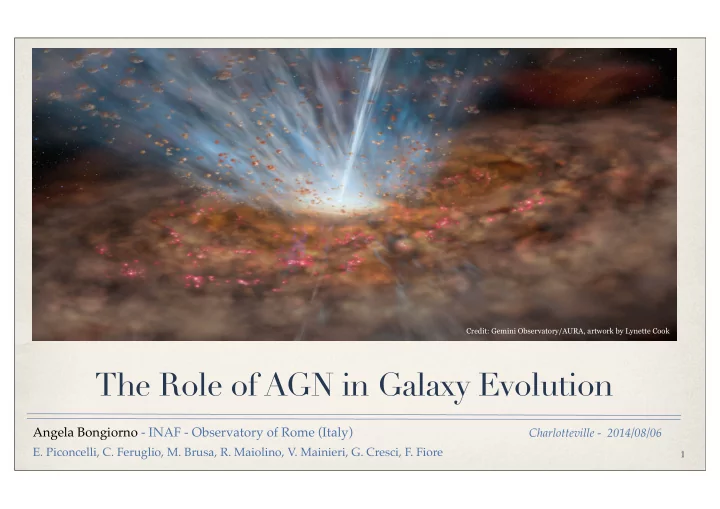
Credit: Gemini Observatory/AURA, artwork by Lynette Cook
Angela Bongiorno - INAF - Observatory of Rome (Italy)
- E. Piconcelli, C. Feruglio, M. Brusa, R. Maiolino, V. Mainieri, G. Cresci, F. Fiore
Charlotteville - 2014/08/06
The Role of AGN in Galaxy Evolution Angela Bongiorno - INAF - - - PowerPoint PPT Presentation
Credit: Gemini Observatory/AURA, artwork by Lynette Cook The Role of AGN in Galaxy Evolution Angela Bongiorno - INAF - Observatory of Rome (Italy) Charlotteville - 2014/08/06 E. Piconcelli, C. Feruglio, M. Brusa, R. Maiolino, V. Mainieri, G.
1
Credit: Gemini Observatory/AURA, artwork by Lynette Cook
Angela Bongiorno - INAF - Observatory of Rome (Italy)
Charlotteville - 2014/08/06
galaxy merger Starburst & buried QSO Normal galaxy Active QSO
gas inflow Hierarchical growth
(Adapted from Hopkins et al. 2008)
2
Quenching AGN feedback
transition/blow-out phase
3
Starburst & buried QSO Active QSO
Quenching AGN feedback
transition/blow-out phase
4
(Merloni, AB et al, 2010) (see also Decarli et al, 2010)
✤ Data very difficult to get: BH masses using the virial formula require the broad line
✤ SAMPLE: 21 red, obscured QSO (Lbol~1012 L⦿, R-K>5 & NH>1022 cm-2) ★ 12 objects from new observations:
✓ SINFONI obs: 3 H2XMM with broad Hα (Sarria+10) ✓ new SINFONI obs - CDFS: 4 with broad Hα ✓ new XSHOOTER obs - COSMOS: 5 with broad Hα
★ 9 objects taken from literature with similar properties
IR spectrum ESO-VLT
5
✤
Obscured red QSOs are located around the local relation (big scatter).
✤
most massive objects are located above
6
21 red QSOs at 1.2<z<2.6 (Bongiorno et al, 2014) Blue unobscured QSOs vs red obscured QSOs
✤
Obscured red QSOs and blue QSOs populate the same region of the plane
7
(Brusa, AB, submitted ; Perna et al, in prep)
✤
Broad (FWHM=900-1600 km/s) and shifted (∆v=300-500 km/s) components in the ionized lines ([OIII],[NII]) clearly revealed in 4/5 targets
✤
They can be ascribed to outflows!
8
(Cresci et al. submitted)
large scale OUTFLOW in [OIII] v = -1500 km/s d ~ 13 kpc from the black hole Ṁout > 1000 M⦿/yr SFR ~ 300 M⦿/yr
9
(Cresci et al. submitted)
✤ The outflowing material is sweeping the gas along the outflow core (‘negative feedback’) ✤ The outflowing material is compressing the gas at its edges inducing star formation (‘positive feedback’)
10
(Brusa al. in prep.)
✤
✤
CO(3-2) emission line detected at ~ 5σ
✤
No blue/red/broad wings ascribed to the outflow detected due to low S/N
✤
L’co = 1.9 x 10¹⁰ K km/s pc2
✤
LFIR= 2.9 x 10¹⁰ L⊙◉☉⨁
✤
SFE = LFIR/L’co ~160
✤
Molecular gas mass: M(H2) = 1.5 - 6 x 10¹⁰ M⊙◉☉⨁ !
✤
M★ ~ 4.5 x 10¹¹ M⊙◉☉⨁ !
✤
fgas=M(H2)/Mtot = 3 % - 15% green: K-band (galaxy) white: CO map
10” x 10”
✤
✤
CO(3-2) emission line detected at 5.4σ
✤
L’co = 5.1 x 10¹⁰ K km/s pc2
✤
Molecular gas mass: M(H2) = 4.1 x 10¹⁰ M⊙◉☉⨁
✤
M★= 3 x 10¹⁰ - 3 x 10¹¹ M⦿
✤
fgas=M(H2)/Mtot= 12% - 57%
✤
Mdyn = 1 - 5 x 10¹⁰ M⊙◉☉⨁ !
✤
M(H2)/Mdyn = 0.4 - 0.1
✤
SFE = LFIR/L’co ~25 - 350
11
(Feruglio, AB et al. 2014)
12
12
(Carilli & Walter, ARA 2013) MS SB
ALMA Cycle 2: program accepted as filler: SAMPLE: objects selected from the Weedman et al. (2012) sample (All Sky WISE selected sample cross-correlated with the SDSS catalog)
✦ They are the most luminous type-1 AGN sample in the Universe at z>1.5 ✦ They are unbiased against dusty object ✦ Best candidate for QSO feedback in action!
OBSERVATIONS:
✦ CO(3-2) for z~3 QSOs and CO(4-3) for z~ 3.5 - 3.8 QSOs ✦ CII and 160um continuum
GOALS:
✦ M(H2) , fgas ✦ study the gas dynamics and search for AGN driven outflows ✦ measure SFR --> SFE
13
14
✤ Obscured, luminous, red, QSOs are believed to undergo the brief transitional phase from a heavily
enshrouded phase of SMBH growth to the blue unobscured QSOs.
✤ MBH/M∗: Intermediate Mass objects at z>1.2 still lie on the local MBH - M∗ relation (big scatter) while High
Mass objects are located above the local relation.
✤ MBH/M∗: At z > 1.2 obscured red QSOs are located in the same region of the MBH - M∗ plane as
unobscured blue QSOs. Their BH is already fully formed!
✤ OUTFLOW: Detailed analysis of the XMM-COSMOS red QSOs revealed the presence of outflow in the
ionized gas component ([OIII] and [NII] lines).
✤ OUTFLOW: In XID2028 we resolve the outflow in the ionized component and find extended (>10 kpc
scale) and powerful (Ṁout > 1000 M⦿/yr) outflow and evidence of both `positive’ and `negative’ feedback
✤ CO obs: No sign of molecular outflow in XID2028 (low S/N). ULAS1539 and XID2028 have low gas
fraction .i.e. the AGN driven outflow has been already efficient in cleaning the gas and dust surrounding the nuclear source
✤ ALMA: Alma program to study the molecular gas content and search for AGN driven outflow in the most
luminous red QSOs in the sky - selected from the Weedman sample (WISE-SDSS)