
SLIDE 1
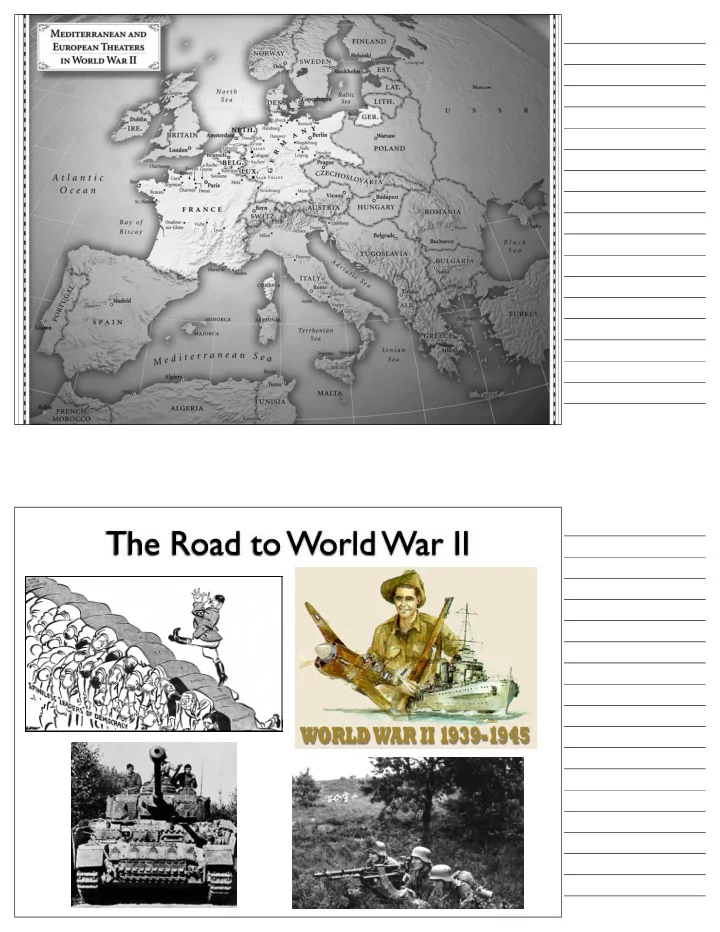
The Road to World War II The Weimar Republic name of the post-WWI - - PDF document
The Road to World War II The Weimar Republic name of the post-WWI government in Germany millions of Germans blamed the Weimar government for their countrys defeat and postwar humiliation Inflation Causes Crisis in Germany Germany had not
In Berlin a loaf of bread cost less than a mark in 1918, more than 160 marks in 1922, and some 200 billion marks by late 1923.
the Dawes Plan provided a loan from American banks to stabilize German currency and strengthen its economy the plan also restructured Germany’s reparations payments Put into effect in 1924, the Dawes Plan helped slow inflation. As the German economy began to recover, it attracted more loans and investments from the United States.
factories made further cuts in production and laid off more workers
the richest 5% of the population earned 33% of all personal income 60% of all American families earned <$2,000/year few could buy the goods being produced store owners cut back their orders from factories factories reduced production and laid off workers workers lost their jobs and then bought even fewer goods scientific farming and new machinery dramatically increased farmers’ crop yields
a worldwide surplus of agricultural products drove prices and profits down many farmers could not pay off the bank loans that kept them in business these unpaid debts weakened banks and forced some to close
many middle- income people began buying stocks on margin in September 1929, some investors started selling their stocks panic ensued; prices plunged to a new low
The Versailles Treaty (above on crutches) took a beating in the U.S. and abroad
Hitler in WWI, far left
National Socialist German Workers’ Party
become a leader in the Nazi Party
wanted to unite all German-speaking people
were to form a work force for the “master race” – “Aryans”
Germany’s strongest political party
appointed Chancellor
democratic government and replaced it with a totalitarian government
rule of Germany the “Third Reich”
its former glory
Hitler visits a factory and is enthusiastically greeted. Many Germans were grateful for jobs after the misery
The Rhineland was the region of Germany that was ‘demilitarized’ after the Treaty of Versailles.
The arrival of German troops was met with great enthusiasm by the Austrians.
Chamberlain returned to England and announced, “I have come back from Germany with peace with honor. I believe it is peace in our time.” Critics called this a dangerous policy of appeasement – or giving up principles to pacify an aggressor. The leaders of Germany (Adolf Hitler), Italy (Benito Mussolini), France (Edouard Daladier), and Great Britain (Neville Chamberlain) met in Munich, Germany. Hitler promised the annexation of the Sudetenland would be has “last territorial demand” Chamberlain and Daladier believed Hitler and signed the Munich Agreement that turned over the Sudetenland to Germany without repercussions.
On March 15, 1939 German troops invaded and
In August of 1939 Germany and the USSR signed a non-aggression pact. This paved the way for Germany to take Poland without fear of an attack from the USSR. On September 3rd, 1939, Germany invaded Poland. The Soviets received part of Poland (a promise made in the non-aggression deal between Germany and the USSR). Great Britain and France, allies of Poland, declared war on Germany. World War II had officially begun.