The Road (to Recovery) Less Traveled: Alternatives to Opioids - - PDF document

the road to recovery less traveled alternatives to opioids
SMART_READER_LITE
LIVE PREVIEW

The Road (to Recovery) Less Traveled: Alternatives to Opioids - - PDF document

The Road (to Recovery) Less Traveled: Alternatives to Opioids Suzanne M. Emmet, CPCU, ARe, CCEP Eastern Alliance Insurance Group Michael Coupland, Cpsych, Rpsych, CRC IMCS Group PA Department of Labor & Industry Workers Compensation


slide-1
SLIDE 1

1 The Road (to Recovery) Less Traveled: Alternatives to Opioids

Suzanne M. Emmet, CPCU, ARe, CCEP

Eastern Alliance Insurance Group

Michael Coupland, Cpsych, Rpsych, CRC

IMCS Group PA Department of Labor & Industry Workers’ Compensation Conference May 16, 2016

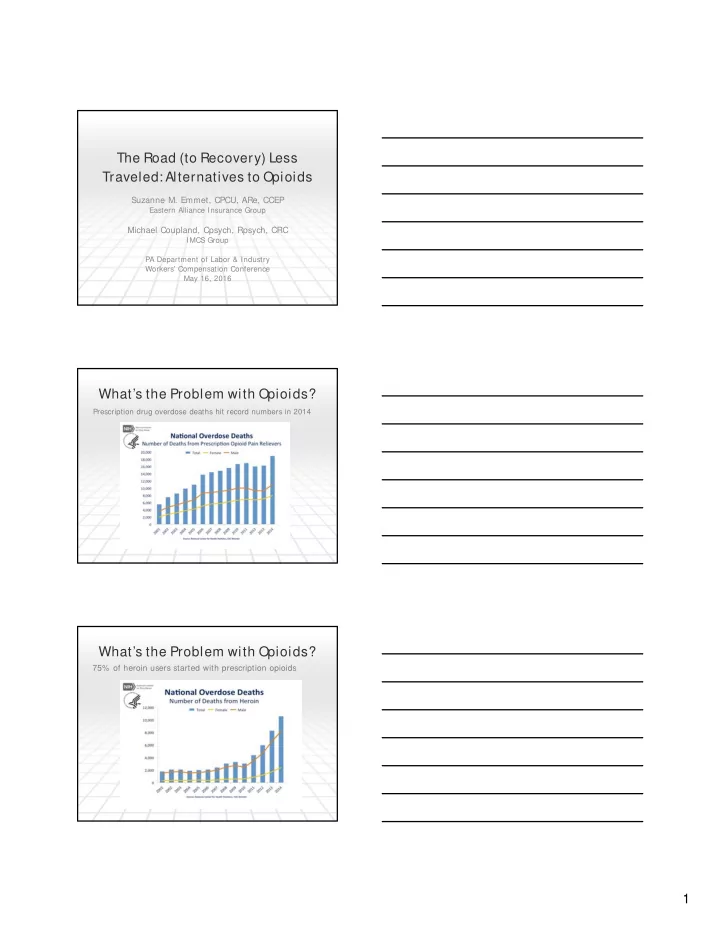
What’s the Problem with Opioids?

Prescription drug overdose deaths hit record numbers in 2014

What’s the Problem with Opioids?

75% of heroin users started with prescription opioids

slide-2
SLIDE 2

2

What is Being Done about this Crisis?

  • CDC Guidelines – March 2016

http://www.cdc.gov/mmwr/volumes/65/rr/rr6501e1.htm

  • President Obama spoke at National Rx Drug

Abuse Summit – Atlanta, March 2016

  • Pennsylvania Guidelines on the Use of Opioids

to Treat Chronic Noncancer Pain

http://www.ddap.pa.gov/Document%20Library/Prescriber_Guidelin es_Chronic_Pain.pdf

  • American Academy of Orthopedic Surgeons

I nformation Statement on Opioid Use, Misuse, and Abuse in Orthopedic Practice

http://www.aaos.org/uploadedFiles/PreProduction/About/Opinion_S tatements/advistmt/1045%20Opioid%20Use,%20Misuse,%20and %20Abuse%20in%20Practice.pdf

But people will still have pain… What are the alternatives to

  • pioids?

WE ARE SO GLAD YOU ASKED!!

‘Putting the pieces together’

Integrated Medical Case Solutions

slide-3
SLIDE 3

3

$ Chronic Pain & Disability Behavior $

Biopsychosocial Model of Chronic Pain

Lifestyle: Exercise, Smoking, Alcohol and Drugs, Obesity / Diet Work Attachment / Age Depression / Anxiety Personality Disorders Hx of Childhood Abuse Perceived Injustice (retribution owed) Fear Avoidant Behavior (Guarding) Catastrophic Thinking Cortisol, substance p, serotonin, Norepinephrine, vasodilatation, vasoconstriction

Dependence & ‘Addiction’

Neurobehavioral Effects of Opioids

Increase Noradrenaline to combat the depressive effects Turn off innate pleasure responses Release Dopamine (Pleasure) * * * Tolerance Develops Demotivation, compromised ability to regulate unsafe behaviors Paired association of Pleasure with initiating reason for

  • pioids

Depress Breathing, Blood Pressure, Alertness

slide-4
SLIDE 4

4 Early Intervention Screening

…..to enable providers / claim professionals / case managers to assess risk for chronic pain, delayed recovery and opioid abuse

E arly Identification of BioPsychoSocial Risk Factors

  • 1. Psychosocial risk factors have been validated
  • a. Meta Analyses
  • b. Prospective studies
  • c. Control group studies
  • 2. A Pain Screening Questionnaire has been validated
  • Scores predict time loss / medical spend / function
  • 3. Brief Cognitive Behavioral Therapy (CBT) interventions

can successfully intervene

  • less time loss / medical spend / greater function

Webster LR, Webster RM. Pain Med. 2005;6(6):432-442.

Misuse 40% Abuse: 20%

Total Pain Population

Addiction: 2% to 5%

Prevalence of Misuse, Abuse and Addiction

slide-5
SLIDE 5

5

COPE with Pain

Cognitive Behavioral Therapy (CBT)

 CBT is brief and time-limited.  A sound therapeutic relationship is necessary for effective

therapy, but not the focus.

 CBT is a collaborative effort between therapist and client.  CBT is based on stoic philosophy.  CBT is structured and directive.  CBT is based on an educational model.  Homework is a central feature of CBT.

How to Treat Psychosocial Factors without Complicating the Claim with “Psych” Issues

The new ‘Health and Behavior Assessm ent and I ntervention’ codes ensure the injured worker does not become further ‘medicalized’ Psychiatric diagnosis and treatment codes are NOT used unless there is already a mental health accepted diagnosis CPT Code Descriptor

96150 Initial assessment to determine biological, psychological and social factors affecting health and any treatment problems 96151 Reassessment to evaluate condition and determine need for further treatment

Treatment

RTW Outcomes

Control Group Intervention Group High Risk and Very High Risk High Risk Very High Risk Sample Size 36 62 109 % claims closed at 26 weeks 33% 76% 62% % working at 26 weeks 17% 68% 39% Avg claim duration at 26 weeks 24 weeks 18.7 weeks 20.2 weeks Coupland, M., Margison, D. Early Intervention in Psychosocial Risk Factors for Chronic Pain, Musculoskeletal Disorders and Chronic Pain Conference, Feb 2011, Los Angeles, CA
slide-6
SLIDE 6

6

Treatment

High Risk vs. Low Risk Psychosocial

  • 9% Fewer Pt. get Physical Therapy
  • 10% Fewer Pt. get I maging Studies
  • 13% Fewer Pt. get I njections
  • 6% Fewer Pt. get Surgeries
  • 5% More Pt. get Vocational Rehabilitation

Outcomes @26 wks+

Coupland, M., Margison, D. Early Intervention in Psychosocial Risk Factors for Chronic Pain, Musculoskeletal Disorders and Chronic Pain Conference, Feb 2011, Los Angeles, CA

Questions?

www.imcs.us (866) 678-2924