OPIOIDS AWARE (and a few other musings) Nottinghamshire and - - PowerPoint PPT Presentation

opioids aware and a few other musings
SMART_READER_LITE
LIVE PREVIEW

OPIOIDS AWARE (and a few other musings) Nottinghamshire and - - PowerPoint PPT Presentation

03/03/2019 Opioids Aware OPIOIDS AWARE (and a few other musings) Nottinghamshire and Derbyshire CD LIN meeting February 2019 http://www.rcoa.ac.uk/faculty-of-pain-medicine/opioids-aware Key messages Opioids are very good painkillers for


slide-1
SLIDE 1

03/03/2019 1

OPIOIDS AWARE (and a few other musings)

Nottinghamshire and Derbyshire CD LIN meeting February 2019

Opioids Aware

http://www.rcoa.ac.uk/faculty-of-pain-medicine/opioids-aware

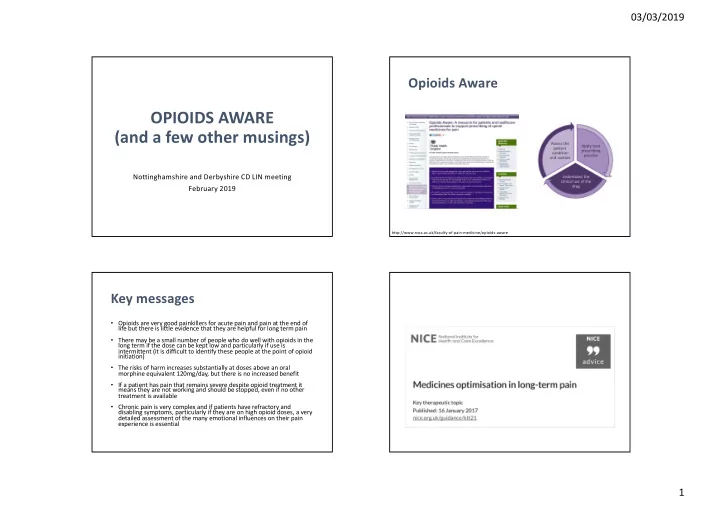
Key messages

  • Opioids are very good painkillers for acute pain and pain at the end of

life but there is little evidence that they are helpful for long term pain

  • There may be a small number of people who do well with opioids in the

long term if the dose can be kept low and particularly if use is intermittent (it is difficult to identify these people at the point of opioid initiation)

  • The risks of harm increases substantially at doses above an oral

morphine equivalent 120mg/day, but there is no increased benefit

  • If a patient has pain that remains severe despite opioid treatment it

means they are not working and should be stopped, even if no other treatment is available

  • Chronic pain is very complex and if patients have refractory and

disabling symptoms, particularly if they are on high opioid doses, a very detailed assessment of the many emotional influences on their pain experience is essential

slide-2
SLIDE 2

03/03/2019 2

History (the short version)

  • Mid 1980’s cancer patients dying in pain
  • Late 1990’s pain relief as a universal human right
  • role of Pharma and patient advocacy groups
  • Undertreatment of pain seen as malpractice
  • Pain as 5th vital sign
  • Small trials showing efficacy of opioids in non-

cancer pain

A public health emergency Opioid prescribing in the UK

Items

1 2 3 4 5 6

200 4 200 5 200 6 200 7 200 8 200 9 201 201 1 201 2 201 3 201 4 201 5 201 6 201 7

Number of items (millions)

10 20 30 40 50 60 70 80

2 4 2 5 2 6 2 7 2 8 2 9 2 1 2 1 1 2 1 2 2 1 3 2 1 4 2 1 5 2 1 6 2 1 7

Cost (£ million)

Morphi ne Oxyc odone Fentanyl Buprenorphine

BNF classification 4.7.2 (opioid analgesics) Compiled from Prescription Cost Analysis. NHS Digital (formerly Health and Social Care Information Centre.

Cost

— In 2017, 23.9 million prescriptions were dispensed in England costing £263.2 million

slide-3
SLIDE 3

03/03/2019 3

How many patients are prescribed opioids?

Cartagena Farias J et al. Prescribing patterns in dependence forming medicines. 2017. London: NatCen.

Duration of opioid prescribing

  • CPRD between 2000 and 2014
  • Opioids
  • Length of continuous prescribing

increased

  • 2000: 64 days
  • 2014: 102 days
  • Dependence forming medicines

prescribed for longer in areas of deprivation

Cartagena Farias J et al. Prescribing patterns in dependence forming medicines. 2017. London: NatCen.

Regional variation in opioid prescribing

  • Substantial regional

variation in opioid prescribing

  • Lower SES, increased

prevalence of patients aged more than 65 years, female gender, smoking, obesity and depression were significantly associated with increased

  • pioid prescriptions

Chen TC et al. Int J Drug Policy 2019; 64: 87 – 94.

— Efficacy or effectiveness

  • No study of opioid therapy

versus placebo, no opioid therapy, or non-opioid therapy evaluated long-term (>1 year)

  • utcomes related to pain,

function, or quality of life

  • No evidence relating to:
  • different dosing strategies
  • short versus long acting
  • continuous versus as

needed

  • opioid rotation

Chou R et al. Ann Intern Med 2015; 162: 276.

slide-4
SLIDE 4

03/03/2019 4

  • 12-month pragmatic randomised clinical trial (n = 240 patients)
  • Compared the use of opioid vs nonopioid treatment for LBP and OA
  • No improvement in pain-related function over 12 months (3.4 vs 3.3 points on an 11-

point scale at 12 months, respectively)

  • Pain intensity was significantly better in the nonopioid group over 12 months (mean

12-month BPI severity was 4.0 for the opioid group and 3.5 for the nonopioid group (difference, 0.5 [95% CI, 0.0 to 1.0])

  • medication-related adverse symptoms were significantly more common in the opioid

group over 12 months (overall P = 0.03)

Krebs EE, Gravely A, Nugent S, et al. JAMA. 2018;319(9):872–882.

Authors' conclusions

There is a critical lack of high-quality evidence regarding how well high-dose opioids work for the management of chronic non-cancer pain in adults, and regarding the presence and severity of adverse

  • events. No evidence-based argument can be made on the use of

high-dose opioids, i.e. 200 mg morphine equivalent or more daily, in clinical practice. Trials typically used doses below our cut-off; we need to know the efficacy and harm of higher doses, which are often used in clinical practice.

Els C et al.. Cochrane Database of Systematic Reviews 2017, Issue 10. Art. No.: CD012299.

Absolute event rate for any adverse event with opioids in trials using a placebo as comparison was 78% Withdrawal due to adverse events: moderate quality of evidence Constipation: moderate quality of evidence Dizziness: moderate quality of evidence Drowsiness or somnolence: moderate quality of evidence Increased sweating: moderate quality of evidence Nausea: moderate quality of evidence Vomiting: low quality of evidence Pruritus: very low quality of evidence Fatigue: very low quality of evidence Hot flushes: very low quality of evidence

Els C et al. Cochrane Database of Systematic Reviews 2017, Issue 10. Art. No.: CD012509.

Psychiatric co-morbidities

  • Dysregulation of the endogenous opioid system in

borderline personality disorder, depression, stress

  • Patients with mood disorders more likely to be

started on opioid treatment than those without

  • Patients with depression almost twice as likely to

continue taking those opioids long term

  • Opioids being used to treat insomnia and stress –

symptoms accompanying chronic pain – rather than the pain itself

Halbert B et al. Pain 2016; 157: 2452. Sullivan MD. Pain 2016; 157: 2395. Prossin AR et al. Am J Psychiatry 2010; 167: 925.

slide-5
SLIDE 5

03/03/2019 5

Common misconception: Addiction thought to be rare

Porter J, Jick H. New Engl J Med 1980; 302:123.

Retraction July 2017

http://retractionwatch.com/2017/06/02/nejm-issues-unusual-warning-readers-1980-letter-opioid-addiction/

Crime Survey for England and Wales 2017

  • In the last year 7.0% of adults aged 16 to 59 years had taken a

prescription-only painkiller not prescribed to them for medical reasons

  • Only 0.2% said it was just for the feeling or experience it gave them
  • Over twice as many people with a long-standing illness or disability

reported use of non-prescribed prescription-only painkillers for medical reasons (14.3%) compared with those with no long- standing illnesses (5.8%)

  • The use of non-prescribed prescription-only painkillers for medical

reasons decreases as life satisfaction increases. Of those with low levels

  • f life satisfaction, 13.8 per cent reported use in the last year, compared

with 5.3 per cent of those with very high levels of life satisfaction

Drug Misuse: Findings from the 2017/18 Crime Survey for England and Wales.

Deaths related to drug poisoning in England

200 400 600 800 1000 1200 1400 2005 2006 2007 2008 2009 2010 2011 2012 2013 2014 2015 2016 2017

Number of drug related deaths

Morphi ne and heroi n Methadone Tram adol Oxyc odone Fentanyl Paracetamol

Office of National Statistics Deaths Related to Drug Poisoning in England and Wales, 2009 – 2017.

slide-6
SLIDE 6

03/03/2019 6

  • 5 studies (n = 278 participants
  • Two studies aimed to reduce opioid consumption via cognitive behavioural therapy (CBT)
  • r electroacupuncture
  • Two studies aimed to reduce opioid misuse in people with chronic pain using CBT or

mindfulness

  • One study aimed to increase treatment compliance and adherence in people with chronic

pain receiving a pain-management treatment

  • Conclusions are limited regarding the benefit of psychological, pharmacological, or other

types of interventions for people with chronic pain trying to reduce their opioid consumption

  • There were reductions in opioid consumption after intervention, and often in control

groups too. Eccleston C et al. Cochrane Database of Systematic Reviews 2017, Issue 11. Art. No.: CD010323

Tapering strategies

Aims to develop a support programme that aims to improve the everyday functioning for people living with chronic pain and reduce their opioid use RCT comparing two different treatments for people with long-term pain. GROUP 1 Usual GP care plus a opioid information booklet and relaxation CD GROUP 2 A support programme in addition to the above. Just finished recruiting

  • In-depth understanding of patients,

clinical pharmacists and GPs’ experiences and views about reducing opioids, and the role of clinical pharmacists in helping people with persistent pain

  • Feasibility trial with 80 patients
  • Full RCT and economic evalution

with other > 1000 patients

Assessing prescribing

From: New Persistent Opioid Use After Minor and Major Surgical Procedures in US Adults

JAMA Surg. 2017;152(6):e170504. doi:10.1001/jamasurg.2017.0504

The rate of new persistent opioid use was 6%

  • By comparison, the incidence in the nonoperative control

cohort was only 0.4%

Risk factors independently associated with new persistent opioid use included: -

  • preoperative tobacco use (adjusted odds ratio [aOR], 1.35;

95% CI, 1.21-1.49)

  • alcohol and substance abuse disorders (aOR, 1.34; 95% CI,

1.05-1.72)

  • mood disorders (aOR, 1.15; 95% CI, 1.01-1.30)
  • anxiety (aOR, 1.25; 95% CI, 1.10-1.42)
  • preoperative pain disorders (back pain: aOR, 1.57; 95% CI,

1.42-1.75; neck pain: aOR, 1.22; 95% CI, 1.07-1.39; arthritis: aOR, 1.56; 95% CI, 1.40-1.73; and centralized pain: aOR, 1.39; 95% CI, 1.26-1.54)

slide-7
SLIDE 7

03/03/2019 7

Monthly prevalence and incidence of tramadol users

Chen T-C et al. Pharmacoepidemiol Drug Saf. 2018; 27: 487-494.

2 4 6 8 10 12 20 40 60 80 100 120 Jan-00 Jul-00 Jan-01 Jul-01 Jan-02 Jul-02 Jan-03 Jul-03 Jan-04 Jul-04 Jan-05 Jul-05 Jan-06 Jul-06 Jan-07 Jul-07 Jan-08 Jul-08 Jan-09 Jul-09 Jan-10 Jul-10 Jan-11 Jul-11 Jan-12 Jul-12 Jan-13 Jul-13 Jan-14 Jul-14 Jan-15 Jul-15 Incidence in per 10000 inhabitants Prevalence in per 10000 inhabitants Monthly prevalence of tramadol users Monthly incidence of tramadol us ers Tramadol classification

  • The baseline trend significantly increased in prevalence (β1: 0.21, p<0.001) but decreased in

incidence (β1: -0.04, p<0.001) of tramadol users.

  • The level of both prevalence (β2: -6.4, p=0.001) and incidence (β2: -1.7, p<0.001) decreased

significantly, but only the trend of prevalence decreased significantly (β3: -0.37, p=0.028) after tramadol classification

Tramadol utilisation and the number of tramadol-related deaths

After tramadol classification, tramadol annual utilisation decreased from 2014, and the number of tramadol-related deaths decreased to 208 in 2015

50 100 150 200 250 300 500 1000 1500 2000 2500 3000 2004 2005 2006 2007 2008 2009 2010 2011 2012 2013 2014 2015 Annual number of reported deaths Annual define daily dose/ 1000 inhabitants Tramadol annual util is ation Num ber of tramadol-related deaths

Chen T-C et al. Pharmacoepidemiol Drug Saf. 2018; 27: 487-494.

Individual changes in pain intensity after pregabalin for fibromyalgia

  • Pregabalin is helpful for
  • nly a small proportion
  • f people with chronic

neuropathic pain

  • It is not possible to know

beforehand who will benefit and who will not

  • Current knowledge

suggests that a short course of treatment (perhaps four weeks) is the best way of telling

Moore A et al. BMJ 2013;346:bmj.f2690; Derry S et al. Cochrane Database of Systematic Reviews 2019, Issue 1. Art. No.: CD007076

Pregabalin and gabapentin misuse

  • Only a small proportion benefit sufficiently to notice

an improvement in QoL

  • Prescribing for patients with a known or suspected

history of dependence, misuse, diversion may place these people at greater risks

  • No patient should normally be excluded from access

to medicines that may help them simply because of a current or past problem with misuse or dependence, increased monitoring may be required if prescription is appropriate

  • Misuse has been reported for some years in clients

attending substance misuse treatment and recovery services, and within secure environment settings

slide-8
SLIDE 8

03/03/2019 8

Increasing safety concerns

  • 12.1 % of all urine specimens from patients with
  • pioid addiction found to be positive for
  • pregabalin. None of the patients concerned had a

medical indication for using pregabalin

  • More likely to be prescribed gabapentin or

pregabalin if

  • previous substance use disorder treatment or diagnosis

(aOR 1.41, 95 % CI 1.31–1.52)

  • previously been dispensed high doses of drugs with

abuse potential (aOR 1.77, 95 % CI 1.62–1.94)

Grosshans M et al. Eur J Clin Pharmacol 2013; Boden R et Eur J Clin Pharmacol 2014.

Gabapentinoid related deaths in UK

20 40 60 80 100 120 140 160 2004 2005 2006 2007 2008 2009 2010 2011 2012 2013 2014 2015 2016 2017

Number of deaths

Gabapentin Pre gabalin

Office for National Statistics. Deaths related to drug poisoning.

Gabapentinoids, opioids and respiratory depression

  • Gabapentinoids are reversible inhibitors of GABA

transaminase and have an inhibitory effects on the respiratory centre in the medulla

  • Gabapentinoids reverse tolerance to opioid effects

and potentiate respiratory depression

Kaplovitch E et al. PLoS ONE 2015; 10(8): e0134550. Gomes T et al. PLoS Med 2017; 14(10): e1002396.

Naloxone utilisation in postoperative period

  • Case control study
  • Single US centre
  • Identified patients undergoing general

anaesthesia discharged to standard postoperative wards and administered naloxone

  • 128 patients received naloxone after
  • peration [OR 1.2 (95% CI 1.0 -1.4) per

1000 general anaesthetics]

  • Continuing chronic gabapentinoids after
  • peration increased the risk of naloxone

administration, with longer hospitalisation and increased delirium

Deljou A et al. Br J Anaesth 2018; 120: 798.

slide-9
SLIDE 9

03/03/2019 9

Summary

  • Uptake of Opioids Aware have been positive
  • Key messages have not changed
  • Classification and scheduling of tramadol has

reduced deaths

  • Watch this space for effects on gabapentin and

pregabalin prescribing