
SLIDE 1
The Rise (and Fall) of Propaganda
Geoff Nunberg Is103 History of Information 11/14/07
Geoff Nunberg
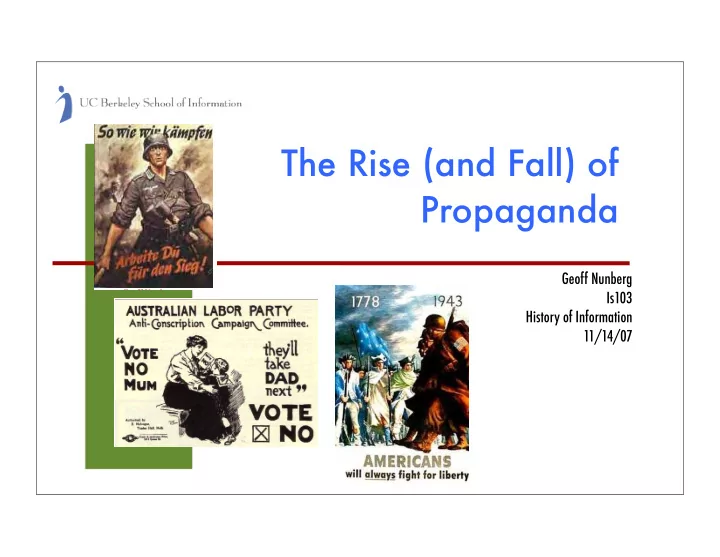
The Rise (and Fall) of Propaganda Geoff Nunberg Geoff Nunberg - - PowerPoint PPT Presentation
The Rise (and Fall) of Propaganda Geoff Nunberg Geoff Nunberg Is103 History of Information 11/14/07 Propaganda and Information Propaganda: As old as politics? Text Thucydides Aristotle 2 Propaganda and the Modern State onarchy.
Geoff Nunberg Is103 History of Information 11/14/07
Geoff Nunberg
2
Thucydides Aristotle
Cf Napoleon’s efforts to control the Parisian press, practice of paying subsidies to sympathetic newspapers...
3
The origins of indirection & euphemism:
Through the whole of this long letter of Roland, it is curious to remark how the nerve and vigor of his style, which had spoken so potently to his sovereign, is relaxed when he addresses himself to the sans-culottes... When he speaks to the populace, he can no longer be direct. The whole compass of the language is tried to find synonymes and circumlocutions for massacre and murder. Things are never called by their common names. Massacre is sometimes agitation, sometimes effervescence, sometimes excess, sometimes too continued an exercise of a revolutionary power. Edmund Burke, 1793 Cf “casualty” in Crimean War, “Acts of collective indiscipline” in WWI
4
Burke Roland
5 Roger Fenton, Crimea, 1855 Paris Commune, 1871
Conflicting interests of the state:
Seeks positive publicity, which entails giving reporters access Avoiding negative publicity entails restricting access. Cf Civil War conflicts between Meade & Edward Crapsey of the Phil. Inquirer
1864: Union Sec’y of War Edwin Stanton begins to “leak” his war diaries to AP, presaging practice of issuing regular war bulletins to the press Efforts to win support of British press for each side...
6
!!
Propaganda (OED) (More fully, Congregation or College
Roman Catholic Church having the care and oversight
XV. "Before 1914, 'propaganda' belonged only to literate
vocabularies and possessed a reputable, dignified meaning... Two years later the word had come into the vocabulary of peasants and ditchdiggers and had begun to acquire its miasmic aura.” Will Irwin, Propaganda and the News
1922: Encyclopedia Britannica first includes propaganda as entry States begin to take a direct role in creating & diffusing pro- government views.
7
8
WWI: Creel Committee, “4-minute men,” etc. 75,000 speakers to give short speeches & lantern-slide presentations 75 million booklets distributed, in multiple languages
“We did not call it propaganda, for that word, in German hands, had come to be associated with deceit and corruption. Our effort was educational and informative throughout. No other argument was needed than the simple, straightforward presentation of facts." George Creel
9
Rise of publicists, press services.
“The development of the modern publicity man is a clear sign that the facts of modern life do not spontaneously take a shape in which they can be known. They must be given a shape by somebody, and since tin the daily routine reporters cannot give a shape to facts... the need for some formulation is being met by the interested parties.” Walter Lippman, Public Opinion, 1923
Connection between propaganda, PR, & advertising (cf other languages) Increasing suspicion of propaganda: 1939 poll shows 40 percent of Americans blame propaganda for the US entry into the First World War.
10
Rise of publicists, press services.
“The development of the modern publicity man is a clear sign that the facts of modern life do not spontaneously take a shape in which they can be
since tin the daily routine reporters cannot give a shape to facts... the need for some formulation is being met by the interested parties.” Walter Lippman, Public Opinion, 1923
Connection between propaganda, PR, & advertising (cf other languages)
11
Rise of publicists, press services.
The conscious and intelligent manipulation of the organized habits and
Those who manipulate this unseen mechanism of society constitute an invisible government which is the true ruling power of our
Edward Bernays, 1928
Increasing suspicion of propaganda: 1939 poll shows 40 percent of Americans blame propaganda for the US entry into the First World War.
12
Adoption of propaganda techniques by Roosevelt during WWII: Office of Facts and Figures --> Office of War Information "the office is not a propaganda agency... We don't believe in this country in artificially stimulated, high-pressure, doctored nonsense.” Fiorello La Guardia The object is “to provide the public with sugar-coated, colored, ornamental matter, otherwise known as 'bunk.” La Guardia, letter to FDR
13
14
Italian Posters, 1944 The Eternal Jew, German Poster, 1940
15
"The easiest way to inject a propaganda idea into most men's minds is to let it go in through the medium of an entertainment picture." Elmer Davis, director of Office of War Information
16
Propaganda = “What the other side does...”
18
"Orwellian": 2,510,000 Google hits >Kafkaesque, Hemingwayesque, Dickensian put together > Machiavellian (1.4 m)
19
1984 Amazon ranking: 126 (The Road to Wigan Pier: 25,989) "Politics and the English Language": 190k Google hits
20
21
Triumph of the Will, Leni Riefenstahl, 1934 1984, Michael Anderson, 1956
22
23
But how to square belief in efficacy of Newspeak with the public's skepticism about political & corporate language? The condescension of modern linguistic ideology… "Mind you, I'm not fooled, but the man in the street"…
Skepticism about language: "mere semantics" "That depends what the meaning of 'is' is."
24
25
26
27
28
29
30