SLIDE 1
K E N O N O ( U N I V E R S I T Y O F V I R G I N I A )
THE RIEMANN HYPOTHESIS
SLIDE 2
IT IS HARD TO WIN $1 MILLION
SLIDE 3
IT CAN BE REALL Y HARD TO WIN $1 MILLION
SLIDE 4 GOD, HARDY, AND THE RIEMANN HYPOTHESIS
On a trip to Denmark, Hardy wrote his friend Harald Bohr:
“Have proof of RH. Postcard too short for proof.”
Hardy’s Thinking. God would not let the boat sink
him the same fame that Fermat had achieved with his "last theorem".
SLIDE 5
HILBERT AND THE RIEMANN HYPOTHESIS
“If I were to awaken after having slept for a thousand years, my fjrst question would be: Has the Riemann Hypothesis been proven?”
David Hilbert (1862 – 1943)
SLIDE 6
- Question. What does this mean? Why does it matter?
RIEMANN HYPOTHESIS (1859)
Bernhard Riemann (1826- 1866)
SLIDE 7 PRIMES
- Defjnition. A prime is a natural number > 1 with no
positive divisors other than 1 and itself.
- Theorem. (Fundamental Theorem of Arithmetic)
Every positive integer >1 factors uniquely (up to reordering) as a product of primes.
SLIDE 8
PRIMES ARE ORNERY
“Primes grow like weeds… seeming to obey no other law than that of chance… nobody can predict where the next one will sprout… …Primes are even more astounding, for they exhibit stunning regularity. There are laws governing their behavior, and they obey these laws with almost military precision.”
Don Zagier
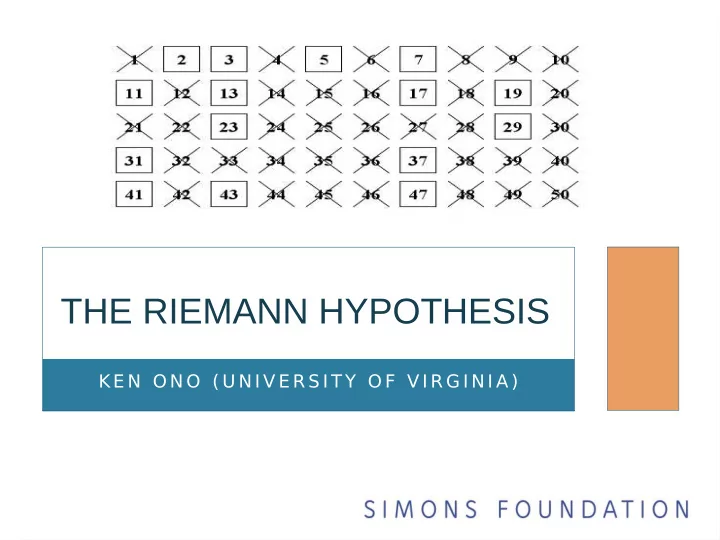
SLIDE 9 SIEVE OF ERASTOTHENES (~200 BC)
Algorithm for listing the primes up to a given bound.
- Problem. This does not reveal much about the primes.
SLIDE 10
EUCLID (323-283 BC)
Theorem (Euclid) There are infjnitely many primes.
SLIDE 11 EULER (1707-1783)
Geometric Series. If |r| < 1, then
- Examples. Strange infjnite series expressions
SLIDE 12
EULER (1707-1783)
The Fund. Thm of Arithmetic and geometric series give Letting s=2 (or any positive even) Euler obtained formulas such as
SLIDE 13 INFINITUDE OF PRIMES APRÉS EULER
- Theorem. If π(n) is the number of primes < n, then
π(n) > -1+ ln(n). Proof.
SLIDE 14
INFINITUDE OF PRIMES APRÉS EULER
Proof continued.
SLIDE 15
GAUSS (1777-1855)
Carl Friedrich Gauss
SLIDE 16
ENTER RIEMANN
Bernhard Riemann (1826-1866)
An 8 page paper in 1859
SLIDE 17 ENTER RIEMANN
Bernhard Riemann (1826-1866)
An 8 page paper in 1859
- Defjned Zeta Function
- Determined many of its properties
- Posed the Riemann Hypothesis
- Strategy to prove Gauss’ Conjecture
SLIDE 18
RIEMANN’S ZETA FUNCTION Theorem (Riemann, 1859)
SLIDE 19
RIEMANN’S ZETA FUNCTION Theorem (Riemann, 1859)
SLIDE 20
RIEMANN’S ZETA FUNCTION Theorem (Riemann, 1859)
SLIDE 21
RIEMANN’S ZETA FUNCTION Theorem (Riemann, 1859)
SLIDE 22
1+2+3+4+5+ . . . = -1/12
“Under my theory 1+2+3+4+…= -1/12. If I tell you this you will at once point out to me the lunatic asylum,,,”
Srinivasa Ramanujan (1887-1920)
SLIDE 23
1+2+3+4+5+ . . . = -1/12
“Under my theory 1+2+3+4+…= -1/12. If I tell you this you will at once point out to me the lunatic asylum,,,”
Srinivasa Ramanujan (1887-1920)
SLIDE 24
1+2+3+4+5+ . . . = -1/12
“Under my theory 1+2+3+4+…= -1/12. If I tell you this you will at once point out to me the lunatic asylum,,,”
Srinivasa Ramanujan (1887-1920)
SLIDE 25 VALUES ON CRITICAL LINE
Spiraling ζ(½ + it) for 0 ≤ t ≤ 50 Note.
- ζ( ½) = -1.460354….
- The fjrst few nontrivial
zeros are encountered.
SLIDE 26
RIEMANN’S HYPOTHESIS
“… it would be desirable to have a rigorous proof of this proposition…” Bernhard Riemann (1859)
SLIDE 27 COUNTING PRIMES
- Theorem. (Chebyshev, von Mangoldt)
Graph of Y=Ψ(X)
SLIDE 28 WHY DO THE NONTRIVIAL ZEROS MATTER?
- Theorem. (von Mangoldt)
- Theorem. (Hadamard, de la Vallée-Poussin (1896)
- Proof. We always have Re(ρ) < 1. ☐
SLIDE 29 WHY DOES RH MATTER?
- Theorem. (von Koch (1901), Schoenfeld (1976))
RH & Generalized RH implications include
- Almost every deep question on primes
- Ranks of elliptic curves, Orders of class groups
- Quadratic forms (eg. Bhargava & Conway-Schneeberger
style)
- Maximal orders of elements in permutation groups
- Running times for primality tests
- Thousands of results proved assuming the truth of RH and
GRH…
SLIDE 30 RAMANUJAN’S TERNARY QUADRATIC FORM
- Theorem. (O-Soundararajan (1997))
Assuming GRH, the only positive odds not of the form x2+y2+10z2 are 3, 7, 21, 31, 33, 43, 67, 79, 87, 133, 217, 219, 223, 253, 307, 391, 679, 2719.
SLIDE 31 EVIDENCE FOR RH
- The lowest 100 billion nontrivial zeros satisfy RH.
- Theorem (Selberg, Levinson, Conrey, Bui, Young,…)
At least 41% of the infjnitely many nontrivial zeros satisfy RH.
- Theorem (Hadamard, Vallée Poussin, Korobov, Vinogradov)
There is a zero-free region for ζ(s).
SLIDE 32 PROSPECTS FOR A PROOF
- (Mertens) RH is equivalent to the Möbius sum estimate
- Polya’s Program: More on this momentarily.
- Functional Analysis: Nyman-Beurling Approach
- Trace Formulas: Weil, Selberg, Connes, …
- Random Matrices: Dyson, Odlyzko, Montgomery, Keating,
Snaith, Katz-Sarnak,…
SLIDE 33
RANDOM MATRICES
SLIDE 34
ROOTS OF THE DEG 100 TAYLOR POLYNOMIAL
SLIDE 35
ROOTS OF THE DEG 200 TAYLOR POLYNOMIAL
SLIDE 36
ROOTS OF THE DEGREE 400 TAYLOR POLYNOMIAL
SLIDE 37 TAKEAWAY FROM THESE EXAMPLES
- Red roots are good approximations to geniune
roots.
- Blue spurious roots are annoying and become more
prevalent as the degrees increase.
SLIDE 38
JENSEN-PÓLYA PROGRAM
SLIDE 39
JENSEN-PÓLYA PROGRAM
SLIDE 40
JENSEN-PÓLYA PROGRAM
SLIDE 41
OUR WORK ON RH & HERMITE DISTRIBUTIONS