The Relational Model Requirements analysis Conceptual design data - - PDF document

the relational model
SMART_READER_LITE
LIVE PREVIEW

The Relational Model Requirements analysis Conceptual design data - - PDF document

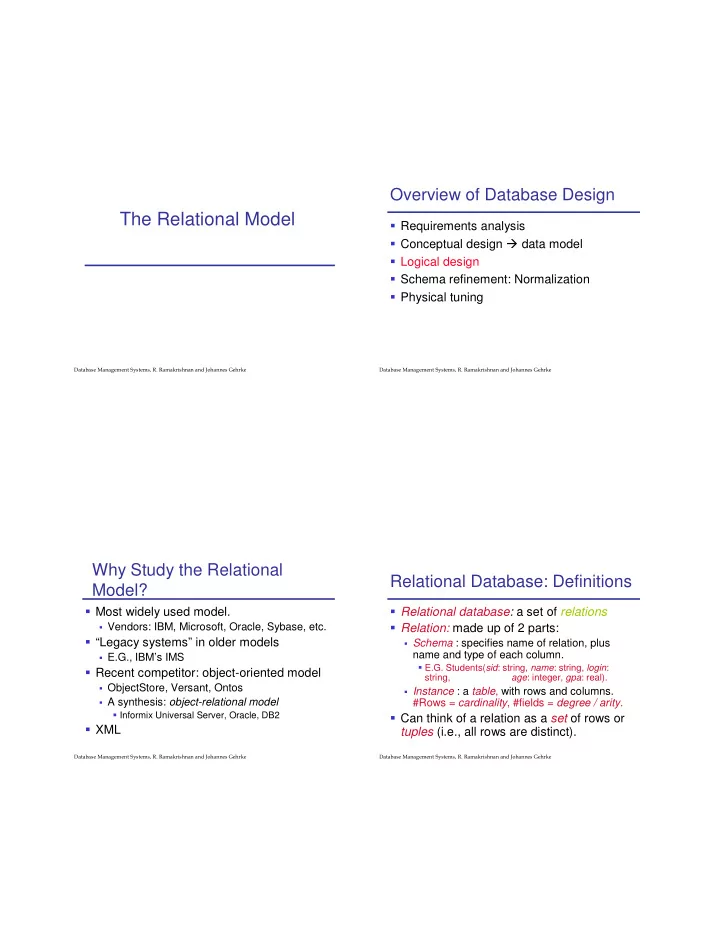
Overview of Database Design The Relational Model Requirements analysis Conceptual design data model Logical design Schema refinement: Normalization Physical tuning


slide-1
SLIDE 1

The Relational Model

Overview of Database Design

Requirements analysis Conceptual design data model Logical design Schema refinement: Normalization Physical tuning

Why Study the Relational Model?

Most widely used model.

Vendors: IBM, Microsoft, Oracle, Sybase, etc.

“Legacy systems” in older models

E.G., IBM’s IMS

Recent competitor: object-oriented model

ObjectStore, Versant, Ontos A synthesis: object-relational model

Informix Universal Server, Oracle, DB2

XML

Relational Database: Definitions

Relational database: a set of relations Relation: made up of 2 parts:

Schema : specifies name of relation, plus

name and type of each column.

E.G. Students(sid: string, name: string, login: string, age: integer, gpa: real).

Instance : a table, with rows and columns.

#Rows = cardinality, #fields = degree / arity.

Can think of a relation as a set of rows or tuples (i.e., all rows are distinct).

slide-2
SLIDE 2

Example Instance of Students Relation

  • !"

# "" !" $ % !& "

  • '(()

* + ,

Logical DB Design: ER to Relational

Entity sets to tables.

Employees ssn name lot

Example Instance

20 Jill 3743923483 10 Jane 9384392483 10 John 0983763423 lot name ssn

Employees

Integrity Constraints (ICs)

IC: condition that must be true for any instance of the database

Domain constraints Key constraints Foreign key constraints (later)

A legal instance of a relation is one that satisfies all specified ICs.

DBMS should not allow illegal instances Avoids data entry errors too!

slide-3
SLIDE 3

Primary Key Constraints

  • A set of fields is a superkey for a relation if :
  • 1. No two distinct tuples can have same values in all

fields

  • A set of fields is a key if:
  • 1. The set of fields is a superkey
  • 2. No proper subset of the set of fields is a superkey
  • If there’s >1 key for a relation, one of the keys is

chosen (by DBA) to be the primary key.

  • E.g., ssn is a key for Employees. (What about

name?) The set {ssn, name} is a superkey.

What does this mean?

'-./-/.01- -

2 '3.2$%4 '3.2$%4 '3.2$4

56.78-72 44

Candidate Keys

Possibly many candidate keys (specified using UNIQUE), one of which is chosen as the primary key.

  • * *

9)* *

'-./-/.01- -

2 '3.2$%4 '3.2$%4 '3.2$4

56.78-724 :96;:- 2 44

Where do ICs Come From?

ICs are based upon the semantics of the real- world enterprise that is being described in the database relations. We can check a database instance to see if an IC is violated, but we can NEVER infer that an IC is true by looking at an instance.

An IC is a statement about all possible instances! From example, we know name is not a key, but the

assertion that sid is a key is given to us.

Key and foreign key ICs are the most common; more general ICs supported too.

slide-4
SLIDE 4

ER to Relational (contd.)

lot dname budget did name Departments Employees ssn since Works_In

Relationship Sets to Tables

Example Instance

20 Jill 3743923483 10 Jane 9384392483 10 John 0983763423 lot name ssn Employees 1000K Databases 108 20K Purchasing 105 10K Sales 101 budget dname did Departments 1 Jun 2002 108 9384392483 2 Jan 2003 108 0983763423 1 Jan 2003 101 0983763423 since did ssn Works_In

Foreign Keys, Referential Integrity

Foreign key : Set of fields in one relation that is used to `refer’ to a tuple in another relation

Must correspond to primary key of the second relation Like a `logical pointer’.

If all foreign key constraints enforced, referential integrity is achieved, i.e., no dangling references.

Not like HTML links!

slide-5
SLIDE 5

Enforcing Referential Integrity

What if a new “Works_In” tuple is added that references a non-existent employee?

Reject it!

What if an Employee tuple is deleted?

Also delete all Works_In tuples that refer to it. Disallow deletion of Employee tuple that is

referred to.

Set ssn to some default value Set ssn in Works_In to null, denoting `unknown’

Similar if primary key of Employee tuple is updated

Referential Integrity in SQL/92

SQL/92 supports all 4 options on deletes and updates.

Default is NO ACTION (delete/update is rejected) CASCADE (delete all tuples that refer to deleted tuple) SET NULL / SET DEFAULT

'-./-/.01-<=62 '3.2!!4 69/-- ./- 56.78-724 >?-698-724->--9'-- ?9-1-/-'.'.-?9:5./--/->.:1/ >?-698-724->--9'- ?9-1-/--/9:11?9:5./-'.'.-4

ER to Relational (contd.)

lot name Employees ssn Reports_To subor- dinate super- visor

Relationship Sets to Tables

slide-6
SLIDE 6

ER to Relational (contd.)

name Suppliers id name Departments id name Parts id Contract

Relationship Sets to Tables ER to Relational (contd.)

Each dept has at most one manager, according to the key constraint on Manages.

dname budget did since lot name ssn Manages Employees Departments

Relationship Sets to Tables

slide-7
SLIDE 7

ER to Relational (contd.)

Each employee works in at least one department according to the participation constraint on Works_In

lot dname budget did name Departments Employees ssn since Works_In

ER to Relational (contd.)

lot name dname budget did since name dname budget did since Manages Departments Employees ssn

Relationship Sets to Tables ER to Relational (contd.)

A weak entity can be identified uniquely only by considering the primary key of another (owner) entity.

lot name age pname Dependents Employees ssn Policy cost

slide-8
SLIDE 8

Translating Weak Entity Sets

Weak entity set and identifying relationship set are translated into a single table.

When the owner entity is deleted, all owned weak

entities must also be deleted.

ER to Relational (Contd.)

Contract_Emps name ssn Employees lot hourly_wages ISA Hourly_Emps contractid hours_worked

Translating ISA Hierarchies to Relations

General approach:

3 relations: Employees, Hourly_Emps and Contract_Emps.

Hourly_Emps: Every employee is recorded in Employees. For hourly emps, extra info recorded in Hourly_Emps (hourly_wages, hours_worked, ssn); must delete Hourly_Emps tuple if referenced Employees tuple is deleted). Queries involving all employees easy, those involving just Hourly_Emps require a join to get some attributes.

Alternative: Just Hourly_Emps and Contract_Emps.

Hourly_Emps: ssn, name, lot, hourly_wages,

hours_worked.

Each employee must be in one of these two subclasses.

Destroying and Altering Relations

Destroys the relation Students. The schema information and the tuples are deleted.

?5/.01-* / @*

)@A+* * B) +*)@

.1/-/.01-* .'?1:9@7C

slide-9
SLIDE 9

Adding and Deleting Tuples

Can insert a single tuple using:

69-/69/?*24 D.1:- 2""EFEF!"$4 '* @

2(4C

  • 1-/-

>? * <3-- (EF

Relational Model: Summary

A tabular representation of data. Simple and intuitive, currently the most widely used. Integrity constraints can be specified by the DBA, based on application semantics. DBMS checks for violations.

Two important ICs: primary and foreign keys In addition, we always have domain

constraints.

Rules to translate ER to relational model