
Converting from E/R to relational model
Introduction
In the last segment, we learned how to create an Entity-relationship model. However, creating the model is only half the task; we still need to convert the model into a usable database. Doing that usually requires two steps. First, we need to eliminate redundancy and other irregularities in the model we
- developed. Second, because the ER model is more expressive than the relational model, we usually
need to simplify the model to make it compatible with the relational model.
Cleaning up the model
Eliminating redundancy
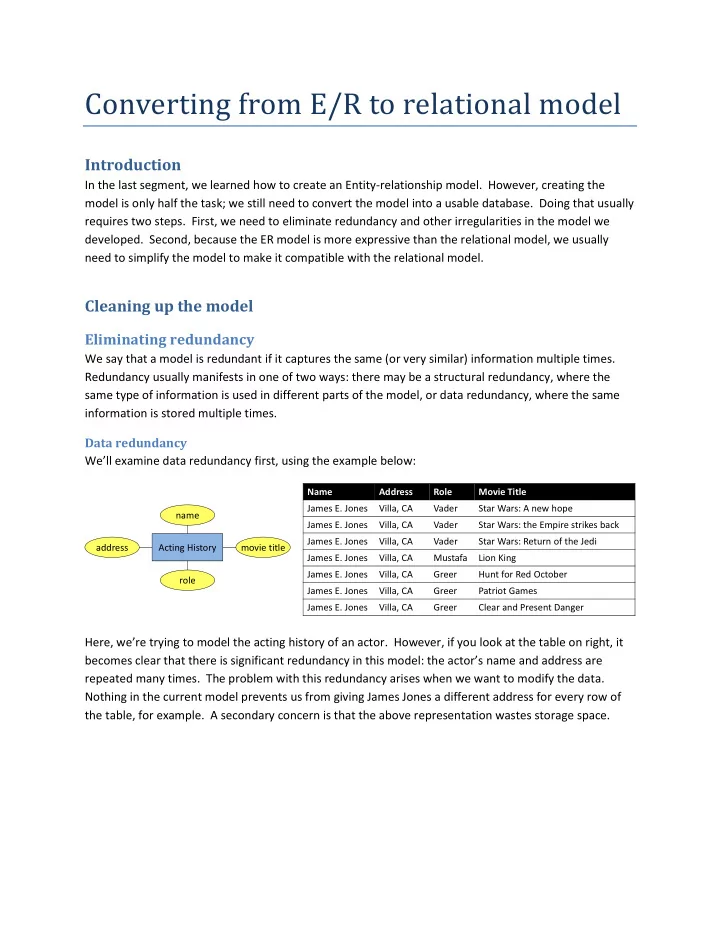
We say that a model is redundant if it captures the same (or very similar) information multiple times. Redundancy usually manifests in one of two ways: there may be a structural redundancy, where the same type of information is used in different parts of the model, or data redundancy, where the same information is stored multiple times. Data redundancy We’ll examine data redundancy first, using the example below: Here, we’re trying to model the acting history of an actor. However, if you look at the table on right, it becomes clear that there is significant redundancy in this model: the actor’s name and address are repeated many times. The problem with this redundancy arises when we want to modify the data. Nothing in the current model prevents us from giving James Jones a different address for every row of the table, for example. A secondary concern is that the above representation wastes storage space.
Name Address Role Movie Title James E. Jones Villa, CA Vader Star Wars: A new hope James E. Jones Villa, CA Vader Star Wars: the Empire strikes back James E. Jones Villa, CA Vader Star Wars: Return of the Jedi James E. Jones Villa, CA Mustafa Lion King James E. Jones Villa, CA Greer Hunt for Red October James E. Jones Villa, CA Greer Patriot Games James E. Jones Villa, CA Greer Clear and Present Danger name Acting History movie title role address