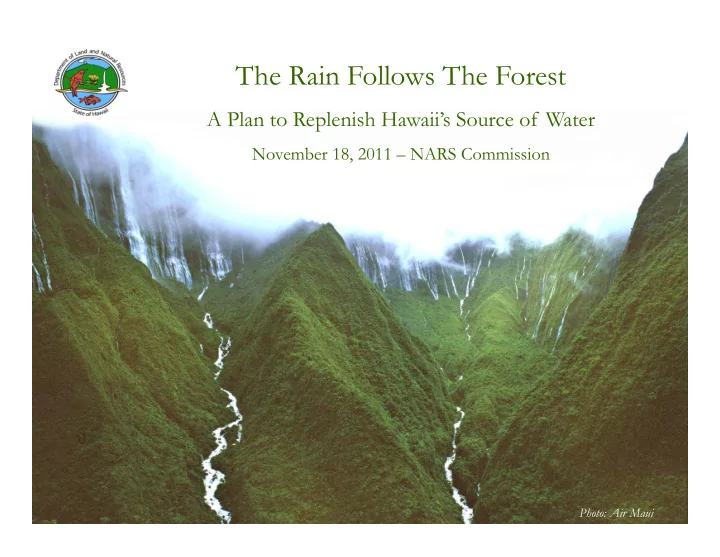
SLIDE 1 The Rain Follows The Forest
A Plan to Replenish Hawaii’s Source of Water
November 18, 2011 – NARS Commission
Photo: Air Maui
SLIDE 2
- Hawaii’s water supply is at risk
- Benefits of forest watershed protection
- Action plan
- Funding and public support
The Rain Follows the Forest
SLIDE 3 Hawaii’s Water Supply is at Risk
Chu, P.-S., and Chen, H. 2005. Interannual and interdecadal rainfall variations in the Hawaiian Islands. Journal of Climate 18: 4796-4813.
Evidence of Long-term Decline in Rainfall
SLIDE 4 Hawaii’s Water Supply is at Risk Hawaii Temperature
Giambelluca, T.W., Diaz, H.F., and Luke, M.S.A. 2008. Secular temperature changes in Hawai‘i. Geophysical Research Letters 35, L12702, doi:10.1029/2008GL034377.
SLIDE 5 Hawaii’s Water Supply is at Risk
U.S. Drought Monitor
SLIDE 6 Hawaii’s Water Supply is at Risk
Oki, D.S., 2004, Trends in Streamflow Characteristics in Hawaii, 1913-2003: U.S. Geological Survey Fact Sheet 2004-3104, 4 p.
Stream Base Flow in Decline
SLIDE 7
Hawaii’s Water Supply is at Risk
SLIDE 8
- Forests capture rain and cloudwater
– Forests can increase water capture by up to 30%
- 1% loss of recharge in the Ko`olau Mtns costs $42
million
- Invasive plants reduce estimated groundwater recharge
in East Hawaii by 85 million gallons/day
- Desalination plant planned for `Ewa will cost $40
million to construct and $5 million annually to produce 5 million gallons/day
Benefits of Forest Watershed Protection
SLIDE 9 Benefits of Forest Watershed Protection
Kohala Hualalai Kilauea
Carbon density Watershed Priority Areas
Asner, G. P., R. F. Hughes, J. Mascaro, A. L. Uowolo, D. E. Knapp, J. Jacobson, T. Kennedy-Bowdoin, and J.
- K. Clark. 2011. High-resolution carbon mapping on the million-hectare island of Hawai‘i. Frontiers in Ecology
and the Environment 9:434-439
SLIDE 10
SLIDE 11
Benefits of Forest Watershed Protection
SLIDE 12
SLIDE 13
- Remove all invasive hooved animals from priority I
and II areas.
Action Plan
SLIDE 14
- Remove or contain damaging invasive weeds that
threaten priority I and II areas
Action Plan
- Weed control in fenced areas
- Control and prevention of new invasive
species that will spread to priority I and II areas
- Use and development of tested integrated
pest management
SLIDE 15
- Monitor and control other forest threats including
fires, predators, and plant diseases.
- Restore native species.
- Establish benchmarks and monitor success.
- Educate Hawaii’s residents and visitors about the
cultural, economic, and environmental importance
- f conserving native forests.
- Promote consistent and informed land use decision-
making that protects watersheds.
Action Plan
SLIDE 16
– Double acreage protected in next 10 years – Requires investment of approximately $11 million per year – Fund approximately 150 FTE natural resource careers – This level of effort, or more, needed in perpetuity to stabilize Hawaii’s water source
Action Plan
SLIDE 17
Action Plan
SLIDE 18
Action Plan
SLIDE 19
Methodology
Evapotranspiration Runoff/Erosion Managed Unmanaged
SLIDE 20
Methodology
Managed Unmanaged
$ ? $ ?
SLIDE 21 Funding
- Dedicated funding needed
- Watershed protection benefits multiple sectors so
identify many funding sources
- Funding from uses that depend on or are mitigated
by watershed protection
- Visitor industries
- Water
- Climate change resiliency
- Greenhouse gas emissions reduction
SLIDE 22
Polling
Public Support
2 4 6 8 10 Urgency to protect sources of fresh water Increase funding from $1 to $11 million
Not support at all Strongly support Not support at all
SLIDE 23
Public Support
Watershed Contributions Average Theme Capture rainfall and replenish fresh water supplies for our use 9.2/10 Water Provide water for local agriculture 8.9/10 Water/Economy Prevent erosion and runoff of sediment into our oceans 8.7/10 Oceans/Climate Change Are of spiritual & cultural importance to native Hawaiian culture 8.1/10 Culture Increase resistance to climate change by absorbing greenhouse gases 8.0/10 Climate Change Support the visitor industry by providing the unique natural beauty that attracts tourists 7.9/10 Aesthetic/Economy
SLIDE 24
Public Support
Watershed Protection Average Theme Hawaii’s forests are important to Hawaii’s fresh water supply 9.5/10 Water Forests need protection because they are declining and home to native plants and wildlife found nowhere else on earth 9.0/10 Native Species Invasive species must be kept to a minimum to protect the health of watershed forests 8.9/10 Invasive Species Spending now to protect our forests saves taxpayer money in the long run 8.2/10 Economy
SLIDE 25
MAHALO Hahai no ka ua i ka ulula`au
The rain always follows the forest Hawaii.gov/dlnr