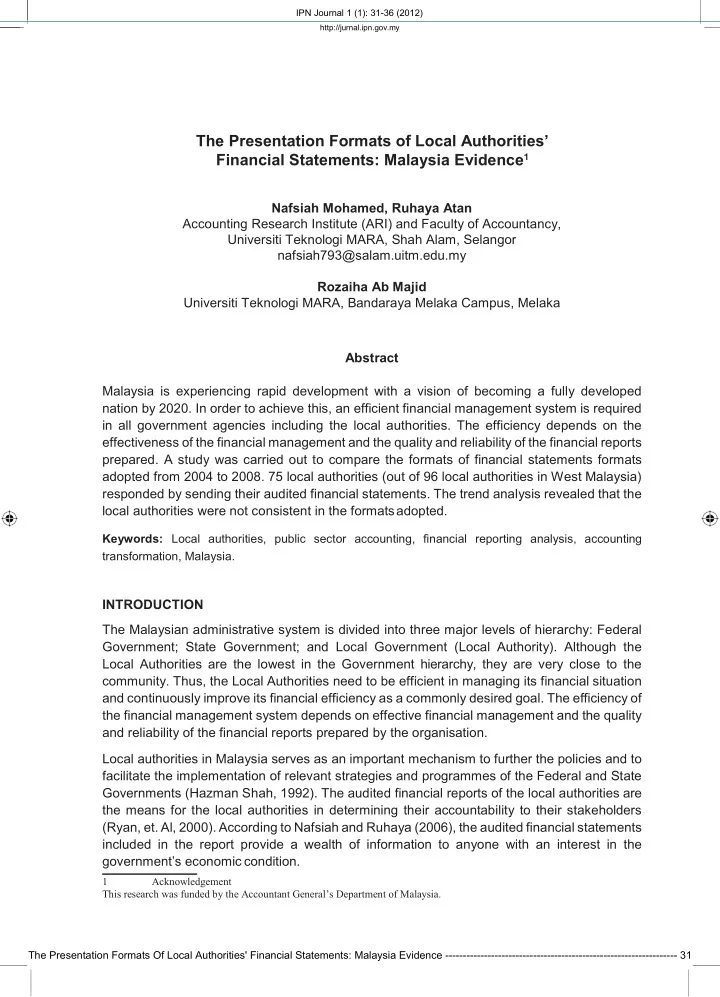
The Presentation Formats of Local Authorities Financial Statements: - - PDF document

the presentation formats of local authorities
SMART_READER_LITE
LIVE PREVIEW

The Presentation Formats of Local Authorities Financial Statements: - - PDF document

IPN Journal 1 ( 1 ): 31-36 (2012) http://jurnal.ipn.gov.my The Presentation Formats of Local Authorities Financial Statements: Malaysia Evidence 1 Nafsiah Mohamed, Ruhaya Atan Accounting Research Institute (ARI) and Faculty of Accountancy,


slide-1
SLIDE 1

IPN Journal 1 (1): 31-36 (2012)

http://jurnal.ipn.gov.my

The Presentation Formats of Local Authorities’ Financial Statements: Malaysia Evidence1

Nafsiah Mohamed, Ruhaya Atan Accounting Research Institute (ARI) and Faculty of Accountancy, Universiti Teknologi MARA, Shah Alam, Selangor nafsiah793@salam.uitm.edu.my Rozaiha Ab Majid Universiti Teknologi MARA, Bandaraya Melaka Campus, Melaka Abstract Malaysia is experiencing rapid development with a vision of becoming a fully developed nation by 2020. In order to achieve this, an efficient financial management system is required in all government agencies including the local authorities. The efficiency depends on the effectiveness of the financial management and the quality and reliability of the financial reports

  • prepared. A study was carried out to compare the formats of financial statements formats

adopted from 2004 to 2008. 75 local authorities (out of 96 local authorities in West Malaysia) responded by sending their audited financial statements. The trend analysis revealed that the local authorities were not consistent in the formats adopted.

Keywords: Local authorities, public sector accounting, financial reporting analysis, accounting transformation, Malaysia.

INTRODUCTION The Malaysian administrative system is divided into three major levels of hierarchy: Federal Government; State Government; and Local Government (Local Authority). Although the Local Authorities are the lowest in the Government hierarchy, they are very close to the

  • community. Thus, the Local Authorities need to be efficient in managing its financial situation

and continuously improve its financial efficiency as a commonly desired goal. The efficiency of the financial management system depends on effective financial management and the quality and reliability of the financial reports prepared by the organisation. Local authorities in Malaysia serves as an important mechanism to further the policies and to facilitate the implementation of relevant strategies and programmes of the Federal and State Governments (Hazman Shah, 1992). The audited financial reports of the local authorities are the means for the local authorities in determining their accountability to their stakeholders (Ryan, et. Al, 2000). According to Nafsiah and Ruhaya (2006), the audited financial statements included in the report provide a wealth of information to anyone with an interest in the government’s economic condition.

1 Acknowledgement This research was funded by the Accountant General’s Department of Malaysia. The Presentation Formats Of Local Authorities' Financial Statements: Malaysia Evidence ------------------------------------------------------------------ 31

slide-2
SLIDE 2

IPN Journal 1 (1): 31-36 (2012)

http://jurnal.ipn.gov.my

In recent years the media has taken an active role in highlighting many issues that concerned the public interest, which demand the local authorities to be more accountable. The United Nation Economic and Social Commission for Asia and the Pacific (1998) study indicated that Malaysia’s Local Authorities financial position is weak because they are not able to acquire additional revenue to provide services demanded by the community. Consistent with the study, public has now raised the issues in the newspapers questioning Local Authorities financial management and the uses of the public funds. Tayib (1995) identified that the local authorities in Malaysia are primarily practising four Accounting Standards: International Accounting Standards (IAS); guidance issued by the Ministry of Housing and Local Government; self created accounting practices; and Federal Treasury Circular. This led to inconsistency in presentation of the financial statements which makes it difficult to make comparison between local authorities. The purpose of this study is to find out whether this practise is still existing in the local

  • authorities. Thus, the specific objective of the study is to compare financial statements format

adopted by the local authorities from 2004 to 2008.2 METHODOLOGY Letters were sent to all 96 local authorities (excluding Kuala Lumpur City Hall) in Peninsular Malaysia requesting Audited Financial Statements for the year ended 2004, 2005, 2006, 2007 and 2008. Then, follow-up letters and calls had been made to the local authorities that failed to submit the Audited Financial Statements within the given timeframe. As a result, a total of 75 local authorities had responded to the request (see Table 1) with a total of 375 audited financial statements being submitted for analysis. Analyses of financial statements were carried out with a focus on the Statements of the Financial Position and Statements of the Financial Performance. Table 1: Number of local authorities responded

STATES TOTAL NO.

  • NO. RECEIVED

Johor 14 8 Kedah 11 11 Kelantan 12 10 Melaka 3 2 Negeri Sembilan 8 2 Pahang 11 11 Pulau Pinang 2 1 Perak 15 10 Perlis 1 1 Selangor 12 12 Terengganu 7 7 96 75

2 The study was conducted between May to October 2010. At the time when letters were sent out, the 2009 financial statements were not yet audited or if audited, were not yet gazetted The Presentation Formats Of Local Authorities' Financial Statements: Malaysia Evidence ------------------------------------------------------------------ 32

slide-3
SLIDE 3

IPN Journal 1 (1): 31-36 (2012)

http://jurnal.ipn.gov.my

Analysis of Format Adopted Format of The Statements of the Financial Position and The Statements of the Financial Performance were analysed according to their presentation. There is no specific requirement for the Local Authorities financial statements to be presented in certain format. The analysis

  • f format would determine whether there is any uniformity in their presentation of financial

statements. ANALYSIS OF RESULT Analysis of Format Presentation I. Statements of Financial Performance According to Coombs and Tayib, p11 (1998) ‘No clear rules and regulations spelling out the form and content of the statement of accounts that should be prepared by the local authorities were laid down either before or after the independence of Malaya’. There has been no development in the regulatory reform since then. This study attempts to determine whether in practice there has been any improvement with the local authority presentation of financial

  • statements. The trend analysis revealed that the local authorities were not consistent in the

formats adopted and disclosure of information. Table 2 shows there were 6 formats adopted by the local authorities. Table 2: Formats adopted by local authorities from 2004 to 2008 FORMAT 2004 2005 2006 2007 2008 A 22 22 22 22 24 B 8 6 6 6 5 C 8 10 10 10 9 D 26 26 26 16 16 E 9 9 9 19 19 F 2 2 2 2 2 Total 75 75 75 75 75 Format A and D are the two formats commonly adopted. They are almost similar except that the items of revenue and expenditure are more detailed in Format D. Table 3: Explanation on the different format of Statement of Financial Performance FORMAT A Disclose breakdown of all income and expenditure with notes for each item. FORMAT B Disclose total income and total expenditure with notes but no breakdown items in the Statement.

The Presentation Formats Of Local Authorities' Financial Statements: Malaysia Evidence ------------------------------------------------------------------ 33

slide-4
SLIDE 4

IPN Journal 1 (1): 31-36 (2012)

http://jurnal.ipn.gov.my

FORMAT C Disclose the breakdown of income according to the types of revenue: Direct Tax; Indirect Tax; Non-Revenue Receipts; and Grants or Contributions from Government. Breakdown of all expenditures are disclosed. In addition, Development Expenditure is included as operating expenditure, even though disclosed under a separate heading. FORMAT D Almost similar to Format A. The difference is that, some of the revenues and expenditures had been grouped and classified under specific headings with notes. FORMAT E Almost similar to Format C. The difference is that, the items under the types of Revenue: Direct Tax; Indirect Tax; and Non-Revenue Receipts are grouped under each heading with notes. No item on Grants or Contributions from Government. For expenditure, most of the items had been grouped under specific headings and details are disclosed in the notes. FORMAT F Almost similar to Format C. The difference is that, the expenditure

  • n

development and capital assets are disclosed and included as part

  • f total expenditure. The statement shows the surplus (if any) being

transferred to the Kumpulan Wang Terkumpul or reserves. It shows that uniformity in presentation is not present. Interviews with some local authorities revealed that the change of format might be due to recommendations by the external auditors

  • r influenced by peers from other local authorities or directives from top management.

When there is no uniformity, comparison between local authorities within a state or among

  • ther states is not possible. Though, they are not operating in a competitive environment,

comparison between the financial performances of the local authorities would gauge how well the local authorities are fulfilling their objectives. The local authorities can placed themselves at par with the other local authorities that are performing well. They can also learn from the mistakes made by other local authorities and improved themselves. Since there are no accounting standards imposed on them, local authorities adopt modified accrual accounting, modify according to their needs. As different treatments were used the problem of comparison among local authorities arises. Uniformity Within States (2004 – 2008) Table 3 shows that out of 11 states only 5 states have uniformity in adopting the format. (Perlis was excluded as the state has only one local authority). In Kedah 10 out of 11 of the local authorities had moved from different format to Format A in 2008. Thus, all 10 are uniform in presenting the Financial Performance except for Alor Setar City Council that had moved to Format D from Format A. Selangor is one of the states that had adopted various formats of the Statements of the

The Presentation Formats Of Local Authorities' Financial Statements: Malaysia Evidence ------------------------------------------------------------------ 34

slide-5
SLIDE 5

IPN Journal 1 (1): 31-36 (2012)

http://jurnal.ipn.gov.my

Financial Performance within the timeframe of 2004 to 2008. As at 2008, five different formats have been adopted: Format A and Format F had been adopted by two local authorities respectively; four local authorities adopted Format B; and Format C and Format D were adopted by two local authorities. Nevertheless, there are also local authorities within the states that are adopting uniform

  • formats. Local authorities in Johor and Melaka for example are adopting Format A, whereas

local authorities in Pahang are adopting Format D, and those in Perak are adopting Format E. Table 3: Format comparison between states Format Uniformity Among States Based on Table 3, it can be seen that there is no uniformity among the states in presenting their Statements of the Financial Performance. For example, Johor and Melaka adopted Format A, whereas Perak and Perlis adopted Format E. Even though local authorities in Johor and Pahang adopted uniform format within their states, comparison between the two states were not possible as Johor adopted Format A whereas Pahang adopted Format D. II. Statement of Financial Position In 2004, it was found that there were three types of Statements of Financial Position format adopted by the local authorities. Table 4 shows in 2004 and 2005, 71 local authorities adopted Format A, three local authorities adopted Format B and only one local authority adopted Format C. Nevertheless by 2008, all the 75 local authorities had adopted a uniform format, that is, Format A. States A B C D E F Johor √ Kedah √ √ Melaka √ Negeri Sembilan √ √ Pulau Pinang √ √ Pahang √ Terengganu √ √ Perak √ Kelantan √ √ Perlis √ Selangor √ √ √ √ √

The Presentation Formats Of Local Authorities' Financial Statements: Malaysia Evidence ------------------------------------------------------------------ 35

slide-6
SLIDE 6

IPN Journal 1 (1): 31-36 (2012)

http://jurnal.ipn.gov.my

Table 4: Format adopted by the local authorities FORMAT 2004 2005 2006 2007 2008 A 71 71 73 73 75 B 3 3 2 2 C 1 1 TOTAL 75 75 75 75 75 Even though there is no uniformity in the Statements of Financial Performance format, either within the states or among the states, the 75 local authorities tend to be uniform in adopting the Statements of Financial Position format. Unlike the private sector where companies must comply with the Malaysian Financial Reporting Standards, the local authorities do not have such regulations. It is high time that a uniform accounting standard to be enforced to all local authorities. CONCLUSION AND RECOMMENDATION In order to enhance the quality and uniformity of financial reporting of Local Authorities throughout Malaysia, harmonisation of the financial reporting format is a priority. It is important that initiatives towards the adoption of one single set of financial reporting be made as soon as possible. The announcement made by the government in March 2011, to move from modified cash accounting to full accrual accounting in 2015 had raised concern among local

  • authorities. It is hoped that the announcement would caused the local authorities to take

necessary actions to ensure that they are ready to embark when the time comes. REFERENCES Hazman, S. A. (1992), Pentadbiran Kewangan Kerajaan Tempatan di Semenanjung Malaysia, Dewan Bahasa dan Pustaka, Kuala Lumpur, Malaysia Nafsiah, M., Ruhaya, A. and Sjofwina, H., (2006), The Need of Accounting Standard in Local Authority, Accountants Today, December 2006, Vol. 19, No. 12, pp1-6. Ryan, C. Robinson, M. And Grigg, T. (2000), Financial Performance Indicators for Australian Local Governments, Accounting, Accountability and Performance, Vol. 6, No. 2, pp.89-106. Tayib, M. (1995), Local Government Financing in Peninsular Malaysia, a research report submitted to Ministry of Science, Technology and Environment of Malaysia. United Nation (1998), “Local Government in Asia and the Pacific: A Comparative Study, Country paper: Malaysia”, United Nation Economic and Social Commission for Asia and the Pacific, Publication and resources (http://www.un.org/) access on 11 January 2011.

The Presentation Formats Of Local Authorities' Financial Statements: Malaysia Evidence ------------------------------------------------------------------ 36