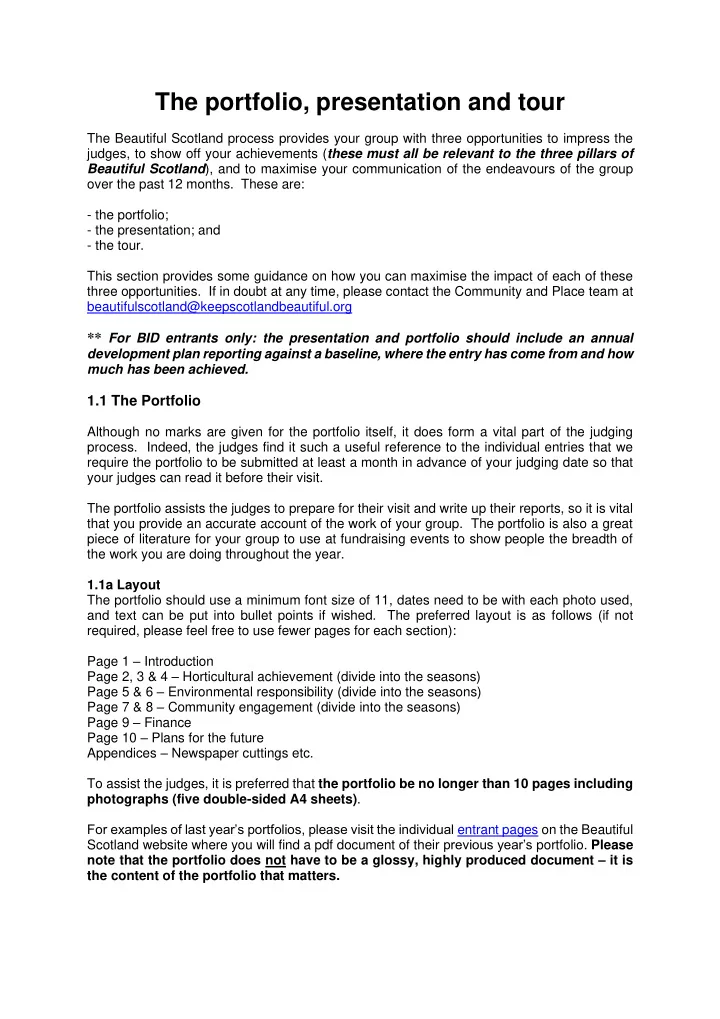
The portfolio, presentation and tour The Beautiful Scotland process - - PDF document

the portfolio presentation and tour
SMART_READER_LITE
LIVE PREVIEW

The portfolio, presentation and tour The Beautiful Scotland process - - PDF document

The portfolio, presentation and tour The Beautiful Scotland process provides your group with three opportunities to impress the judges, to show off your achievements ( these must all be relevant to the three pillars of Beautiful Scotland ), and to


slide-1
SLIDE 1

The portfolio, presentation and tour

The Beautiful Scotland process provides your group with three opportunities to impress the judges, to show off your achievements (these must all be relevant to the three pillars of Beautiful Scotland), and to maximise your communication of the endeavours of the group

  • ver the past 12 months. These are:
  • the portfolio;
  • the presentation; and
  • the tour.

This section provides some guidance on how you can maximise the impact of each of these three opportunities. If in doubt at any time, please contact the Community and Place team at beautifulscotland@keepscotlandbeautiful.org

** For BID entrants only: the presentation and portfolio should include an annual

development plan reporting against a baseline, where the entry has come from and how much has been achieved.

1.1 The Portfolio

Although no marks are given for the portfolio itself, it does form a vital part of the judging

  • process. Indeed, the judges find it such a useful reference to the individual entries that we

require the portfolio to be submitted at least a month in advance of your judging date so that your judges can read it before their visit. The portfolio assists the judges to prepare for their visit and write up their reports, so it is vital that you provide an accurate account of the work of your group. The portfolio is also a great piece of literature for your group to use at fundraising events to show people the breadth of the work you are doing throughout the year. 1.1a Layout The portfolio should use a minimum font size of 11, dates need to be with each photo used, and text can be put into bullet points if wished. The preferred layout is as follows (if not required, please feel free to use fewer pages for each section): Page 1 – Introduction Page 2, 3 & 4 – Horticultural achievement (divide into the seasons) Page 5 & 6 – Environmental responsibility (divide into the seasons) Page 7 & 8 – Community engagement (divide into the seasons) Page 9 – Finance Page 10 – Plans for the future Appendices – Newspaper cuttings etc. To assist the judges, it is preferred that the portfolio be no longer than 10 pages including photographs (five double-sided A4 sheets). For examples of last year’s portfolios, please visit the individual entrant pages on the Beautiful Scotland website where you will find a pdf document of their previous year’s portfolio. Please note that the portfolio does not have to be a glossy, highly produced document – it is the content of the portfolio that matters.

slide-2
SLIDE 2

1.1b Content The portfolio is your opportunity to set the scene and show the judges everything that they can’t see on the judging tour, but it is not your only opportunity to do so. As the portfolio is due with KSB by the start of July, we are aware that it will not be possible to include information from end June and July. However, the presentation is the ideal opportunity to highlight this work. With only limited space available, it is very important that the portfolio focuses on illustrating the ways in which you have addressed the three pillars of the competition. In particular, it should:

  • Highlight and explain the main features of your group’s entry, where possible linking to the

three main pillars and sub sections;

  • Document areas of work that will perhaps not be viewed during the judges’ visit;
  • Provide evidence of the work your group has done to ensure that your community looks

good throughout the year. Think about work done in the autumn, winter and spring especially;

  • Inform the judges about the support you have received from your community, businesses

and other partners; and

  • Set out your group’s plans for future developments.

It is also worth considering the following top tips:

  • 1. Photographs are an important way of getting your message across. Please ensure

that these are dated and were taken within the last 12 months. If you use photographs that include people, their permission must be obtained as the portfolio will be used on the Beautiful Scotland website.

  • 2. Ask a senior school, college, or youth group to assist with the design of your portfolio

as part of a project.

  • 3. With

sustainability in mind, the portfolio should be e-mailed to beautifulscotland@keepscotlandbeautiful.org (if the file size of your portfolio is over 10MB, you can reduce the size using the free service on this website: https://smallpdf.com/compress-pdf or email it to same address by using the free file transfer service available at www.wetransfer.com). If you have any questions about putting together your portfolio, please contact beautifulscotland@keepscotlandbeautiful.org

1.2 The Presentation

Every entrant group has the opportunity to give a 15-minute presentation about their local campaign on judging day. This is an important part of the day and it is strongly recommended that you deliver your presentation before your assessed tour as it is a great way to set the scene. The presentation should not be included in your tour time; it is a separate 15 minute section. The presentation is not marked, but again gives your group the opportunity to highlight things that the judges won’t see on the tour. It will help stimulate discussions with the judges and help them to understand your group and vision. The presentation should focus primarily on giving an overview of year-round working and could even be set up in chronological order, taking the judges through the year and showing them the variety of activities in which you have been involved, from bulb planting days to community meetings, to school projects. It is also a great opportunity to show the judges projects/groups

slide-3
SLIDE 3

which they won’t visit/meet on the tour. It can include images of recent work that couldn’t be included in the portfolio, and it is also an opportunity to highlight fundraising events, future plans and work with other groups in your area. Please consider the following guidance for your presentation:

  • Maximum length of 15 minutes.
  • You decide on the format of the presentation e.g. PowerPoint presentation, scrap

book, display boards or printed hand-outs - what is important is the content of your presentation rather than the style and technology used.

  • Although the presentation is not judged in itself, the judges will be looking for

supporting evidence of your year-round working.

  • If your group submitted a self-nomination for a discretionary award, ensure your

presentation (and tour) includes evidence of your eligibility for the award. The judges who visit could be influential in supporting your nomination.

  • And lastly, remember to only present on things relevant to the three pillars of the

Beautiful Scotland competition.

1.3 The Tour

1.3a Categories and tour times The tour is when the judges will start marking your achievements. Each Beautiful Scotland category is allocated a specific amount of time for the judging tour and these are outlined in the table below. Category Electoral roll figure TOUR Press Presentation Total Wee Village Up to 300 1 hour 15 mins 15 mins 1 hour 30 mins Small Village 301-1,000 1 hour 15 mins 15 mins 15 mins 1 hour 45 mins Large Village 1,001-2,500 1 hour 30 mins 15 mins 15 mins 2 hours Coastal Village Up to 2,500 1 hour 30 mins 15 mins 15 mins 2 hours Coastal Town 2,501-35,000 2 hours 30 mins 15 mins 15 mins 3 hours Urban Community 1,001-12,000 2 hours 30 mins 15 mins 15 mins 3 hours Small Town 2,501-6,000 2 hours 15 mins 15 mins 2 hours 30 mins Medium Town 6,001-12,000 2 hours 30 mins 15 mins 15 mins 3 hours Large Town 1.5 miles 3 hours 15 mins 15 mins 3 hours 30 mins Small City 35,001-100,000 3 hours 30 mins 15 mins 15 mins **4 hours plus 30 min break City 100,001 and over 4 hours 15 mins 15 mins **4 hours 30 mins plus 30 min break

slide-4
SLIDE 4

Residential Community N/A 1 hour 15 mins 15 mins 1 hour 30 mins Business Improvement District (BID) N/A 2 hours 15 mins 15 mins 2 hours 30 mins Tours may be shorter if you don’t feel you require the full time – please let your judges know in advance if you have decided to do this. Overall, the time should not exceed the time specified in the ‘Total’ column but the judges will be flexible e.g. if heavy traffic delays the tour vehicle etc. **For the City and Small City categories, you may add in a ½ hour break in the middle of your tour (please discuss this with your judges when they contact you to arrange their visit). This is to allow the judges to have a refreshment/comfort stop, and the ‘tour clock’ must be stopped during this time. This ½ hour must not be used to extend the time of your tour. The judges are trained to take into account the fact that some entrants cannot be assessed

  • n certain criteria: for example, smaller communities may not contain any shops, car parks
  • etc. Where this is the case, the marks for that section will be adjusted to ensure that all entrants

are treated fairly. It is also worth noting that if judges are shown anything at all on the tour that the entrant being assessed has not somehow been involved with, they are instructed not to include it in their

  • report. It is up to you, the entrant, to make sure that you explain clearly how you have worked

with other groups and/or It’s Your Neighbourhood projects which are included in your tour. And lastly, please remember to only show the judges things that are relevant to the three pillars of the Beautiful Scotland competition. 1.3b Planning your tour With such a wide range of communities taking part in the national competition, it is difficult to demonstrate an itinerary that suits all occasions. Instead, we would recommend that you keep the following points in mind when designing the route that the judges will take during their visit (please email beautifulscotland@keepscotlandbeautiful.org if you would like examples of good tour itineraries emailed to you): Early planning

  • Read the marking sheet and guidance carefully to ensure you cover as many points as you

can while on your tour.

  • Think carefully about what you should include in your tour to evidence year-round activity

during the tour.

  • Identify a meeting point and who will be accompanying the judges on their tour. This must

be forwarded to your judges in advance of the judging date.

  • Draw up a list of sites you should visit and potential people you could meet on the route

(the judges really enjoy meeting people and hearing what their role is/what they do) – where possible, use the judging sheet, the three pillars and their sub sections to help you identify key locations.

  • Identify a place to carry out the presentation – e.g. a town hall, a local café, a school.
  • Discuss and confirm a suitable location for the 15-minute press/photo shoot if you have
  • ne. It can take place at any location of your choice, however, it is advisable that it is kept

to one location if possible. It is also a good idea to make sure someone from the group can take photos in case the local press is not able to attend. Please remember that this time can’t be used to extend the tour.

slide-5
SLIDE 5

Route development

  • Remember, everything is judged on the route – take a ‘critical friend’ around the route

before the day and take on board their suggestions.

  • Concentrate on showing the judges things that have been a result of your activities, or that

you have been involved in/with.

  • Link the itinerary to the competition’s three main pillars and their sub sections. Think about

how many points each section is worth.

  • A good tour should have inputs from other members of the community at various stopping

points throughout.

  • If transport is required, make the necessary arrangements well in advance – the group must

provide a vehicle if required (you must not ask the judges to drive). Vehicles should have good visibility and should not have tinted windows. Make sure you know who will travel with whom and whether more than one vehicle will be needed. Ensure that you have a driver and a guide, rather than one person doing both tasks. Ensure valid vehicle insurance is in place and that vehicle is fit for purpose. It is important to keep the tour efficient so please do not spend too long in a vehicle.

  • Do not just take judges to private gardens but display a variety of locations where possible.

Two or three private gardens are acceptable.

  • If your group submitted a self-nomination for a discretionary award, ensure your tour (and

presentation) includes evidence of your eligibility for the award. The judges who visit could be influential in supporting your nomination.

  • Be realistic with your timings - judges may ask questions, take photos, there may be traffic

jams, all of which could take you over your planned times. Don’t try and squeeze too much in – is it better to show something in your presentation rather than rushing to take the judges there? Practice timing

  • Make sure that all arrangements are confirmed, and the judging route has been timed to

perfection.

  • Carry out a full rehearsal if possible.
  • Ensure that your supporting members of the community realise that their time may be cut

short and not to be offended if this happens. Tour preparation

  • It is recommended that you start the tour with your presentation, but if it fits better later on

that is fine.

  • Remember, you don’t have to use all of the allocated 15 minutes for your presentation, but

you cannot add any time saved on to your tour time.

  • The venue for the presentation can also be used to provide refreshments/comfort

break facilities for judges – they may have come a long way and will always appreciate any hospitality you give them.

  • It is vital that you have the judges’ mobile numbers and they have yours in case of any

issues in the run up to or on the day.

  • A map and an itinerary that clearly highlight the judging route must be given to the judges
  • n arrival, but preferably in advance so they know what to expect. It is also a useful

document for judges to make notes against. Meet people on route

  • Judges will expect to be accompanied throughout the tour by a maximum of four people

(two is preferred), each of whom should be competent to answer questions.

  • Remember you can alternate or meet people at various locations in order to include

particular experts/allow the judges to meet the groups involved at certain points.

  • Be sure to highlight the involvement of the community at all times. Don’t just show the

judges your wildflower meadow – invite some of the people who helped sow or plant it to

slide-6
SLIDE 6

talk about it (make sure they introduce themselves to the judges, letting them know what their role is).

  • Judges are very happy to meet with members of the community, particularly young people,

who have been involved in working on the projects they see. However, please make sure that everyone knows that the time is strictly limited, and they should not delay the judges beyond their allocated time.

  • If you work with It’s Your Neighbourhood groups, or other Beautiful Scotland groups,

consider including them too – but always check that the groups are happy with this. Use every opportunity

  • Don’t waste a minute. If you have planned a comfort break or cup of tea half way through,

then have displays available and perhaps even manned by local groups who help you out.

  • Make sure community notice boards are up to date and include information about your

work, where relevant.

  • Try to make use of the 15 minutes that has been allocated over and above the judging time

for press and photo opportunities. Articles and photographs in the local press help towards building your profile. The judges are happy to answer questions and be photographed, however try to keep this to one location.

  • Use the judging checklist which can be found on-line here.

On the day

  • Organise for a few people to check there is no litter on the judging route before the tour

begins.

  • Remember to offer your judges a comfort break and refreshments before the tour starts (if

not offering during or at the end of your tour) – they may have been travelling all day or come straight from judging another entry. Please do check with your judges in advance of the day if they have time for this.

  • Make it absolutely clear when the judging tour commences, so that the judges are aware.
  • Please remember that the judges who visit your community are volunteers and are giving

their time and expertise to support you and your community. The visit should be an enjoyable experience for all involved.

  • Don’t start off the tour with a negative – if you have experienced local authority cuts in your

area, tell the judges what steps your group has made to work with the council or what your group is doing to help with this. For example, outline any partnership working or how you’ve turned a grass area that used to be cut by the council into a wild flower area.

  • Please make allowance for the weather on the day of the judges’ visit. Be prepared to

provide umbrellas or bottles of water as appropriate.

  • Most importantly, the day should be fun and a celebration of everything you are

achieving in your community – perhaps plan a party for after the judges have left to reward everyone who has been involved over the year. And please remember, what you show to your judges on the day should not be for one day

  • nly. Standards should be kept throughout the year.

1.3c Judging fairness In order to protect the integrity of the competition, it is important that all entrant groups are aware that the judges will take a negative view if any of the following occur, and marks will be adjusted accordingly:

  • There is evidence that material has been brought in solely for the judging day and is not

provided for the whole season.

  • The judges are offered gifts or other inducements aimed at affecting the judging process.
slide-7
SLIDE 7
  • The arranged judging tour continues longer than the allocated length of time given. Extra

time will only be allowed if there are unforeseen circumstances and then only at the judges’ discretion.