SLIDE 1
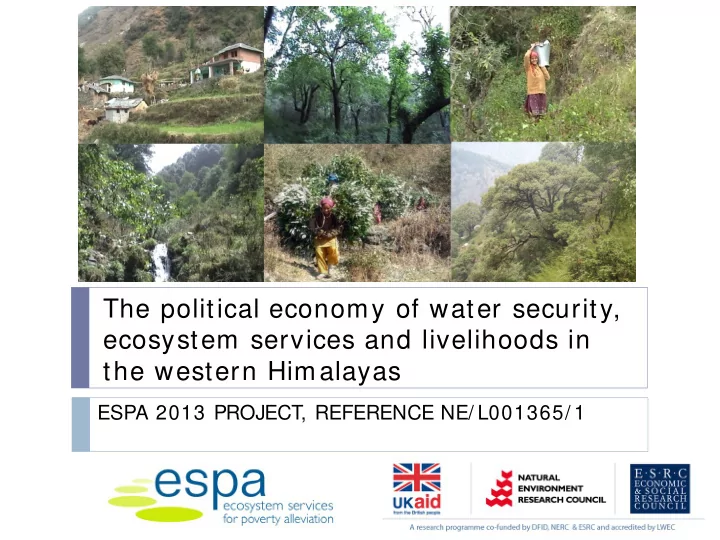
The political economy of water security, ecosystem services and livelihoods in the western Himalayas
ESPA 2013 PROJECT, REFERENCE NE/ L001365/ 1
SLIDE 2 University of Cambridge
Bhaskar Vira
Centre for Development and Research (CEDAR), India
Dr Rajesh Thadani Chetan Agarwal Professor S P Singh Dr Vishal Singh Dr Devendra Chauhan Dr Ajay Saxena
Southasia Institute of Advanced Studies (SIAS), Nepal
Dr Hemant Ojha Dr Ngamindra Dahal Dr Kamal Devkota
Project team
SLIDE 3 Project focus: small towns
Growing populations in small towns –
neglected urbanisation?
For every large urban settlement,
estimated to be ten small towns
Rapid growth, expected to double in
number and size every 15 years (Pilgrim et
Specific focus – Indian state of Himachal
Pradesh and Uttarakhand, and Nepal
Of the estimated 8.3 million residents in
the region, 46% live in small towns (below 100,000 people)
Key characteristics
Continued dependence on surrounding ecosystem
for water – usually surface water sources
Wider relationship with natural ecosystems and
surrounding catchments, despite urbanisation
SLIDE 4
Historically contested environments in the Western Himalayas
Hydrological connections between the forested Himalayas
and downstream communities
‘Dessicationist’ discourses of the 19th century, to the
‘theory of Himalayan degradation’ of the mid-1970s
Continued lack of detailed empirical or theoretical
consensus on the forest-hydrology relationship
Forests and rainfall Forests and evapo-transpiration Forests and stream flow
Widespread belief in hydrological relationships
Conservation of the Shimla Water Catchment since the 19th c. Continued focus on links between Himalayan land-use change and
hydrological flows in the northern/eastern plains
SLIDE 5
‘New ecologies’ of risk and vulnerability
Demands for ecosystem
services from downstream beneficiaries
Human vulnerability to disaster
and exposure to risk
Trade-offs between ecological
protection and developmental pressures
Drivers of change: dam building,
deforestation, roads, pilgrim tourism, extreme weather events (climate change?)
Settlement patterns along road
and trade networks, spontaneous and unplanned urbanisation
SLIDE 6
Previous ESPA-funded research (2011- 13)
Palampur town, 1219 m., at the foothills of
the Dhauladhar range, Himachal Pradesh
‘Small town’ – estimated population
46,224
Av. rainfall 250 cm p.a., 80% in the
monsoon months (June-Aug)
Dependent on the streams from upper
catchments for drinking water and irrigation
PES negotiated to reduce upstream
pressure on infiltration zone and protect forests
Post agreement political economy of
access, use and control
Need to understand needs and
perspectives of upstream/downstream stakeholders, and recognise trade-offs
SLIDE 7
Role of landuse planning and zoning
Important for securing water supplies in mountain
regions, and reducing risk and vulnerability
Need to understand the full range of ecosystem services
in the landscape, and how these are accessed by both rural and urban stakeholders
Trade-offs and choices in these contexts
How is water used and allocated? Who benefits from enhanced infiltration and recharge? How is the well-being of the (rural and urban) poor impacted
by changes in landuse, and improvements in aggregate water availability?
What impacts are there on other ecosystem services?
SLIDE 8
Project aims
To understand negotiation processes between different stakeholders
(both rural and urban) over landuse and zoning strategies that influence access to water and other ecosystem services in selected catchments surrounding small towns in the Western Himalayan region;
To identify the critical synergies and trade-offs associated with
alternative zoning and landuse management strategies, and their likely impacts on different stakeholders;
To investigate the contrasting political, governance and institutional
arrangements which frame the context for these negotiations, focusing on two case studies each across three different jurisdictions – Himachal Pradesh, Uttarakhand, and Nepal;
To work with local planning authorities and decision makers to
explore the potential for landuse planning and zoning to address the water security needs of the region.
SLIDE 9
Specific research questions
RQ1: From what sources do the selected small towns derive
their water supply, and what is the current state of knowledge about the condition of these sources and threats to their sustainability?
RQ2: What are the specific areas in the surrounding and
source watersheds that are critical to the long term sustainability of these water supply sources (‘critical water zones’)?
RQ3: What are the other ecosystem services that flow from
these critical water zones, and what is the current state of knowledge about their condition and trends?
RQ4: Who are the stakeholders that depend on the flows of
water, and other ecosystem services, from these critical water zones, and what are their current livelihood strategies (and their poverty status)?
SLIDE 10
Specific research questions
RQ5: Who are the key decision makers in these landscapes,
and what are their specific institutional and resource interests in relation to flows of water, and other ecosystem services?
RQ6: What are the synergies and trade-offs between (a)
ecosystem services; and (b) stakeholders in these landscapes?
RQ7: What is the potential for stakeholder engagement and
negotiation in order to develop interventions that secure water supplies, other ecosystem services and promote sustainable livelihoods and poverty alleviation in these landscapes?
RQ8: What are the implications of these findings for
knowledge about the institutional and governance contexts in which ecosystem-based interventions can provide pro-poor strategies for water supply and other ecosystem services in low income (mountain) regions?
SLIDE 11
Impact and Research into Use strategy
Identifying local ‘policy champions’ in case study towns
and surrounding villages
Engaging local stakeholders and building capacity Targeted meetings with key decision makers Flexibility – looking for windows of opportunity Working with civil society and local NGOs Use of new media to disseminate early insights, including
visual/documentary/film/blogs/podcasts
Academic project partners and advisory groups Close liaison with DFID South Asia Research Hub and
RCUK offices in the region