The Pig System Christopher Olston, Benjamin Reed, Utkarsh Lets see - - PDF document

the pig system
SMART_READER_LITE
LIVE PREVIEW

The Pig System Christopher Olston, Benjamin Reed, Utkarsh Lets see - - PDF document

The Pig System Christopher Olston, Benjamin Reed, Utkarsh Lets see how we can create complex Srivastava, Ravi Kumar, Andrew Tomkins: Pig MapReduce workflows by programming in a Latin: a not-so-foreign language for data high-level


slide-1
SLIDE 1

1

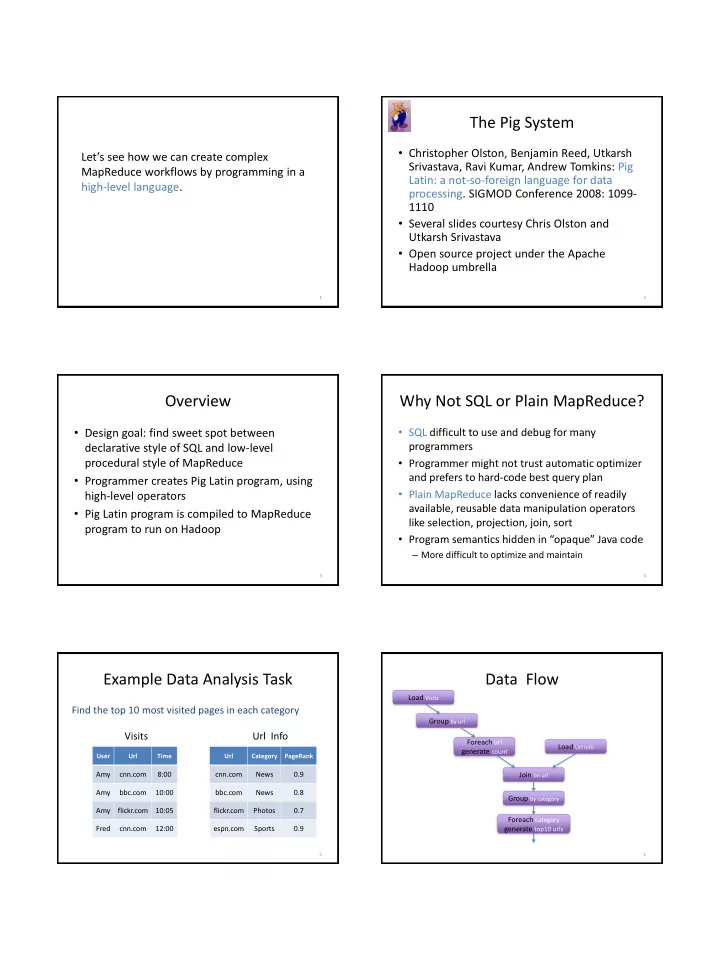
Let’s see how we can create complex MapReduce workflows by programming in a high-level language.

The Pig System

  • Christopher Olston, Benjamin Reed, Utkarsh

Srivastava, Ravi Kumar, Andrew Tomkins: Pig Latin: a not-so-foreign language for data

  • processing. SIGMOD Conference 2008: 1099-

1110

  • Several slides courtesy Chris Olston and

Utkarsh Srivastava

  • Open source project under the Apache

Hadoop umbrella

2

Overview

  • Design goal: find sweet spot between

declarative style of SQL and low-level procedural style of MapReduce

  • Programmer creates Pig Latin program, using

high-level operators

  • Pig Latin program is compiled to MapReduce

program to run on Hadoop

3

Why Not SQL or Plain MapReduce?

  • SQL difficult to use and debug for many

programmers

  • Programmer might not trust automatic optimizer

and prefers to hard-code best query plan

  • Plain MapReduce lacks convenience of readily

available, reusable data manipulation operators like selection, projection, join, sort

  • Program semantics hidden in “opaque” Java code

– More difficult to optimize and maintain

4

Example Data Analysis Task

User Url Time

Amy cnn.com 8:00 Amy bbc.com 10:00 Amy flickr.com 10:05 Fred cnn.com 12:00

Find the top 10 most visited pages in each category

Url Category PageRank

cnn.com News 0.9 bbc.com News 0.8 flickr.com Photos 0.7 espn.com Sports 0.9

Visits Url Info

5

Data Flow

Load Visits Group by url Foreach url generate count Load Url Info Join on url Group by category Foreach category generate top10 urls

6

slide-2
SLIDE 2

In Pig Latin

visits = load ‘/data/visits’ as (user, url, time); gVisits = group visits by url; visitCounts = foreach gVisits generate url, count(visits); urlInfo = load ‘/data/urlInfo’ as (url, category, pRank); visitCounts = join visitCounts by url, urlInfo by url; gCategories = group visitCounts by category; topUrls = foreach gCategories generate top(visitCounts,10); store topUrls into ‘/data/topUrls’;

7

Pig Latin Notes

  • No need to import data into database

– Pig Latin works directly with files

  • Schemas are optional and can be assigned

dynamically

– Load ‘/data/visits’ as (user, url, time);

  • Can call user-defined functions in every

construct like Load, Store, Group, Filter, Foreach

– Foreach gCategories generate top(visitCounts,10);

8

Pig Latin Data Model

  • Fully-nestable data model with:

– Atomic values, tuples, bags (lists), and maps

  • More natural to programmers than flat tuples

– Can flatten nested structures using FLATTEN

  • Avoids expensive joins, but more complex to

process

yahoo , finance email news

9

Pig Latin Operators: LOAD

  • Reads data from file and optionally assigns

schema to each record

  • Can use custom deserializer

queries = LOAD ‘query_log.txt’ USING myLoad() AS (userID, queryString, timestamp);

10

Pig Latin Operators: FOREACH

  • Applies processing to each record of a data set
  • No dependence between the processing of

different records

– Allows efficient parallel implementation

  • GENERATE creates output records for a given

input record expanded_queries = FOREACH queries GENERATE userId, expandQuery(queryString);

11

Pig Latin Operators: FILTER

  • Remove records that do not pass filter

condition

  • Can use user-defined function in filter

condition real_queries = FILTER queries BY userId neq `bot‘;

12

slide-3
SLIDE 3

Pig Latin Operators: COGROUP

  • Group together records from one or more

data sets

13

queryString url rank Lakers nba.com 1 Lakers espn.com 2 Kings nhl.com 1 Kings nba.com 2 queryString adSlot amount Lakers top 50 Lakers side 20 Kings top 30 Kings side 10 Lakers, (Lakers, nba.com, 1) (Lakers, espn.com, 2) (Lakers, top, 50) (Lakers, side, 20) Kings, (Kings, nhl.com, 1) (Kings, nba.com, 2) (Kings, top, 30) (Kings, side, 10) , ,

COGROUP results BY queryString, revenue BY queryString

results revenue

Pig Latin Operators: GROUP

  • Special case of COGROUP, to group single data

set by selected fields

  • Similar to GROUP BY in SQL, but does not

need to apply aggregate function to records in each group grouped_revenue = GROUP revenue BY queryString;

14

Pig Latin Operators: JOIN

  • Computes equi-join

join_result = JOIN results BY queryString, revenue BY queryString;

  • Just a syntactic shorthand for COGROUP followed

by flattening temp_var = COGROUP results BY queryString, revenue BY queryString; join_result = FOREACH temp_var GENERATE FLATTEN(results), FLATTEN(revenue);

15

Other Pig Latin Operators

  • UNION: union of two or more bags
  • CROSS: cross product of two or more bags
  • ORDER: orders a bag by the specified field(s)
  • DISTINCT: eliminates duplicate records in bag
  • STORE: saves results to a file
  • Nested bags within records can be processed

by nesting operators within a FOREACH

  • perator

16 Transform to (user, Canonicalize(url), time) Join url = url Group by user Transform to (user, Average(pagerank) as avgPR) Filter avgPR > 0.5 Load Pages(url, pagerank) Load Visits(user, url, time) (Amy, 0.65) (Amy, 0.65) (Fred, 0.4) (Amy, { (Amy, www.cnn.com, 8am, 0.9), (Amy, www.snails.com, 9am, 0.4) }) (Fred, { (Fred, www.snails.com, 11am, 0.4) }) (Amy, www.cnn.com, 8am, 0.9) (Amy, www.snails.com, 9am, 0.4) (Fred, www.snails.com, 11am, 0.4) (Amy, cnn.com, 8am) (Amy, http://www.snails.com, 9am) (Fred, www.snails.com/index.html, 11am) (Amy, www.cnn.com, 8am) (Amy, www.snails.com, 9am) (Fred, www.snails.com, 11am) (www.cnn.com, 0.9) (www.snails.com, 0.4)

Pig Latin workflow and example records

17

MapReduce in Pig Latin

map_result = FOREACH input GENERATE FLATTEN(map(*)); key_groups = GROUP map_result BY $0;

  • utput = FOREACH key_groups GENERATE reduce(*);
  • Map() is a UDF, where * indicates that the entire input

record is passed to map()

  • $0 refers to first field, i.e., the intermediate key here
  • Reduce() is another UDF

18

slide-4
SLIDE 4

Implementation

cluster Hadoop Map-Reduce Pig SQL

automatic rewrite +

  • ptimize
  • r
  • r

user

19

execution plan

Pig Compiler

Pig System

cluster

parsed program

Parser user

cross-job

  • ptimizer

Pig Latin program

Map-Reduce

map-red. jobs

MR Compiler

join

  • utput

filter

X

f( )

Y

20

Compilation into Map-Reduce

Load Visits Group by url Foreach url generate count Load Url Info Join on url Group by category Foreach category generate top10(urls) Map1 Reduce1 Map2 Reduce2 Map3 Reduce3

Every group or join operation forms a map-reduce boundary Other operations pipelined into map and reduce phases

21

Is Pig a DBMS?

DBMS Pig

Bulk and random reads & writes; indexes, transactions Bulk reads & writes only System controls data format Must pre-declare schema Pigs eat anything System of constraints Sequence of steps Custom functions second- class to logic expressions Easy to incorporate custom functions workload data representation programming style customizable processing

22