
SLIDE 1
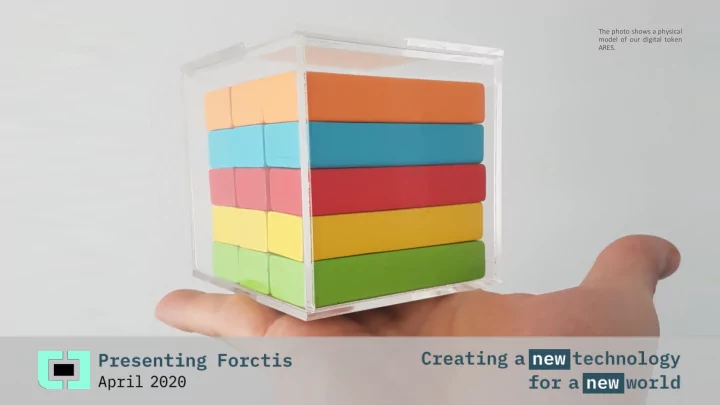
The photo shows a physical model of our digital token ARES.
The photo shows a physical model of our digital token ARES. Its - - PowerPoint PPT Presentation
The photo shows a physical model of our digital token ARES. Its about how we will transform asset management into something as convenient and engaging as online shopping or social media. By building a unique ecosystem for the
The photo shows a physical model of our digital token ARES.
It’s about how we will transform asset management into something as convenient and engaging as online shopping or social media.
By building a unique ecosystem for the tokenization of any asset class
Banking on a USD 5 trillion market potential by 2024
a
See the notes section at the end of this presentation for a list of information sources; the adoption path in the graph above shows our model-based projection based on data from those sources. Abbreviations used in the graph: WEF – World Economic Forum; TMR – Transparency Market Research; MM – Markets and
the IMF and World Bank. Please note the different estimates in this graph might be based on definitions of tokenization not strictly comparable but broadly in agreement.
This is not an illusion, but change in the making. Our aim is to be at the forefront of this incipient change.
Inside Magazine Deloitte
November 2018 (Nr. 19, Part 2)
Organization for Economic Cooperation and Development (OECD)
January 2020
https://www.bis.org/speeches/sp200417.htm
Trillion
Trillion Of which we estimate that to be stock of investible assetsb worldwide By the year 2024 we project will be owned by U-HNWI
c
Plus an estimated $70 trillion in financial wealth moving between cohorts (from the Silent Generation and early Baby Boomers to heirs) within the next 15-20 yearsd
In an environment subject to marked attitudinal shifts
Compared to
Generation and early Baby Boomers (adults now ≥60y/o)
that today are keen to manage their wealth directly
About Holding
late Baby Boom cohorts (adults now <60y/o)
net wealth
are active users of platforms or tools enabling them immediate control
(usually without human intermediation)
We are a young technology company that works at the leading edge of science to help people and businesses thrive. Creating new solutions for a new world.
A group of experienced entrepreneurs, technologists and leading academics who have a vision and the drive to transform it into something real.
We are creating a platform supported by leading-edge research, yet not conceived by solely searching within the walls of a laboratory. Our team has its feet solidly anchored to the everyday world, and our focus is to
We start from a different place.
masterclass in computational models and data mining as part
Those digital instruments are known as tokens. They are a thing “serving as a visible or tangible representation of a fact, event, object, feeling, etc.” (Oxford English Dictionary, 2009 edition) We further define as “tokenplaces” those markets where digital tokens are transacted.
Tokenization is simply the representation, deconstruction or creation of property or contractual rights into fungible or non-fungible instruments on a digital platform.
1
Representation
2
Deconstruction
3
Creation
Liquidity as a Service
(liquidity provision)
We are the first to create a new digital token and protocol to deliver a truly integrated, multi-asset ecosystem.
▪ The Silent Generation and Baby Boomers. ▪ Highest wealth per capita. ▪ Since the 2008 financial crisis, showing more openness towards creative approaches to asset management. ▪ Considering non-traditional mechanisms for sweating their high-value assets. ▪ Vigorously searching for higher yields or looking for
Comprising late Gen-X and most of the Millenial generations.
▪ Typically identified as the digitally native cohorts. ▪ Compared to the older generations, they tend to display a different attitude to asset ownership. ▪ The 2008 crisis grew in them a distrust (even a despise)
▪ They actively search for alternative investment options. ▪ Particularly those facilitated by technology.
The present The future
By building partnerships with leading luxury and iconic brands, financial industry players, realtors and other global servicers to our target groupse
Our planning to 2022
What we bring to the table in asset tokenization
Helping businesses and individuals squeeze the highest possible liquidity and yield from owned assets. Opening doors to new investment opportunities for everyone.
Additional notes to this presentation
d Own estimates at 2020 prices based on information from multiple sources, amongst them: Credit Suisse Global Wealth Report 2019; WEF Technology Tipping Points and
Societal Impact Report 2015; ECB Household Finance and Consumption Survey (Wave 2, 2017); B. Hammer (2015), The Ownership of Assets and the Role of Age: Age-Specific Household Balance Sheets for Euro Area Countries, AGENTA WP 8/2015; Hemmons, Hernandez Kent and Ricketts (2018), The Demographics of Wealth, 2018 Series, Federal Reserve Bank of St. Louis; The Peter G. Peterson Foundation; Cerulli Associates (2019), The Neglected Generation; EY 2018 Global Alternative Fund Survey; Lele and Shim (2019), NextWave Consumer Financial Services: financial subscriptions are coming, EY research; Accenture (2012), The “Greater” Wealth Transfer: Capitalizing on the Intergenerational Shift in Wealth; L. Batchelder (2020), Leveling the Playing Field between Inherited Income and Income from Work through an Inheritance Tax, The Hamilton Project, Brookings Institution, Appendix Table 1; PWC (2014), Asset Management 2020: A Brave New World; WSJ Wealth Management Report 2015; US Labor Bureau, US Census Bureau, UK FCA, Federal Reserve Board Survey of Current Finances, OECD, IMF, ECB and World Bank datasets. Given the multiple sources of data (and many data gaps) together with conflicting evidence it is quite difficult to provide a precise estimate; our simulations suggest that wealth transfers between cohorts over the next 15 to 20 years would be in the range of $53 trillion to $80 trillion globally, valued at 2020 prices.
c See Credit Suisse Global Wealth Report 2019; Capgemini World Wealth Report 2019; Oliver Wyman PFA Report and Future of Private Banking reports; Boston ConsultingGroup Global Wealth 2019; Knight Frank (2019 and 2020) Wealth Report; Finoa (2019), The Era of Tokenization; CISCO Blockchain Whitepaper (2019), Build trust-based business networks for digital transformation; OECD, IMF and World Bank datasets. Our projection is preliminary and subject to change. Baseline yearly data for 2019 reflects the 12 months to Jun 2019.
e According to Quintessentially, one of the leading worldwide luxury lifestyle groups (see https://bit.ly/383kizQ) Millenials and younger cohorts are expected to capture40% of luxury market in the next five years, in an environment where 80% of luxury purchases will be influenced by digital. In Quintessentially (UK) Limited (2018), Group Strategic Report for the Year Ended 30 April 2018, pag. 2 (Business Environment).
b Own estimates based on information from Credit Suisse Global Wealth Report 2019; Capgemini World Wealth Report 2019; Boston Consulting Group Global Wealth 2019;Knight Frank (2019 and 2020) Wealth Report; Wealth-X (2019), High Net Worth Handbook 2019; IMF and World Bank datasets. Baseline value set at $69 trillion in 2019, CAGR estimated at 5.7% between 2019 and 2024.
a 60% originating from personal financial wealth and the remaining 40% from non-financial wealth (investible dwellings/REITs plus alternative investments). Forecasted
CAGR of 5.47% between 2019 and 2024.