
1/15/2020 1
Monte Carlo Simulation II
Anders Ringgaard Kristensen and Dan Børge Jensen
Department of Veterinary and Animal Sciences
Outline
- 1. Summary of Monday’s lecture
- 2. The SimFlock model
- User interface
- State variables
- Decision variables
State of nature
- Hyper distribution
- Output variables
- 3. Use of the simulation model
- Running simulation jobs
- Results and interpretation
- 4. Simulation as a decision support tool
Department of Veterinary and Animal Sciences Advanced Quantitative Methods in Herd Management Slide 2
Summary from Monday
Simulation models, two (main) types:
- 1. Deterministic: no randomness – same input, same output
- 2. Stochastic: random sampling – same input, different output
- 1. Random sampling is done using random number
generation with an appropriate distribution function State-of-nature:
- (Basically) a collection of all the information that describes
the system, you are trying to model Uncertainty of the state-of-nature:
- Each parameter of the s.o.n is specified through a
distribution instead of a value.
- Such a distribution is called a hyper distribution.
- The parameters of a hyper distribution are called hyper
parameters. The SimBatch model
- A simulation model implemented in R
- Fairly straight forward – you could make one yourself!
Department of Veterinary and Animal Sciences
The SimFlock Model
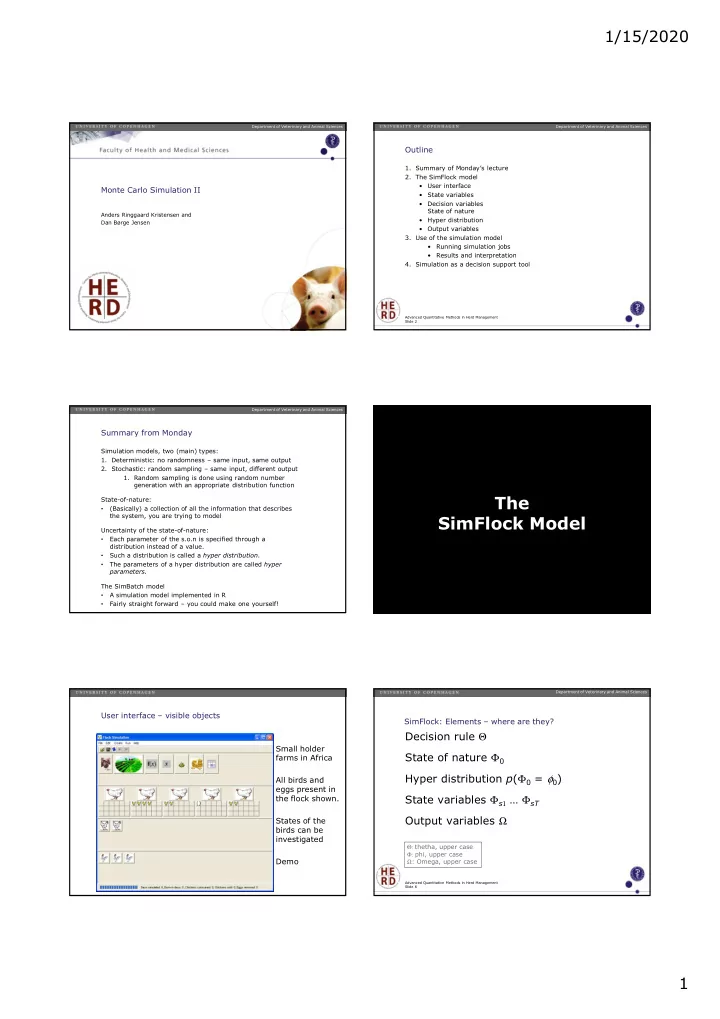
User interface – visible objects Small holder farms in Africa All birds and eggs present in the flock shown. States of the birds can be investigated Demo SimFlock: Elements – where are they?
Decision rule Θ State of nature Φ0 Hyper distribution p(Φ0 = φ0) State variables Φs1 … ΦsT Output variables Ω
Advanced Quantitative Methods in Herd Management Department of Veterinary and Animal Sciences Slide 6
Θ: thetha, upper case Φ: phi, upper case Ω: Omega, upper case