The First, a Marine comes to the attention of Medical because they - - PDF document

the
SMART_READER_LITE
LIVE PREVIEW

The First, a Marine comes to the attention of Medical because they - - PDF document

9/25/2012 The Process The First, a Marine comes to the attention of Medical because they Integrated Disability sustain a combat injury, Evaluation System Evaluation System are a training casualty, are a training casualty (IDES)


slide-1
SLIDE 1

9/25/2012 1

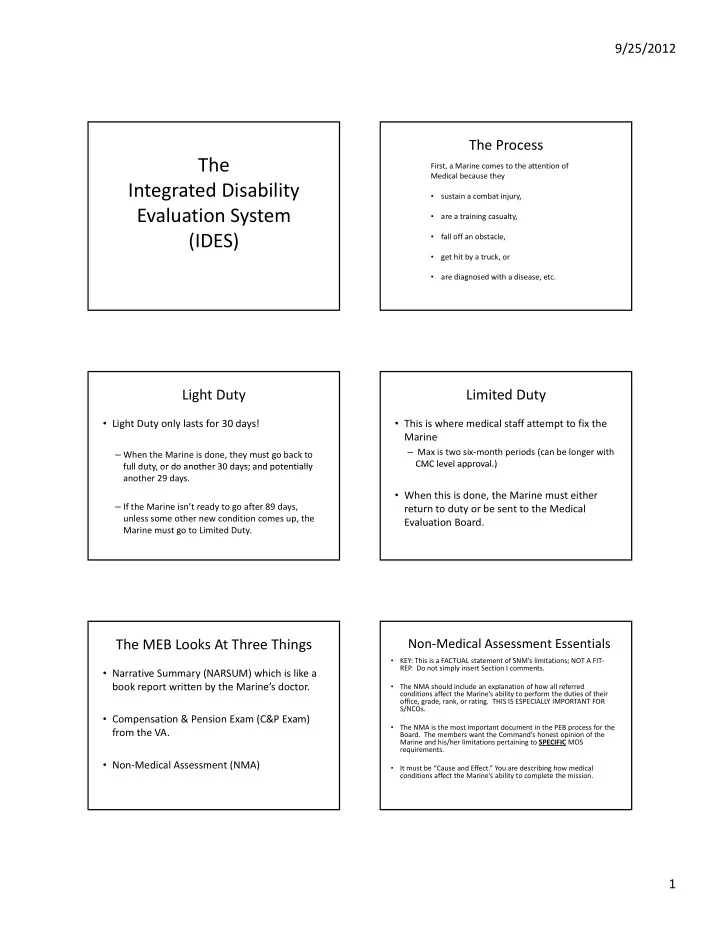
The Integrated Disability Evaluation System Evaluation System (IDES)

The Process

First, a Marine comes to the attention of Medical because they

  • sustain a combat injury,
  • are a training casualty
  • are a training casualty,
  • fall off an obstacle,
  • get hit by a truck, or
  • are diagnosed with a disease, etc.

Light Duty

  • Light Duty only lasts for 30 days!

– When the Marine is done, they must go back to full duty or do another 30 days; and potentially full duty, or do another 30 days; and potentially another 29 days. – If the Marine isn’t ready to go after 89 days, unless some other new condition comes up, the Marine must go to Limited Duty.

Limited Duty

  • This is where medical staff attempt to fix the

Marine

– Max is two six‐month periods (can be longer with CMC level approval.) CMC level approval.)

  • When this is done, the Marine must either

return to duty or be sent to the Medical Evaluation Board.

The MEB Looks At Three Things

  • Narrative Summary (NARSUM) which is like a

book report written by the Marine’s doctor. C i & i (C& )

  • Compensation & Pension Exam (C&P Exam)

from the VA.

  • Non‐Medical Assessment (NMA)

Non‐Medical Assessment Essentials

  • KEY: This is a FACTUAL statement of SNM’s limitations; NOT A FIT‐
  • REP. Do not simply insert Section I comments.
  • The NMA should include an explanation of how all referred

conditions affect the Marine’s ability to perform the duties of their

  • ffice, grade, rank, or rating. THIS IS ESPECIALLY IMPORTANT FOR

S/NCOs.

  • The NMA is the most important document in the PEB process for the
  • Board. The members want the Command’s honest opinion of the

Marine and his/her limitations pertaining to SPECIFIC MOS requirements.

  • It must be “Cause and Effect.” You are describing how medical

conditions affect the Marine’s ability to complete the mission.

slide-2
SLIDE 2

9/25/2012 2

NMA Cont’

  • “Due to his (insert medical condition), the Marine can’t run, hump,

do MCMAP, or carry combat loads due to the strain on SNM’s (insert body part).”

  • “Due to his (insert medical condition), the Marine can’t
  • concentrate. I have observed this on several occasions; the most

recent being . . . .”

  • NOT: “Because of the Marine’s physical and mental limitations,

they should be separated from the service and retired with benefits.”

  • NOT: “SNM is a belligerent know‐it‐all who has a problem with
  • authority. It is beyond this Command how SNM ever achieved the

rank of (insert rank).”

IMR Unfavorable Ankylosis of the Cervical Spine?

  • If the Marine doesn’t understand what the

Medical Board Report says, why in the world would they sign it?

  • Request Independent Medical Review (IMR.)
  • A doctor (usually the PCM) will explain what it

says, in plain language.

Rebuttal

  • After the MEB counselor shows the Marine the

final PEB package to be mailed, the Marine then has 5 calendar days to write a rebuttal to the MEBR on any topic they feel is incorrect. y p y

  • A rebuttal WILL add time to the PEB package, it’s

true, but NOTHING like as much time as an appeal to a Formal Physical Evaluation Board will add.

The MEB

  • Two or three doctors‐ they give a thumbs up,

thumbs down, answering the following question: “DOES THE CONDITION APPEAR TO UNREASONABLY “DOES THE CONDITION APPEAR TO UNREASONABLY INTERFERE WITH THE MARINE’S ABILITY TO PERFORM THE DUTIES AND RESPONSIBILITIES OF THEIR OFFICE, GRADE, RANK, OR RATING?” (or: Is the Marine Non‐Mission Capable?)

The Informal Physical Evaluation Board Evaluation Board (IPEB)

Informal Physical Evaluation Board (IPEB)

  • The Marine’s package gets reviewed by three

people, generally they are O6s.

  • If the Marine is a Reservist, there must be at least

,

  • ne Reservist on the board.
  • If the member is a Marine, there “should

normally” have at least one Marine on the board; having Marine representation is not mandatory.

slide-3
SLIDE 3

9/25/2012 3

IPEB (cont’d)

  • It’s nothing more than a document review.
  • They look at the package, read what’s in it, and

then make a decision.

  • They can only come out with three decisions:

Unfit, Fit, or PFIT

UNFIT

Unfit has nothing to do with the Marine’s ideal body weight, it means the PEB thinks the Marine is “Not Mission Capable.”

Fit

  • This doesn’t mean the Marine can do their current job, it

means they can do “some” job within the Marine Corps that is appropriate to their Office, Grade, Rank, or Rating.

PFIT

PFIT means “PRESUMED Fit.” It doesn’t mean “Fit,” it really means that the IPEB never even looked at the file because the Marine is too looked at the file, because the Marine is too senior, already submitted for retirement, or some other reasons. It’s only a PRESUMPTION, which is a GUESS.

Accept, Reconsider, or Appeal

  • Accept, if the Marine received favorable findings.
  • Reconsider, if the Marine is ok with the fit/unfit,

but not the percentage from the VA. (the Marine p g ( can ONLY reconsider “unfit” conditions while still

  • n active duty. Once they’re out, they can have

ALL of them looked at by VA.)

  • Appeal, if the Marine have other unfit conditions.

Formal Physical Evaluation Board (FPEB)

  • Marine has orders to the Washington Navy

Yard, where they will meet with their FPEB attorney.

  • The two will take all of the new evidence the

Marine managed to assemble (letters, doctors notes, new diagnoses, etc) and will duke it out with the PEB.

  • Once finished, the PEB will issue new findings

(although they don’t have to change them).

slide-4
SLIDE 4

9/25/2012 4

SECNAVINST 1850.4e 3403 (a) Disciplinary Or Misconduct Administrative Action

  • Whenever a member is being processed through

the PEB and, subsequently the member is processed for an administrative involuntary separation for misconduct, disciplinary proceedings which could result in a punitive p g p discharge, or an unsuspended punitive discharge is pending, or is pending separation under provisions that authorize a characterization of service of Under Other Than Honorable conditions (OTH), disability evaluation shall be suspended and monitored by the PEB.

3403(a) Disciplinary Or Misconduct Administrative Action Cont’

  • The PEB case will remain in suspense pending

the outcome of the non‐disability proceedings.

  • If the result taken does not include punitive or

p administrative discharge for misconduct, the PEB will continue to process the case.

  • If the result includes either a punitive or

administrative discharge for misconduct, the PEB will be suspended indefinitely.

3403 (b)

Do not submit a case to the PEB for a member who is currently being processed for misconduct which could result in a punitive discharge as the result of a captain’s mast or discharge as the result of a captain s mast or courts‐martial or for a member who is pending an administrative discharge due to misconduct.

References

  • TITLE 10, UNITED STATES CODE
  • DOD Inst 1332.18 (38, 39) ‐ DoD DES
  • SECNAVINST 1850.4_ ‐ Disability Evaluation

M l D l d f I Manual ‐ Download from Internet at http://neds.nebt.daps.mil

  • NAVMED P‐117 (ManMed) – Art. 15, 16 & 18
  • Directive‐Type Memorandum (DTM) 11‐015