SLIDE 1
SLIDE 2
“The paradigm of a totality”
Kaarle Nordenstreng in Cees Hamelink (ed.), Communication in the Eighties: A Reader on the MacBride Report. Rome: IDOC, 1980 Critical essays on the Report by IAMCR scholars including Alfred Opubor, Tamás Szecskö and Herbert Schiller, right after the MacBride Report was published, put together during the IAMCR conference in Caracas in July 1980 Reprinted in Mass Comunication Review Yearbook Vol 3, 1982 (Beverly Hills: Sage)
SLIDE 3 My points in 1980
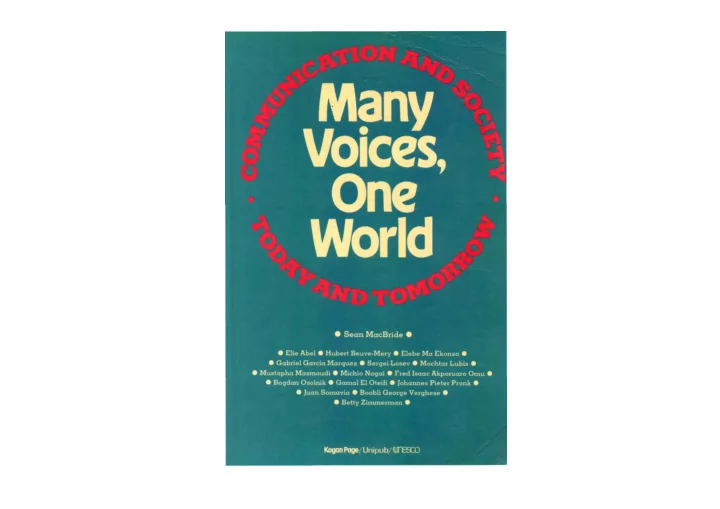
“Many voices, one world. Communication and society, today and tomorrow” – what is provided
- n (1) world, (2) society and (3) communication?
- The “one world” shallow while the approach is
- ahistorical
- eclectic and incoherent
- media-centred
- The “society” and “communication” follow
- bourgeois liberalism
- functionalist-positivist paradigm
SLIDE 4 History of communications
Unless we embrance what might be called “real world history”, we are left with the history of communications in isolation from fundamental social and global developments Such a picture of communication history is not
- nly incomplete: it amounts to a crucial choice of
methodology carrying with it a particular concept
- f communication, a paradigm where
communication is understood as a phenomenon related to a number of other social phenomena but not organically linked with them
SLIDE 5 “One world”
The Report does not contain any coherent picture
- f the world – neither the world of today not of
tomorrow, or for that matter the world of yesterday That is why a demand or a programme toward a “new order”, whatever attributes are attached to it, remains also a fairly empty slogan with more political connotations than theoretical insight
SLIDE 6
Society and communication
No adequate definition provided, no proper elements for description of these two central concepts The paradigm is not far from the mainstream of bourgeois liberalism (ahistorical and abstract notion of society, value pluralism, etc.) The model of communication is exchange with many connections to othe social phenomena but without really organic links with them Moreover the paradigm eliminates human consciousness in the communication process
SLIDE 7
Conclusion in 1980
The report is an excellent illustration of the dilemma of eclecticism: you try to be comprehensive but you loose the totality which you are supposed to discover In this respect the Report could well be called “Mission impossible”.
SLIDE 8
My points in 33 years later
Exactly the same! Even more serious given the field’s expansion Self-criticism of not following up that uncompromised line