The OSI Layers Surasak Sanguanpong nguan@ku.ac.th - - PDF document

the osi layers
SMART_READER_LITE
LIVE PREVIEW

The OSI Layers Surasak Sanguanpong nguan@ku.ac.th - - PDF document

1/9 The OSI Layers Surasak Sanguanpong nguan@ku.ac.th http://www.cpe.ku.ac.th/~nguan Last updated: 27 June 2002 Applied Network Research Group Department of Computer Engineering, Kasetsart University 2/9 OSI


slide-1
SLIDE 1

Applied Network Research Group Department of Computer Engineering, Kasetsart University 1/9

The OSI Layers

Surasak Sanguanpong nguan@ku.ac.th http://www.cpe.ku.ac.th/~nguan

Last updated: 27 June 2002 Applied Network Research Group Department of Computer Engineering, Kasetsart University 2/9

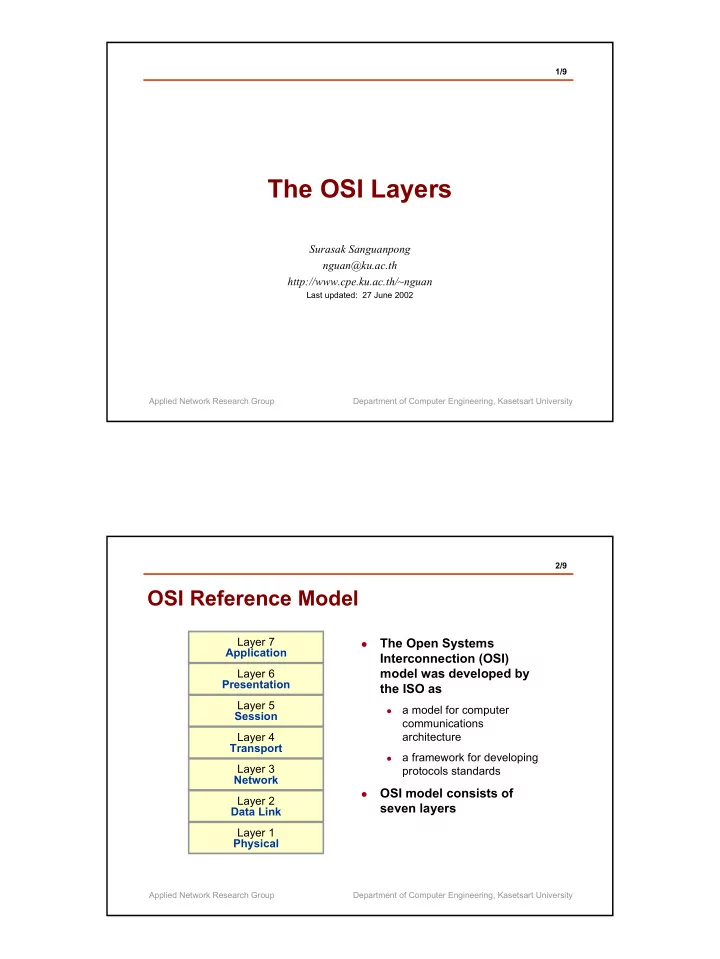
OSI Reference Model

Layer 1 Physical Layer 2 Data Link Layer 3 Network Layer 4 Transport Layer 5 Session Layer 6 Presentation Layer 7 Application

  • The Open Systems

Interconnection (OSI) model was developed by the ISO as

  • a model for computer

communications architecture

  • a framework for developing

protocols standards

  • OSI model consists of

seven layers

slide-2
SLIDE 2

Applied Network Research Group Department of Computer Engineering, Kasetsart University 3/9

Layering

Layer 1 Physical Layer 2 Data Link Layer 3 Network Layer 4 Transport Layer 5 Session Layer 6 Presentation Layer 7 Application User-oriented functions Communications functions

Packet Frame Bit

Application Programs

Applied Network Research Group Department of Computer Engineering, Kasetsart University 4/9

Why Seven Layers?

Both end-to-end and hop-by-hop actions are required Transport layer handles end-to-end functions such as flow control Network layer handles routing in hop-by hop fashion

Applications Physical Applications Datalink Physical Applications Transport Network Datalink Physical

Need at least Physical and Application layers Datalink concerns all the link independent details for different link technology

Applications Presentation Network Datalink Physical Session Transport

Separate some application functions to Presentation and Session Layers

slide-3
SLIDE 3

Applied Network Research Group Department of Computer Engineering, Kasetsart University 5/9

Service Access Point (SAP)

  • Each layer has its own

functionality

  • When a layer needs

functionality of another layer, it must issue a request.

  • At each layer boundary,

there is at least one point

  • f services called SAP

Layer N Layer N-1

Service #1 Service #2 Service #3 Service #M

Layer Boundary

= Service Access Point

Applied Network Research Group Department of Computer Engineering, Kasetsart University 6/9

Virtual Communications

Session protocol Network Access Protocol Application protocol

Applications Presentation Network Datalink Physical Session Transport Applications Presentation Network Datalink Physical Session Transport

Physical Media

Presentation protocol Transport protocol Datalink protocol Physical protocol

slide-4
SLIDE 4

Applied Network Research Group Department of Computer Engineering, Kasetsart University 7/9

Protocol Data Unit

Data Data AH

Applications Presentation Session Transport Network Datalink Physical

Data AH PH Data AH PH SH Data AH PH SH TH Data AH PH SH TH NH Data AH PH SH TH NH DH DT

Application PDU Presentation PDU Session PDU Transport PDU Network PDU Datalink PDU

protocol data unit (PDU) = combination of data from the next higher and control information Additional of control information to data is referred to encapsulation

Encapsulation

Data AH PH SH TH NH DH DT Applied Network Research Group Department of Computer Engineering, Kasetsart University 8/9

Decapsulation

Data Data AH

Applications Presentation Session Transport Network Datalink Physical

Data AH PH Data AH PH SH Data AH PH SH TH Data AH PH SH TH NH Data AH PH SH TH NH DH DT

In each layer, corresponding header/trailer has been removed

Data AH PH SH TH NH DH DT

Decapsulation

slide-5
SLIDE 5

Applied Network Research Group Department of Computer Engineering, Kasetsart University 9/9

OSI and TCP/IP

TCP/IP OSI

Application Application Presentation Presentation Session Session Transport Transport Network Network Data Link Data Link Physical Physical Application Application Transport Transport Internet Internet Network Access Network Access Physical Physical