The Opti Community Regulatory Approvals Initial research by NOAA, - - PDF document

the opti community
SMART_READER_LITE
LIVE PREVIEW

The Opti Community Regulatory Approvals Initial research by NOAA, - - PDF document

7/27/2017 ADDRESSING STORMWATER GOALS WITH CONTINUOUS MONITORING AND ADAPTIVE CONTROL WEF eShowcase July 27, 2017 Marcus Quigley - OptiRTC, Inc. The Opti Community Regulatory Approvals Initial research by NOAA, EPA, WERF in 2007 Full


slide-1
SLIDE 1

7/27/2017 1

ADDRESSING STORMWATER GOALS WITH CONTINUOUS MONITORING AND ADAPTIVE CONTROL

WEF eShowcase July 27, 2017

Marcus Quigley - OptiRTC, Inc.

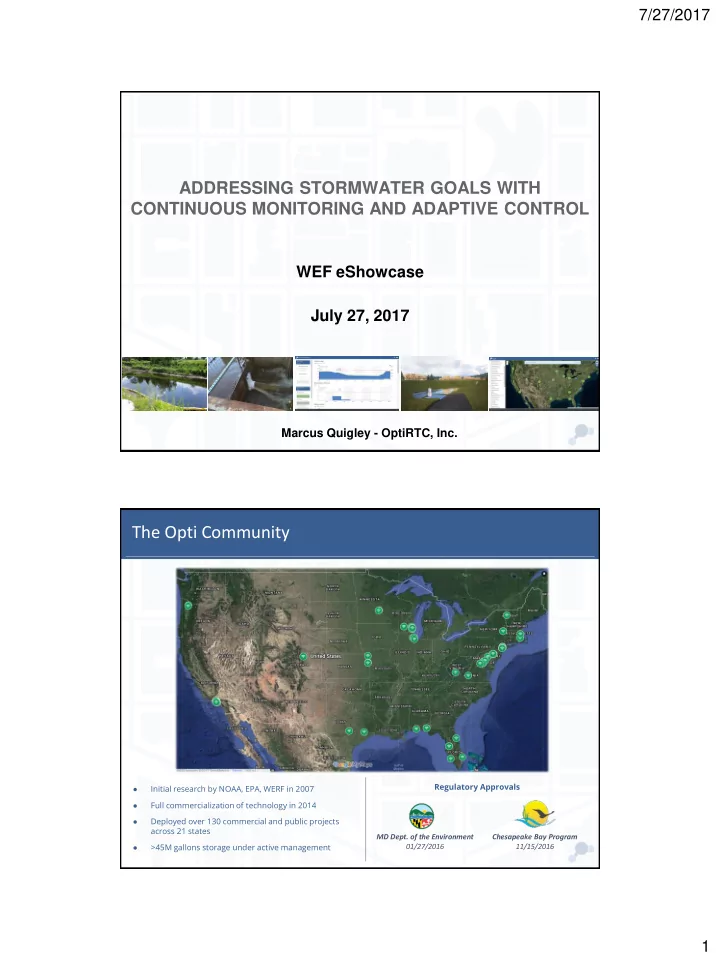
  • Initial research by NOAA, EPA, WERF in 2007
  • Full commercialization of technology in 2014
  • Deployed over 130 commercial and public projects

across 21 states

  • >45M gallons storage under active management

The Opti Community

Regulatory Approvals Chesapeake Bay Program 11/15/2016 MD Dept. of the Environment 01/27/2016

slide-2
SLIDE 2

7/27/2017 2

Typical Urban Stormwater Challenges

  • Sediment
  • Nutrients
  • Trash/Debris

Water Quality

  • Economic Impact
  • Social Impact
  • Environmental Impact

Flooding

  • 40 million people in 32

states

  • 850 Billion gallons of

untreated sewage Combined Sewer Overflows

Opportunities to enhance traditional approaches

Compliance Risk and Reporting

slide-3
SLIDE 3

7/27/2017 3

Continuous Monitoring and Adaptive Control (CMAC)

5

stormwater infrastructure runoff infiltration control panel actuated valve

  • utlet or pump

water level sensor web-based dashboard NWS forecast Opti cloud software

Adaptive use of storage - improved water quality and flood control

Institution of Civil Engineers

Field View of Hardware Components

ACTUATED VALVE OPTI CONTROL PANEL WATER LEVEL SENSOR

slide-4
SLIDE 4

7/27/2017 4

Range of CMAC applications

Large Small Medium

Scale Residential (gallons) Application Water Reuse Scale Development (cubic feet) Application Water Quality Application Flood Control Scale Regional (acre feet)

Case Study: Philadelphia CSO mitigation on private property

8-acre drainage area Adaptively Controlled Retention

slide-5
SLIDE 5

7/27/2017 5

SMIP CMAC retrofit at Cintas Corporation

Project Timeline (award to run) 6 months Incremental Benefit 3.3 Green Acres Capital Cost $48,000/GA Net Savings for Cintas ~$17,000/yr

Integrated CMAC

CMAC performance analysis

Observed pond volume and flows with Opti system control Modeled pond volume and flows with passive outlet control

  • CMAC system exceeded PWD’s criteria for wet weather site discharge by

completely avoiding wet weather outflow for nearly all rain events.

  • In total, during a period with approximately 1.01 million gallons of runoff

generated from 14 storm events, the system prevented 0.97 million gallons

  • f water from entering the combined sewer during wet weather.

Integrated CMAC

slide-6
SLIDE 6

7/27/2017 6

A closer look at flow

Observed flows with Opti system control Modeled flows with passive outlet control

CMAC resulted in a 96% reduction in wet weather flow volume (1.01M gallons of runoff to 40K gallons)

Integrated CMAC

Case Study: Ormond Beach, FL Flood protection

slide-7
SLIDE 7

7/27/2017 7

2009 flood, a historic storm event in Ormond Beach

Integrated CMAC

Laurel Creek Basin project background

550-acre drainage basin 5 existing lakes (low lying area) Single family developments Existing pumps at Lake 1

Integrated CMAC

slide-8
SLIDE 8

7/27/2017 8

Responding to the floods in Ormond Beach

Phase 1: $3.4M

Lake Interconnections

Bridge: $200K

Pump Station Upgrade (Mar. 2017)

Phase 2: $8M

Increased Pump Capacity Why

  • Reduce localized flooding

Why

  • Address uncertainty of

Phase 2 Why

  • Eliminate localized flooding

What

  • Interconnection of 5 Lakes
  • Downstream sluice gates for

tide control (bypass pumping) What

  • Forecast-based control
  • Variable Frequency Drive
  • Generator

What

  • Additional pump stations

with discharge to intercoastal waterway Additional Benefits

  • Aesthetic and recreational

Additional Benefits

  • Asset management and

maintenance inspections

  • Decision support
  • Insurance policy

Additional Benefits

  • Reduction of 100-year flood

stage

Integrated CMAC

Ormond Beach web-based dashboard

Integrated CMAC

slide-9
SLIDE 9

7/27/2017 9

Case Study: Lenexa, KS water quality + flood protection Adaptively Controlled Retention

CMAC in Lenexa, KS

Coon Creek North Coon Creek South Coon Creek East City Center Goal: Water quality improvement while increasing flood control capacity Construction: Retrofit existing outlet structures (City of Lenexa performed retrofit) Integrated CMAC

slide-10
SLIDE 10

7/27/2017 10

CMAC in Lenexa, KS

Integrated CMAC

CMAC Simplified Logic

  • Coon Creek Ponds – Release Before Forecasted Storm
  • Coon Creek North and South – Adjust release timing

and watershed area to maximize benefit of facilities in the same watershed

  • City Center – Allow storm to fill pond above permanent

pool, release after retention period

Integrated CMAC

slide-11
SLIDE 11

7/27/2017 11

CMAC Preliminary Storms

Coon Creek East – December 17 City Center – January 15

Integrated CMAC

CMAC Preliminary Storms

Coon Creek North – January 15 Coon Creek South – January 15

Integrated CMAC

slide-12
SLIDE 12

7/27/2017 12

Case Study: Montgomery County, MD peak flow reduction + water quality 15 ac-ft Adaptively Controlled Detention/Retention

University Blvd. Wet Pond

  • Anacostia River Watershed
  • 15 ac-ft wet pond
  • 440 acre drainage; 36% imp.
  • In line on Sligo Creek
  • Retrofit November 2015

Integrated CMAC

slide-13
SLIDE 13

7/27/2017 13

University Blvd. Wet Pond – Hardware

Integrated CMAC

University Blvd. Wet Pond – Web Dashboard

Integrated CMAC

slide-14
SLIDE 14

7/27/2017 14

University Blvd. Wet Pond – Hydraulic Monitoring

Integrated CMAC

University Blvd. Wet Pond – DRAFT Pollutant Removal

Storm Size Nitrogen Percent Removal CMAC MDE Wet Pond* 0.30 28% 20% 0.32 42% 21% 0.52 48% 26% 0.79 68% 30% 1.32 47% 36%

*Credits given for water quality volumes in Accounting for Stormwater Wasteload Allocations and Impervious Acres Treated, MDE,2014

Storm Size TSS Percent Removal CMAC MDE Wet Pond* 0.30 53% 40% 0.32 71% 41% 0.52 88% 53% 0.79 77% 61% 1.32 86% 72%

Integrated CMAC

slide-15
SLIDE 15

7/27/2017 15

Case Study: Washington County, OR flow-duration control + peak control + water quality 2M Gallons Adaptively Controlled Detention/Retention

Flow control and hydrograph matching Based on continually updated precipitation forecasts, automated valve controls discharge to achieve flow-duration goals

Control Panel Actuated Valve in Flow Control Vault Washington County, Oregon

6 ac-ft pond for flood and channel erosion protection

Integrated CMAC

slide-16
SLIDE 16

7/27/2017 16

CMAC performance

Integrated CMAC

Flow-duration control results

Highlights

  • 60% reduction in wet weather volume
  • 70% reduction in volume within erosive flow range
  • Increase in residence time from 1 to 19 hours
  • 30% lower peak flow in large events
  • Ability to adjust control parameters to target

alternative goals

Integrated CMAC

slide-17
SLIDE 17

7/27/2017 17

Case Study: Curtiss Pond Capitol Region Watershed District, MN flood control retrofit Adaptively Controlled Retention

Adaptive Control of Existing Storage for Flood Reduction

Integrated CMAC

slide-18
SLIDE 18

7/27/2017 18

How CMAC operates for Curtiss Pond

Integrated CMAC

Case Study: NYCDEP GI-RD Continuous Monitoring

slide-19
SLIDE 19

7/27/2017 19

Institution of Civil Engineers

Project Description

The data collected as part of the GI-RD project is being stored and managed using the Opti platform.

Environmental data storage on the Opti Platform Advanced data visualization Secure data validation

Continuous Monitoring

Institution of Civil Engineers

Project Results

Continuous Monitoring

slide-20
SLIDE 20

7/27/2017 20

Case Study: Chicago Smart Green Infrastructure Monitoring

2007-2011 flooding in Chicago: $773M in property damage

40

Source: Center for Neighborhood Technology

Continuous Monitoring

slide-21
SLIDE 21

7/27/2017 21

Pilot at UILabs’ bioswale

Continuous Monitoring

Opti monitoring platform

Continuous Monitoring

slide-22
SLIDE 22

7/27/2017 22

Opti monitoring platform (continued)

Continuous Monitoring

Case Study: Milwaukee, WI Rain:NET Green Infrastructure Monitoring

slide-23
SLIDE 23

7/27/2017 23

Rain:NET - Collaborative Program in Milwaukee

Project: Performance, Operation & Maintenance of Green Infrastructure (POMGI) Goals of the Project

  • Investigate real-time monitoring strategies for Performance

monitoring and O&M support

  • Explore techniques that are scalable at relatively low-cost

Functionalities

  • Evaluate performance
  • Display the data in real-time
  • Automatically alert operators when equipment maintenance

is needed

10 Sites monitored

  • 4 Green Roofs
  • 5 Biofiltration Sites
  • 1 Cistern

Continuous Monitoring

Questions & contact

Marcus Quigley, D.WRE, P.E.

Chief Executive Officer

mquigley@optirtc.com Philadelphia Water Department City of Ormond Beach Johnson County Stormwater City of Lenexa, KS National Fish and Wildlife Foundation Metro Washington Council of Governments Montgomery County, MD Clean Water Services Capitol Region Watershed District NYC DEP City of Chicago Milwaukee Metropolitan Sewerage District ACKNOWLEDGEMENTS