The only thing constant in life is change. 2 Self Preservation - - PDF document

the only thing constant in life is change
SMART_READER_LITE
LIVE PREVIEW

The only thing constant in life is change. 2 Self Preservation - - PDF document

11/24/2020 Mentally Preparing for Lifes Transitions AKA: The Psychology of Transition Presented by: Robynn Moraites Executive Director NC Lawyer Assistance Program 1 It has become clich The only thing constant in life is


slide-1
SLIDE 1

11/24/2020 1

Mentally Preparing for Life’s Transitions

AKA: The Psychology of Transition

Presented by: Robynn Moraites Executive Director NC Lawyer Assistance Program

It has become cliché

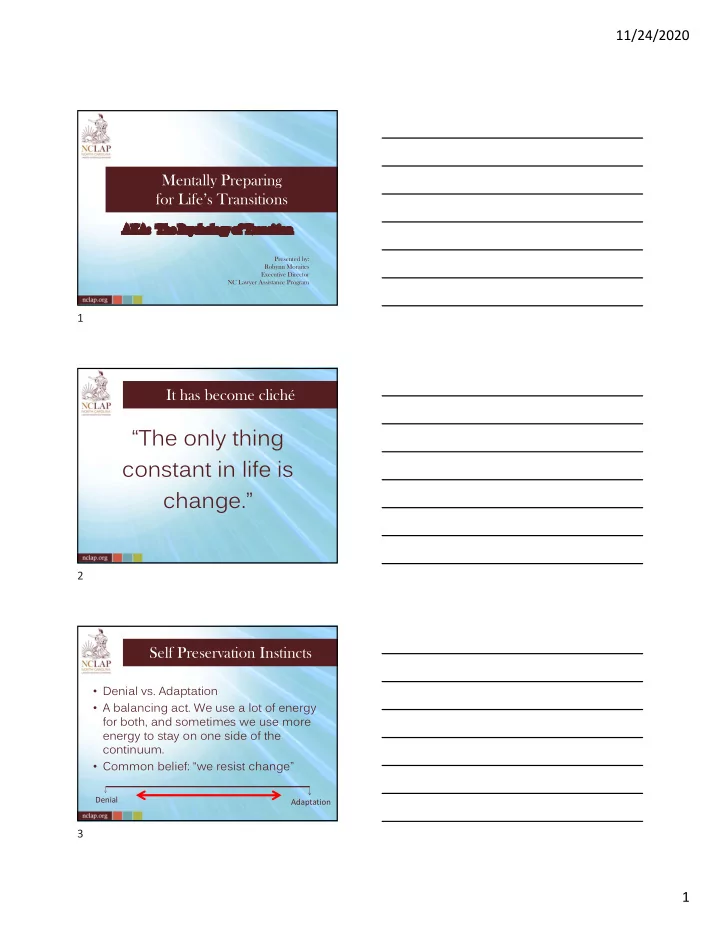
“The only thing constant in life is change.”

Self Preservation Instincts

  • Denial vs. Adaptation
  • A balancing act. We use a lot of energy

for both, and sometimes we use more energy to stay on one side of the continuum.

  • Common belief: “we resist change”

Denial Adaptation

1 2 3

slide-2
SLIDE 2

11/24/2020 2

Definition of Change:

  • to make the form, nature, content, future

course, etc., of (something) different from what it is (or from what it would be if left alone)

  • to transform or convert

Transition on the other hand…

  • Letting go of that piece of ourselves that

we have to give up when and because the situation has changed.

  • William Bridges – The Way of Transition
  • This is actually what we resist because

it is so deeply significant and personal.

Psychological Stages of Change

4 5 6

slide-3
SLIDE 3

11/24/2020 3

Stage 1 – Precontemplation

  • “Not ready” or avoidance - The change is

not on the person’s radar screen yet.

– Not speaking circumstantially here, we’re speaking psychologically

  • If approached about a possible change,

the person will typically (unconsciously) underestimate the pros and overestimate the cons with little to no actual information

Stage 2 – Contemplation

  • “Getting Ready” or overcoming

ambivalence

  • On the radar screen, starting to gather

information

  • Pros and cons are about equal as they

are weighed

  • Ambivalence can lead to long delays of

months or years before taking action

Stage 3 – Preparation

  • “Ready”
  • Begin with small steps
  • Support from friends, family and

colleagues is key

  • Biggest concerns are usually if they

take this action, will there be the payoff expected? Will it work out as hoped? What will happen?

7 8 9

slide-4
SLIDE 4

11/24/2020 4

Stage 4 – Action

  • “All in”
  • Change is made, new behavior

underway

  • This can be a very motivated time, new

experiences, new ways of reacting or interacting…often excitement of a new chapter

Stage 5 – Maintenance

  • “New Way of Life”
  • Change is well established
  • Old ways seem distant
  • One may even question, “Why did it

take me so long to come to this decision (action) (change)?”

If only it were that simple…

  • There are several compounding factors

that influence a person’s readiness to change and to progress through the 5 stages of change.

  • These factors are the three largest

factors for our talk today and yet remain mostly, if not completely, unacknowledged

10 11 12

slide-5
SLIDE 5

11/24/2020 5

ELEPHANT in the Room #1 Ego (False Self)

  • Psychological vice that masquerades

as virtue for many professionals: the unmitigated identification of self with

  • ccupation, accomplishment and

professional satisfaction.

  • WSJ
  • One of the biggest fears for holders of

respected positions is the potential loss

  • f public esteem.

So WHY is it so difficult to let that go?....

Adding to that Egoic False Self

  • Legal profession adds new layers and

dimensions – we are largely unaware of

  • Zealous advocacy;
  • Always the helper;
  • Confidentiality;
  • Isolated; Workload
  • Tomorrow never comes; prioritizing false self

goals over true interests that do not serve a professional or reputational purpose

  • Success

13 14 15

slide-6
SLIDE 6

11/24/2020 6

ELEPHANT in the Room #2 Anxiety

  • Venture into the unknown = uncertainty
  • Instinctual drive to stay safe, self preserving –

moving past those boundaries, by definition, creates anxiety

  • Therefore, all change, big or small, is also

accompanied by some form of anxiety

– Might be insignificant or debilitating, but it is there

Insignificant Debilitating

Anxiety continued…

  • Behaviors include:

– Overthinking - identifying and planning for every possible contingency (A, B, C, and D) (then A1/A2, B1/B2, etc)

  • We invariably miss something anyway

– Difficult to “trust the unfolding process” – Believe it is “all up to me” to create a result – Quite sure “other shoe will drop” – Catastrophising - forgetting to look back and see things that have worked out in the past – Lots of self-doubt and second guessing

Can look like good lawyering!

16 17 18

slide-7
SLIDE 7

11/24/2020 7

Common Example

  • Staying in an unsatisfying job (practice

area or practice setting) due to security fears (“Devil you know…”)

– “Fear” of financial insecurity vs financially secure reality (leaving big firm example)

  • Missed opportunities (not work related)

ELEPHANT in the Room #3 Grief

19 20 21

slide-8
SLIDE 8

11/24/2020 8

5 Stages of Grief

  • Denial
  • Anger
  • Bargaining
  • Depression
  • Acceptance

Let’s talk about grief

  • All change, no matter how big or small,

whether we label it “good” or “bad” is accompanied by some form of grief

– Might be insignificant or debilitating, but it is there

Insignificant Debilitating

Grief continued…Stories

  • Which vacuum to keep?
  • Why can’t I let myself sell this house?
  • Switching practices – leaving in-house
  • The Veterinarian’s Observation

22 23 24

slide-9
SLIDE 9

11/24/2020 9

Resources

  • Cultural mores about any form of grief

today (excerpt from Joan Didion’s book)

  • The Grief Club by Melody Beattie
  • The Way of Transition by William

Bridges (one of many books)

Stages of Grief/Traits of Anxiety

  • Denial
  • Anger/Angst
  • Bargaining/

Planning

  • Depression
  • Acceptance

Stages of Change

  • Pre-contemplation
  • Contemplation
  • Preparation
  • Action
  • Maintenance

Notice any correlations?

Not always an exact correlation, but you can see the similarities and convergences of processes – how grief or anxiety can influence moving through stages of change.

Now put it all together:

  • Unconscious over identification with job
  • Anxiety that comes with change
  • Unspoken, unrecognized grief that

comes with change

– That we’re culturally not allowed to recognize or speak of

  • All reinforcing denial stage (pre-contemplation)

25 26 27

slide-10
SLIDE 10

11/24/2020 10

No Wonder…

  • It is no wonder phasing out of law

practice can be so difficult for us.

  • Now that we know some of what is at

play, what are some practical steps we can take to prepare?

Begin Simple Self-Reflection

  • Look back on your own life.

– Jot down 5 major changes or transitions you have been through in your life

  • personally. Some common examples:
  • Going to undergrad or law school
  • Getting married or divorced
  • Having children (each child counts as an event)
  • Starting a job, leaving a job, switching practices
  • Moving to a new city

28 29 30

slide-11
SLIDE 11

11/24/2020 11

Stages of Grief

  • Denial
  • Anger
  • Bargaining
  • Depression
  • Acceptance

Stages of Change

  • Precontemplation
  • Contemplation
  • Preparation
  • Action
  • Maintenance

What can you identify?

Where did you spend the most time before? during? after? the change.

Fears/Anxieties

  • Overplanning
  • Dreading
  • Trying to control process or participants
  • Being stuck due to uncertainty about change

Predictor

  • We tend to be creatures of habit and

conditioned emotional response

  • We usually have a standard repertoire
  • f emotional responses

– Knowing how we dealt with something in the past will help us anticipate it in the future so that we can prepare adaptive strategies

  • Looking at big picture trends that stand
  • ut

Assess Yourself

Not identified Totally identified Insignificant Debilitating Insignificant Debilitating

Job Anxiety Grief #1 - Typical #2 – Facing major changes

31 32 33

slide-12
SLIDE 12

11/24/2020 12

Looking Ahead – Proven Strategies

  • When dealing with the emotional and

psychological transition of retirement, identify for yourself:

– Where do you currently overly identify with your job/role?

  • Strategy for dis-identifying – true example
  • Analogous “work” – i.e., serving on boards

(two most recent foundation presidents) (Projects of passion, Rotary, tutoring, taxes, mentoring) that still gives us the ego-perks

Looking Ahead – Proven Strategies

  • When dealing with the emotional and

psychological transition of retirement, identify for yourself:

– What outside interests have you maintained? – What outside interests can you start fostering now?

A Smart Guy Said It

“Life is like riding a

  • bicycle. To keep

your balance you must keep moving.”

~ Albert Einstein, letter to his son Eduard, 1930

34 35 36

slide-13
SLIDE 13

11/24/2020 13

What’s On Your Plate?

37 38 39

slide-14
SLIDE 14

11/24/2020 14

Nicole Ellington Eastern Area 919-719-9267 nicole@nclap.org Cathy Killian Clinical Director/West 704-910-2310 cathy@nclap.org

Thank you!

Robynn Moraites Executive Director 704-503-9695 robynn@nclap.org

40