Motion with Constant Acceleration 1 Particle Under Constant - - PDF document

motion with constant acceleration
SMART_READER_LITE
LIVE PREVIEW

Motion with Constant Acceleration 1 Particle Under Constant - - PDF document

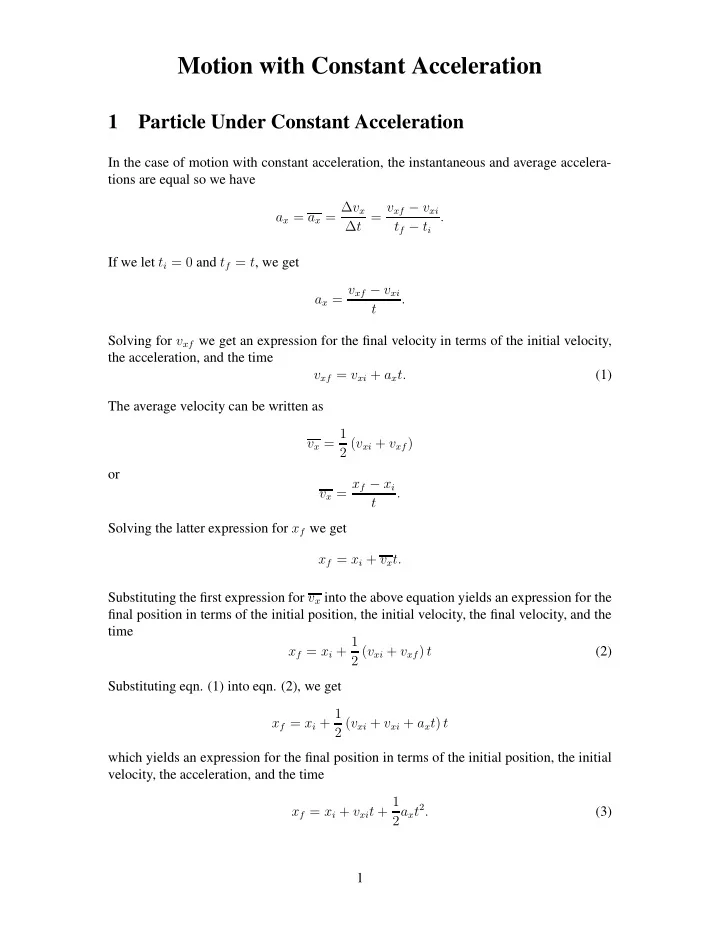
Motion with Constant Acceleration 1 Particle Under Constant Acceleration In the case of motion with constant acceleration, the instantaneous and average accelera- tions are equal so we have a x = a x = v x t = v xf v xi . t f t


slide-1
SLIDE 1

Motion with Constant Acceleration

1 Particle Under Constant Acceleration

In the case of motion with constant acceleration, the instantaneous and average accelera- tions are equal so we have ax = ax = ∆vx ∆t = vxf − vxi tf − ti . If we let ti = 0 and tf = t, we get ax = vxf − vxi t . Solving for vxf we get an expression for the final velocity in terms of the initial velocity, the acceleration, and the time vxf = vxi + axt. (1) The average velocity can be written as vx = 1 2 (vxi + vxf)

  • r

vx = xf − xi t . Solving the latter expression for xf we get xf = xi + vxt. Substituting the first expression for vx into the above equation yields an expression for the final position in terms of the initial position, the initial velocity, the final velocity, and the time xf = xi + 1 2 (vxi + vxf) t (2) Substituting eqn. (1) into eqn. (2), we get xf = xi + 1 2 (vxi + vxi + axt) t which yields an expression for the final position in terms of the initial position, the initial velocity, the acceleration, and the time xf = xi + vxit + 1 2axt2. (3) 1

slide-2
SLIDE 2

Solving eqn. (1) for t and substituting into (2), we get xf = xi + 1 2 (vxi + vxf)

vxf − vxi

a

  • which can be solved for the final velocity squared in terms of the initial velocity squared,

the acceleration, and the displacement v2

xf = v2 xi + 2ax (xf − xi) .

(4) Graphs of position, velocity, and acceleration as a function of time for motion with con- stant acceleration are shown in Figure 1.

1.1 Constant Acceleration Example

You brake your Porsche from 75 km/h to 45 km/h over a distance of 88 m. (a) What is the acceleration, assumed to be constant? vxi = 75 km/h vxf = 45 km/h xf − xi = 88 m ax =? v2

xf = v2 xi + 2ax (xf − xi)

ax = v2

xf − v2 xi

2 (xx − xi) = (45 km/h)2 − (75 km/h)2 2 (0.088 km) = −2.0 × 10⁴km/h2 ax = −2.0 × 10⁴km h2

1000 m

1 km

1 h

3600 s

2

= −1.5 m/s2 (b) What is the elapsed time? xf − xi = 1 2 (vxi + vxf) t t = 2 (xf − xi) vxi + vxf = 2 (0.088 km) 75 km/h + 45 km/h = 1.5 × 10⁻³h = 5.3 s (c) If you continue to slow down with the acceleration calculated in (a), how much time will elapse in bringing the car to rest from 75 km/h? vxi = 75 km/h vxf = 0 ax = −2.0 × 10⁴km/h2 t =? vxf = vxi + axt t = vxf − vxi ax = 0 − 75 km/h −2.0 × 10⁴km/h2 = 3.8 × 10⁻³h = 14 s 2

slide-3
SLIDE 3

Figure 1: Graphs of position, velocity, and acceleration versus time for motion with con- stant acceleration. 3

slide-4
SLIDE 4

2 Freely Falling Objects

Free fall near the surface of the earth is the most common example of motion with (nearly) constant acceleration. Free-fall acceleration near the surface of the earth is g = 9.80 m/s2. In solving free-fall problems, we will use the equations derived earlier for motion with constant acceleration with the following substitutions x → y and ax → ay = −g = 9.8 m/s2.

2.1 Free Fall Example

A worker drops a wrench down an elevator shaft of a tall building. (a) Where is the wrench 1.5 seconds later? yi = 0 vyi = 0 t = 1.5 s yf =? yf = yi + vyit + 1 2ayt2 yf = 0 + 0 + 1 2

  • −9.8 m/s2

(1.5 s)2 = −11 m (b) How fast is the wrench falling after 1.5 s? vyf = vyi + ayt = 0 +

  • −9.8 m/s2

(1.5 s) = −15 m/s

3 Homework Set 2 - Due Monday, Sept. 13

  • Read Sections 2.6-2.7
  • Answer Question 9 & 11
  • Do Problems 19, 26, 33 & 39

4