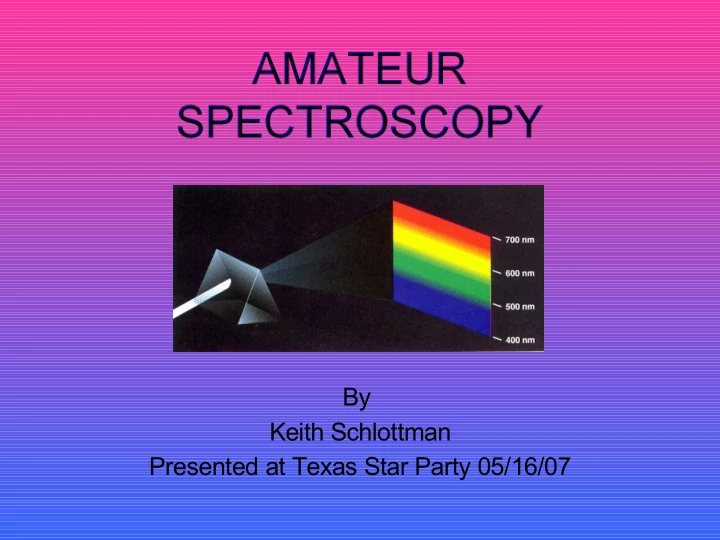
By Keith Schlottman Presented at Texas Star Party 05/16/07 Have - - PowerPoint PPT Presentation

by keith schlottman presented at texas star party 05 16
SMART_READER_LITE
LIVE PREVIEW

By Keith Schlottman Presented at Texas Star Party 05/16/07 Have - - PowerPoint PPT Presentation

By Keith Schlottman Presented at Texas Star Party 05/16/07 Have You Ever Used Spectroscopy? Used a Nebula Filter? Noticed that Vega is Bluish and Arcturus is Seen a Rainbow? Reddish? Viewed the Sun in H-Alpha? The Spectrum Tells A Story


slide-1
SLIDE 1

By Keith Schlottman Presented at Texas Star Party 05/16/07

slide-2
SLIDE 2

Have You Ever Used Spectroscopy?

Seen a Rainbow? Used a Nebula Filter? Viewed the Sun in H-Alpha? Noticed that Vega is Bluish and Arcturus is Reddish?

slide-3
SLIDE 3

The Spectrum Tells A Story

  • Stars

– Stellar classifications / HR Diagram – Age of star – Surface gravity – Pressure – Surface temperature – Radial velocity – Identify spectroscopic binaries

  • Other Objects

– Galactic and Quasar redshifts – Nebular compositions – Comets and Planets

slide-4
SLIDE 4

Equipment – Visual Spectroscopy

  • Prism
  • CD-ROM
  • Project Star Spectrometer
  • Naked Eye (Rainbows & Moonbows)
slide-5
SLIDE 5

Equipment – Telescopic Spectrographs

  • More Expensive
  • SBIG SGS
  • LHIRES III
  • Baader DADOS
  • Sivo Scientific Nu-View II
  • Moderately Expensive
  • SBIG DSS-7
  • Less Expensive
  • DG Spectrum Filters
  • Rainbow Optics Star Spectroscopes
  • Rigel Systems RS-Spectroscope
  • Paton Hawksley Star Analyser
  • Build Your Own
slide-6
SLIDE 6

Comparison of 4 Spectrographs

SBIG SGS SBIG DSS7 LHIRES III DG1 FILTER COST $4,950 $1,595 ~ $3,000 ~ $150 GRATING TYPE Reflection Reflection Reflection Transmission GRATING Lines/mm 150 (Low) 600 (High) 100 150, 300, 600, 1200, 2400 200, 500, or 1,000 DISPERSION Angst./pixel w/ST-7 4.3 (Low) 1.1 (High) 5.4 3.0 (Lowest) to 0.12 (Highest) Up to 0.5 RESOLUTION With ST-7 9Å (Low) 2.4Å (High) 16Å Up to 0.4Å Varies λ RANGE Tuneable Fixed Tuneable Fixed GUIDING Internal or External None or External Separate or External Internal or External BEST FOR Stars, Nebulae Nebulae, Galaxies Stars Stars

Information based on my experience and manufacturer claims, may not be 100% accurate

slide-7
SLIDE 7

Acquiring Data With the SGS

  • Use CCDSoft
  • Guide on Slit
  • Binning 1x4
  • Note that images are monochrome!
slide-8
SLIDE 8

Processing Data

  • Dark Subtract, Median Combine (CCDStack)
  • Rotate if Low-Res Mode (IRIS)
  • Wavelength Calibration (vSpec)
  • Flux Calibration for CCD Response (equivalent

to Flat Field)

slide-9
SLIDE 9

Wavelength Calibration - H

Edmund Scientific Lamps are used

slide-10
SLIDE 10

Spectral Types

Spectra taken with The SBIG SGS on a 12” LX-200GPS from my Tucson backyard on October 16 & 17, 2006.

RED BLUE

slide-11
SLIDE 11

Identifying Stellar Composition

slide-12
SLIDE 12

Emission Nebula

The OIII emission lines were thought to be a new element in the early 20th century, “Nebulium”.

slide-13
SLIDE 13

Emission Nebulae

slide-14
SLIDE 14

Planets

slide-15
SLIDE 15

Comets

slide-16
SLIDE 16

Novae

slide-17
SLIDE 17

Variable Stars

slide-18
SLIDE 18

Pro-Am Collaborations

Amateur spectroscopists were asked to

  • btain data on this star, which was a target

for the COROT satellite.

slide-19
SLIDE 19

Be Stars

slide-20
SLIDE 20

Young Stars

slide-21
SLIDE 21

T Tauri

A very young star, still undergoing contraction.

slide-22
SLIDE 22

Texas Star Party 2007

Blueshifted absorption feature provides a basis for calculating radial velocity of the expanding shell. Preliminary calculation from this data is ~ 200 km/sec. This data was

  • btained early

Monday morning at TSP Upper Field.

slide-23
SLIDE 23

DG Spectrum Filter

  • Zero and First Order on Main Chip

Vega

  • Use Known Lines to Calibrate in vSpec
slide-24
SLIDE 24

The Easiest Spectrum to Observe – No Equipment Necessary!

For more information see: http://www.xanaduobservatory.com