The Ohio MicroMD Laboratory $27M investment by State of Ohio 20,000 - - PDF document

the ohio micromd laboratory
SMART_READER_LITE
LIVE PREVIEW

The Ohio MicroMD Laboratory $27M investment by State of Ohio 20,000 - - PDF document

NSF NSEC for Affordable Nanoengineering of Polymeric Biomedical Devices (CANPBD) Director- L. James Lee Affordable polymer nanoengineering and transport at the nanoscale Multiscale modeling Biocompatibility and ethical/societal


slide-1
SLIDE 1
  • Affordable polymer nanoengineering and transport at the

nanoscale

  • Multiscale modeling
  • Biocompatibility and ethical/societal implications
  • Nanofluidic biomedical devices and nanofactory
  • UCSF: Tejal Desai (Biomedical Eng.)– nanofabrication
  • FAMU/FSU (HBCU): Ravindran Chella (Chemical Eng.)- fluid

mechanics

  • VCU: Mike Peters (Chemical Eng.)– drug delivery modeling
  • JHU: Kam Leong (Biomedical Eng.)– gene therapy
  • PUR: Rashid Bashir (Electrical Eng.)– device integration
  • UA: Darrell Reneker (Polymer Sci.)– electrospin nanofibers
  • UCB: Jean Frechet (Chemistry)– nanoparticle and surface

synthesis

  • UM: Ron Larson (Chemical Eng.)- molecular simulation

NSF NSEC for Affordable Nanoengineering of Polymeric Biomedical Devices (CANPBD) Director- L. James Lee

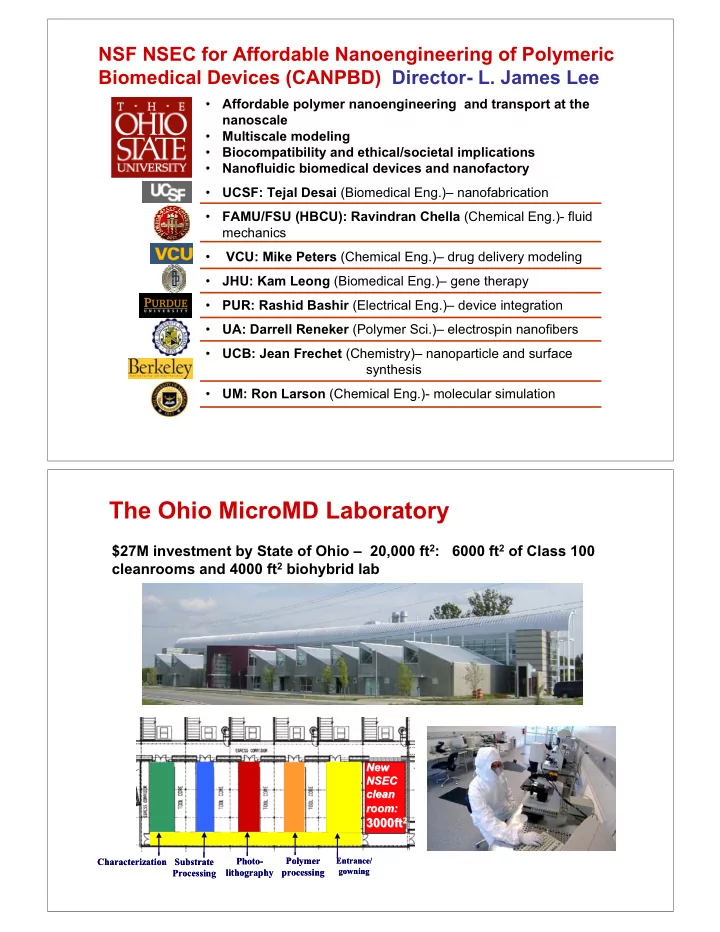
The Ohio MicroMD Laboratory

$27M investment by State of Ohio – 20,000 ft2: 6000 ft2 of Class 100 cleanrooms and 4000 ft2 biohybrid lab

Characterization Substrate Processing Photo- lithography Polymer processing

Entrance/ gowning

Characterization Substrate Processing Photo- lithography Polymer processing

Entrance/ gowning

New New NSEC NSEC clean clean room: room:

3000ft 3000ft2

2

slide-2
SLIDE 2

Micro/Nanomachining Lab

1. Micro-milling machine 2. Nano-grinding machine

  • 3a. Femtosecond Pulse Laser/Proximal Probe on a SEM
  • 3b. Assisted High Precision Magnetic Suspension Stage
  • 4. Three-axial Sputtering Machine

1 3b 4 3a 2

Micro/Nanoprocessing Lab

1. EVG Aligner and Nano-imprintingSystem 2. EVG Hot-Embossing Machine 3. SCF Molding/Bonding System 4. Micro-injection Molding Machine 5. Dip Pen Lithography System 6. Plasma RIE 7. PECVD 8. Electroplating 9. Photolithography System 3 4 1 2 5 6 7 8 9

slide-3
SLIDE 3

Nanoscale Characterization Lab

1. Instron Micro-Tester 2. Bio-AFM 3. High Pressure-Ellipsometry (with hot stage) 4. High Pressure-Surface Nano-Rheometer 5. BIC Dynamic Light Scattering Goniometer 6. BIC Zeta/Stream Potential Measurement System 7. Environmental SEM 8. Cryo TEM 9. Static/Dynamic Contact Angle Measurement System 10. Dual Beam Optical Tweezer 11. Size Exclusion Chromatograph

10 9 7 1 2 3 4 5 6 11 1. Invert Fluorescence Microscope 2. Syringe Pumps 3. Spin-Disk Confocal Micro-PIV 4. High Speed CCD System 5. Multi-Electrode EOF/EP System 6. Centrifuge Micro/Nanofluidic Device 7. Automated Micro-Pipette System

Micro/Nanofluidics Lab

6 3 5 4 1 2 7

slide-4
SLIDE 4

Super/Subcritical Fluids

Building Blocks (Functional Polymers, Biomolecules, Nanoparticles) Thrust Areas (Nanoengineering, Multiscale Modeling, Biocompatibility) Core Technology Platform

Nanofiber Synthesis Nano Manipulation Self/Dynamic Assembly

Testbeds Nanofactory

Nanofluidic Protein Separation Nanofluidic Drug/Gene Delivery Nano Manufacturing Micro/Nano Fluidics

Electro Spinning of Electro Spinning of Nanofibers Nanofibers Wound Dressing Wound Dressing

Contact: D. Reneker (U. Akron) 3 month old skin lesions cured in one or two weeks!

NO NO NO NO NO NO NO NO NO NO NO NO

S K I N

  • Acid
  • Nitrite
  • Super absorbent

H2O

  • Nanofiber

Nitric Oxide release for 6 to 12 hours Promotes Wound Healing

Time Elapsed – 8 days

NANOFIBERS

slide-5
SLIDE 5

A piece of adipose tissue taken from the body and prepared for SEM

3D Tissue Culture and An Adipose Tissue

a b

3D scaffold seeded with embryonic stem cells that have been induced to become fat cells (adipocytes)

Air Air + solvent vapor Air Air + solvent vapor

REFLECTION MODE OF OPTICAL MICROSCOPY

Embedded PEO nanofibers in PAA matrix

Contact: M. Cakmak ( Cakmak@uakron.edu), Ph#330-972-6928

ELECTROSPINNING/SOLUTION CASTING HYBRID PROCESSING PLATFORM

Casting Electrospinning

slide-6
SLIDE 6

Effect of CO Effect of CO2

2 on Surface

  • n Surface T

Tg

g and Chain Diffusion

and Chain Diffusion

  • Y. Yang, and L.J. Lee, , The Ohio State University

interfacial width

substrate

AFM/Gold Particles

20 nm

w/o CO2

Neutron Reflectivity

hPS dPS

w CO2 35oC

Depth, nm

5 10 15 200 205 210

Tg, oC

40 50 60 70 80 90 100 110

Tg, bulk = 100.2 oC 90.6 oC 10.3 nm

Time, s

2000 4000 6000 8000

Interfacial Width, nm

5 10 15 20

12.2 nm good fusion Rg = 11.3 nm

PS lid PS nanochannels bonded interface

TB=70oC (Tg=90.6oC ) PB= 200 psi PC= 42 psi tB= 1 hr

200 nm

CO CO2

2 Bonding at the

Bonding at the Nanoscale Nanoscale (PS) (PS)

slide-7
SLIDE 7

TB=35oC, PB= 0.79 MPa PC= 0.08 MPa, tB= 1 hr

PLGA lid PLGA nanochannels bonded interface

200 nm

Low T Fusion of Polymer Nanostructures Using CO Low T Fusion of Polymer Nanostructures Using CO2

2

Depth, nm 5 10 15 200 205 210 Tg, oC 20 25 30 35 40 45 50 55

Tg, bulk = 48.3oC 42.7oC 40.4oC 16.8 nm

  • Y. Yang, and L.J. Lee, , The Ohio State University

Diameter: 5 µm Height: 3.95 µm Diameter: 5 µm Height: 3.9 µm After CO2 Bonding:

5 m 5 m

Before CO2 Bonding: TB = 35oC, PB = 100 psi (Tg = 42.4oC ), tB = 4 hr

CO CO2

2 Bonding at the

Bonding at the Microscale Microscale

PLGA

slide-8
SLIDE 8

http://www.nlm.nih.gov/medlineplus /ency/imagepages/19194.htm

Tissue Engineering Tissue Engineering

http://www.becomehealthynow.com/ popups/liver.htm

Construction of Multiple Cell Construction of Multiple Cell-

  • Scaffold Complex

Scaffold Complex

CO2 fusing

ES cells in Scaffold #1 NIH 3T3 cells in Scaffold #2

3D cell-scaffold complex

NIH 3T3 cells scaffolds ES cells slice view 3D view

slide-9
SLIDE 9

20 m 20 m 50 m 50 m 100 m 100 m

CO CO2

2 Effects on Human

Effects on Human Mesenchymal Mesenchymal Stem Cells ( Stem Cells (hMSCs hMSCs) )

viability adhesion proliferation

Calcein AM - live cells EthD-1 - dead cells DAPI - nuclei F-actin - cytoskeleton BrdU-labeled nuclei merged with DAPI stained nuclei to show cells in proliferation stage

Before CO2 exposure After CO2 exposure @ 200 psi

CO CO2

2 Effects on Mouse Embryonic Stem (ES) Cells

Effects on Mouse Embryonic Stem (ES) Cells

viability adhesion differentiation

After CO2 exposure @ 200 psi

20 m 100 m Scale bar: 20 m Nestin: neuronal cells Pax-6: neuroectoderm BMP-4: mesoderm Nkx2.5: cardiac muscle cells Myf5: skeletal muscle cells

Early embryonic lineages Neurogenesis Cardiogenesis Myogenesis

100 m 100 m

undifferentiation growth

Calcein AM - live cells EthD-1 - dead cells OCT-4 expression EB bodies

slide-10
SLIDE 10

Super/Subcritical Fluids

Building Blocks (Functional Polymers, Biomolecules, Nanoparticles) Thrust Areas (Nanoengineering, Multiscale Modeling, Biocompatibility) Core Technology Platform

Nanofiber Synthesis Nano Manipulation Self/Dynamic Assembly

Testbeds Nanofactory

Nanofluidic Protein Separation Nanofluidic Drug/Gene Delivery Nano Manufacturing Micro/Nano Fluidics

Applications of Nanofluidics in Drug Delivery and Genetic Engineering

  • Nanoneedle array cell patch for ex

vivo gene delivery

  • electrophoretic nanofluidic
  • Nanofactory for production of

multifunctional nanoparticles for in vivo gene delivery

slide-11
SLIDE 11

Nanonozzle Nanonozzle Cell Patch for Cell Patch for Ex Vivo Ex Vivo Gene Gene Delivery Delivery

( (Electrophoretic Electrophoretic Nanofluidics Nanofluidics) )

Transformed Cell Separation and Collection Cell Suspension Loading Gene Delivery Through Nanoneedle Array Cell Patch Air Bubble Injection

1 2 Coiled DNA Cell Cell 1 2 Stretched DNA

Electrophoresis to deliver gene Mild electric shock to open cell membrane

80nm 2 m

Small pore end

80nm 2 m

Small pore end

Nanonozzle Array

Fabrication of Fabrication of Nanotip Nanotip/nozzle Array by /nozzle Array by Sacrificial Template Imprinting (STI) Sacrificial Template Imprinting (STI)

Image Guide Differential Etching Nanotip Array Sacrificial Template Polymer Nanonozzle Array Replica Molding Casting Molding PDMS Daughter Mold Spin Coating

A B C D E

50 m B

5m 5m

C

5m

D

3m

E

slide-12
SLIDE 12

Dynamic (Electric/Magnetic) Assembly in Nanochannels

Immobilized anions Micro-channel Wall Mobile cations Drag effect

  • +

+ + + + + + + + +

  • R

200nm 50 nm

  • S. Wang, C. Zeng and L.J. Lee, Adv. Materials 2005

EOF/EP

  • PMMA

N+ N+ N+ N+ N+ N+ N+ N+ N+ N+ N+ N+ N+ N+ N+ N+ N+ N+ N+ N+

  • SO3
  • SO3
  • SO3
  • SO3
  • SO3
  • SO3
  • SO3
  • SO3
  • SO3
  • SO3

Silica

  • PMMA

PMMA

N+ N+ N+ N+ N+ N+ N+ N+ N+ N+ N+ N+ N+ N+ N+ N+ N+ N+ N+ N+ N+ N+ N+ N+ N+ N+ N+ N+ N+ N+ N+ N+ N+ N+ N+ N+ N+ N+ N+ N+ N+ N+ N+ N+ N+ N+ N+ N+ N+ N+ N+ N+ N+ N+ N+ N+ N+ N+ N+ N+

  • SO3
  • SO3
  • SO3
  • SO3
  • SO3
  • SO3
  • SO3
  • SO3
  • SO3
  • SO3
  • SO3
  • SO3
  • SO3
  • SO3
  • SO3
  • SO3
  • SO3
  • SO3
  • SO3
  • SO3
  • SO3
  • SO3
  • SO3
  • SO3
  • SO3
  • SO3
  • SO3
  • SO3

Silica

  • Dynamic Assembly within Converging

Nanochannels

0025 .

,

  • channel

s e microspher

D d

C=0.000265% 0025 .

  • D

d

  • : converging angle
slide-13
SLIDE 13

Dynamic Assembly within Converging Nanochannels

sharp end large end

Electrophoretic Migration of -DNA through Nanonozzle Array, Ds= 200nm, 20V/cm

Nanofluidic Platform Donor side Acceptor side

Nanonozzle Array Support film edge

100x Oil immersed Objectives

slide-14
SLIDE 14

Electrophoretic Migration of -DNA through Converging/Diverging Nanonozzle Array

Diverging Flow Converging Flow d d( (

  • DNA,= 1.4

DNA,= 1.4 m) m) D Ds

s(= 200 nm)

(= 200 nm)

7.0 7.0

Delay 5 min Delay 0 min

Different Methods for Gene Delivery (NIH 3T3 Cells)

DNA pEGFP Cell PET membrane Cell Cell

0.02 0.04 0.06 0.08 0.1 0.12 0.14 cells in suspension positive control (LipofectAmine) Alkaline Phosphatase at 405 nm SeAP SeAP-Qdot Biotin labeled DNA plasmid Biotin labeled DNA plasmid

SeAP (EP Cell Patch) Bulk Electroporation pEGFP-N1 (Localized Electroporation)

pEGFP

EP Cell Patch

slide-15
SLIDE 15

Multifunctional Lipid-Coated Nanoparticles for Gene Delivery

Advantages:

* Fusogenic properties improves cytosolic delivery * Enhanced translocation into the nucleus by NLS * Integration into host genome by integrase * Less immunogenic than virus due to PEG coating

DNA Nuclear localization signal (NLS) Integrase Fusion-inducing molecules Lipid bilayer PEG DNA condensing agent RNA genome Capsid Integrase Nucleocapsid protein Glycoprotein Reverse transcriptase Envelope Matrix

Diagram of a retrovirus

DNA in nanochannel Channel 1 Channel 1 Nanowire detector Channel 1 Channel 1 Channel 2

Nanoscale Assembly Line

Integrase DNA condensing agent DNA Nuclear localization signal AFM

slide-16
SLIDE 16

Experiment Simulation

Y.J. Juang, S. Wang, X. Hu, and L.J. Lee, Phys. Review Letters, 93, 2004

DNA Stretching in Electrophoretic Extension

Conventional method A (PEI into DNA) Dynamic complexation 300:1 3:1 30:1 3000:1 Scan area of all images is 1 by 1 um

AFM Images of PEI/-DNA Complexes

Conventional method B (DNA into PEI) N:P ratio

slide-17
SLIDE 17

Patterning DNA Patterning DNA Nanowire Nanowire Array Using Soft Array Using Soft Lithography Modified Molecular Combing Lithography Modified Molecular Combing

10 m 10 m

Fluorescence micrographs of DNA nanowire array on glass Fluorescence micrographs of DNA nanowire array on glass Side view Top view

DNA Contact line 1. 2. 3. 4. 5. DNA nanostrand

Mechanism of DNA-Nanostrand Formation

slide-18
SLIDE 18

0.94nm1.26nm 1.21nm1.26nm 1.18nm a b

10 m 2 m

AFM Images of DNA Nanowires

  • J. Guan and L.J. Lee, PNAS, in press

Array of “pens” DPN in MicroMD 10 m DNA array

DNA Conjugation by Dip-Pen Nanolithography (DPN)

DNA

A B Microchannel A B

Electrode

DNA

Side-view Top-view DNA Conjugation by Microfluidics

slide-19
SLIDE 19

Double Printing of DNA Nanowires

10 m

Potential Applications: Synthesis of multifunctional nanoparticles and artificial chromosomes for gene therapy Cloning (DNA recombination) Gene repair Potential Applications: Synthesis of multifunctional nanoparticles and artificial chromosomes for gene therapy Cloning (DNA recombination) Gene repair

Nanofactory Concept

Nanofactory

Ultraprecision platform

  • single molecule sensors
  • single molecule probes
  • nanofluidic actuators
  • nanoscale reactors

Genes Functional Polymers Lipids Proteins Nano- particles

well-defined, multifunctional polymer-biomolecule conjugates assembly line