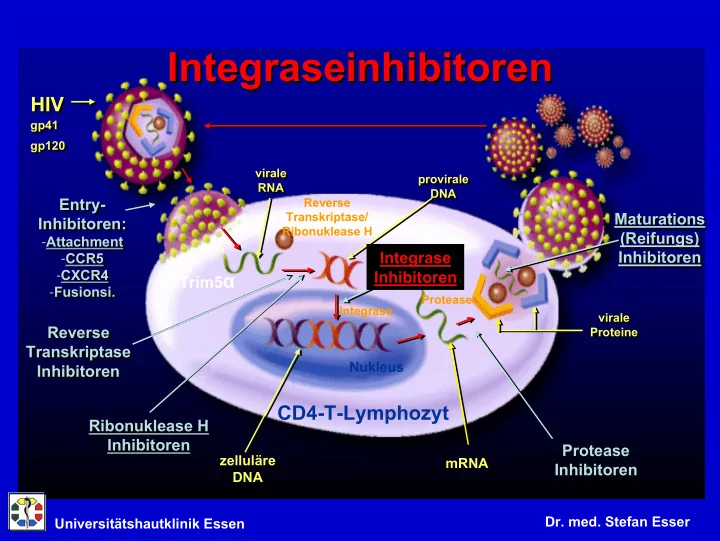
Integraseinhibitoren Integraseinhibitoren HIV HIV gp41 gp41 - - PowerPoint PPT Presentation

integraseinhibitoren integraseinhibitoren
SMART_READER_LITE
LIVE PREVIEW

Integraseinhibitoren Integraseinhibitoren HIV HIV gp41 gp41 - - PowerPoint PPT Presentation

Integraseinhibitoren Integraseinhibitoren HIV HIV gp41 gp41 gp120 gp120 virale virale provirale provirale RNA RNA DNA DNA Entry- Reverse Entry- Transkriptase/ Maturations Maturations Inhibitoren: Inhibitoren: Ribonuklease H


slide-1
SLIDE 1

virale RNA virale RNA Reverse Transkriptase/ Ribonuklease H provirale DNA provirale DNA virale Proteine virale Proteine

mRNA mRNA zelluläre DNA zelluläre DNA

Reverse Transkriptase Inhibitoren Reverse Transkriptase Inhibitoren Protease Inhibitoren Protease Inhibitoren

Nukleus

HIV HIV

Integrase Inhibitoren Entry- Inhibitoren:

  • Attachment
  • CCR5
  • CXCR4
  • Fusionsi.

Entry- Inhibitoren:

  • Attachment
  • CCR5
  • CXCR4
  • Fusionsi.

Protease Integrase gp41 gp41 gp120 gp120

Universitätshautklinik Essen

CD4-T-Lymphozyt

Maturations (Reifungs) Inhibitoren Maturations (Reifungs) Inhibitoren Trim5α Ribonuklease H Inhibitoren Ribonuklease H Inhibitoren

  • Dr. med. Stefan Esser

Integraseinhibitoren Integraseinhibitoren

slide-2
SLIDE 2

Mature Provirus Gap Repair Nuclear Membrane Nuclear Entry Virale DNA Synthesis 1 Assembly on Viral DNA in a Nucleoprotein Complex 2 In-Dependent Processing

  • f 3´Ends

3a Target DNA Binding 3b Concerted Target DNA Cleavage and Joining

3 Strand- Transfer

Hazuda et al 7th CROI San Fransisco

HIV-Integrase

HIV-spezifische Integrase katalysiert Einfügen der proviralen in Wirts-DNA

Universitätshautklinik Essen

slide-3
SLIDE 3

Mature Provirus Gap Repair Nuclear Membrane Nuclear Entry Virale DNA Synthesis 1 Assembly on Viral DNA in a Nucleoprotein Complex 2 In-Dependent Processing

  • f 3´Ends

3a Target DNA Binding 3b Concerted Target DNA Cleavage and Joining

3 Strand- Transfer

Hazuda et al 7th CROI San Fransisco

HIV-Integrase

HIV-spezifische Integrase katalysiert Einfügen der proviralen in Wirts-DNA

Universitätshautklinik Essen

HIV-1 Integrase Transfer Inhibitors: ~ S-1360 ~ L-708,906 ~ L-879810 ~ MK-0518 ~ GS-9137 (JTK-303)

HIV-1 DNA-Integrase Complex Formation Inhibitor: ~ V-165

slide-4
SLIDE 4

Raltegravir Raltegravir (MK 0518): (MK 0518): A Novel HIV A Novel HIV-

  • 1 Integrase Inhibitor

1 Integrase Inhibitor

  • A new mechanism of action:

A new mechanism of action: HIV-1 Integrase Transfer Inhibitor

  • Potent

Potent in vitro in vitro activity activity

  • IC

IC95

95 = 33 nM

= 33 nM ± ± 23 nM in 50% human serum 23 nM in 50% human serum

  • Active against:

Active against:

– – multi multi-

  • drug resistant HIV

drug resistant HIV-

  • 1

1 – – CCR5 and CXCR4 HIV CCR5 and CXCR4 HIV-

  • 1

1

  • HIV resistant to raltegravir remain

HIV resistant to raltegravir remain sensitive to other ARTs sensitive to other ARTs

  • Synergistic

Synergistic in vitro in vitro with all ARTs tested with all ARTs tested

  • Potent activity in combination therapy in Phase II studies

Potent activity in combination therapy in Phase II studies – – in ART in ART-

  • naive patients

naive patients at Week 24 at Week 24 (Markowitz et al, IAC 2006, Abst

(Markowitz et al, IAC 2006, Abst THLB0214) THLB0214)

  • 85

85 – – 95% with HIV RNA < 50 copies/mL 95% with HIV RNA < 50 copies/mL – – In patients failing therapy with triple class resistant virus at In patients failing therapy with triple class resistant virus at Week Week 24 24 (Grinsztejn et al, ICAAC 2006, Abst H

(Grinsztejn et al, ICAAC 2006, Abst H-

  • 1670b)

1670b)

  • 57

57-

  • 67%

67% with HIV RNA < 50 copies/mL with HIV RNA < 50 copies/mL

N N H N O O- O H N F O N N O K+

  • D. Cooper, R. Steigbigel et al., 14th CROI Los Angeles 2007, Abstract # 105 a&b LB

Universitätshautklinik Essen

slide-5
SLIDE 5

Raltegravir Raltegravir: BENCHMRK : BENCHMRK-

  • 1 & 2: Study Design

1 & 2: Study Design

  • 2 identical ongoing randomized, double-blind, placebo controlled Phase III

studies (in different countries)

  • Raltegravir 400 mg b.i.d. vs placebo (randomized 2:1)

– All in combination with optimized background therapy (OBT) – Selected investigational ART permitted as OBT

  • Key Inclusion Criteria

– Documented genotypic/phenotypic resistance to ≥ 1 drug in each of 3 classes (NNRTI + NRTI + PI) – HIV RNA > 1000 copies/mL

  • Patients virologically failing after ≥ 16 weeks of therapy could enter an open-

label raltegravir arm (OLpVF)

  • D. Cooper, R. Steigbigel et al., 14th CROI Los Angeles 2007, Abstract # 105 a&b LB

Universitätshautklinik Essen

slide-6
SLIDE 6

BENCHMRK BENCHMRK-

  • 1 & 2 : Baseline Patient Characteristics

1 & 2 : Baseline Patient Characteristics

BENCHMRK-1 BENCHMRK-2 Placebo + OBT N = 119 46 (8) 90 65 Mean CD4 Count, cells/mm Mean CD4 Count, cells/mm3

3

GM Viral Load, copies/mL (log GM Viral Load, copies/mL (log10

10HIV RNA)

HIV RNA) % AIDS % AIDS Median Yrs of Prior ARTs (median # ART) Median Yrs of Prior ARTs (median # ART) % Hep B+/% Hep C+ % Hep B+/% Hep C+ 156 156 40519 (4.6) 40519 (4.6) 94 94 11 (12) 11 (12) 8/15 8/15 153 31828 (4.5) 90 10 (12) 4/20 146 48366 (4.7) 91 10 (12) 10/3 163 47789 (4.7) 92 10 (12) 3/4 % GSS % GSS§

§ 0/1

0/1 % PSS % PSS§

§ 0/1

0/1 % new enfuvirtide in OBT % new enfuvirtide in OBT % new darunavir in OBT % new darunavir in OBT 30/33 30/33 19/29 19/29 21 21 27 27 29/41 18/33 20 25 20/44 10/34 19 45 26/40 19/27 20 50 Raltegravir + OBT N = 232 Placebo + OBT N = 118 Raltegravir + OBT N = 230 Mean Age, yrs (SD) % Male % Caucasian 46 (9) 46 (9) 84 84 75 75 44 (8) 87 81 45 (9) 91 55

§ § GSS/PSS = total ART in OBT to which pt GSS/PSS = total ART in OBT to which pt’ ’s virus showed geno/phenotypic sensitivity by s virus showed geno/phenotypic sensitivity by Phenosense GT assay. Enfuvirtide and darunavir use in na Phenosense GT assay. Enfuvirtide and darunavir use in naï ïve patients were each ve patients were each counted as + 1 active agent and added to GSS/PSS counted as + 1 active agent and added to GSS/PSS

  • D. Cooper, R. Steigbigel et al., 14th CROI Los Angeles 2007, Abstract # 105 a&b LB

Universitätshautklinik Essen

slide-7
SLIDE 7

Percent of Patients with Virologic Response Percent of Patients with Virologic Response <50 Copies/mL (Non <50 Copies/mL (Non-

  • Completer = Failure)

Completer = Failure)

* + OBT p<0.001 at Week 16 for both parameters

BENCHMRK-1 BENCHMRK-2

0 2 4 8 12 16 24 Weeks 20 40 60 80 100 Percent of Patients with HIV RNA <50 Copies/mL Number of Contributing Patients 0 2 4 8 12 16 24 232 230 158 118 118 81 Raltegravir* Placebo* 230 229 128 119 119 69

  • D. Cooper, R. Steigbigel et al., 14th CROI Los Angeles 2007, Abstract # 105 a&b LB

Universitätshautklinik Essen

slide-8
SLIDE 8

Partial Analysis of Raltegravir Resistance in BENCHMRK-1 and BENCHMRK-2

  • Virologic failure on Raltegravir vs. placebo:

76 (16%) vs. 121 (51%)

  • Raltegravir failure: associated with one of two genetic pathways:

N155H or Q148K/R/H

  • Additional mutations were observed with both pathways

N155H + (E92Q,V151I, T97A, G163R, L74M) Q148K/R/H + (G140S/A, E138K)

  • Other pathways?

Y143R/C + (L74A/I, E92Q, T97A, I203M, S230R)

Partial analysis based on genotyping 41 Raltegravir failures 32 with integrase changes, 9 with no consistent changes from baseline

  • D. Cooper, R. Steigbigel et al., 14th CROI Los Angeles 2007, Abstract # 105 a&b LB

Universitätshautklinik Essen

slide-9
SLIDE 9

Combined Efficacy* (1) Combined Efficacy* (1) – – % Patients with HIV RNA < 400 copies/mL at Week 16 % Patients with HIV RNA < 400 copies/mL at Week 16 by Selected ARTs in OBT by Selected ARTs in OBT

Overall Efficacy Data Subgroup Efficacy by ARTs in OBT Enfuvirtide Darunavir + + + +

  • n

% of Patients

20 40 60 80 100

43 87 63 55 29 79 98 90 90 74 447 44 42 80 191 230 23 24 47 90

Raltegravir + OBT Placebo + OBT

+ : First Use in OBT

  • : No Use in OBT

* Virological failures carried forward

  • D. Cooper, R. Steigbigel et al., 14th CROI Los Angeles 2007, Abstract # 105 a&b LB
slide-10
SLIDE 10

BENCHMRK BENCHMRK-

  • 1 and 2 Conclusions

1 and 2 Conclusions

♦ In patients with advanced HIV infection, failing ARTs with multi-drug resistant virus, raltegravir + OBT

  • Was generally well tolerated

– with safety profile comparable to that of placebo + OBT – with few adverse experiences leading to discontinuation

  • Had potent and superior antiretroviral activity

compared to placebo + OBT at Week 16 – Partial data at Week 24 shows similar response – When raltegravir was combined with enfuvirtide and/or darunavir, >90% achieved HIV RNA < 400 copies /mL

  • D. Cooper, R. Steigbigel et al., 14th CROI Los Angeles 2007, Abstract # 105 a&b LB

Universitätshautklinik Essen

slide-11
SLIDE 11

GS GS-

  • 9137 (

9137 (Elvitegravir Elvitegravir ): ): Phase 2 Study Schema Phase 2 Study Schema

*CPI included 49% darunavir, 27% tipranavir

278 patients HIV RNA ≥1000 copies/mL Any CD4 cell count ≥1 protease resistance mutation CPI* (n=63) OBT = NRTIs +/- T-20 NNRTIs not allowed in OBT Stratified by T-20 use in OBT GS-9137 20 mg (n=71) GS-9137 50 mg (n=71) GS-9137 125 mg (n=73)

  • A. Zolopa et al., 14th CROI Los Angeles 2007, Abstract # 143 LB
  • Dihydroquinoline carboxylic acid strand

transfer inhibitor of HIV integrase

  • Boosted with 100 mg qd ritonavir

Universitätshautklinik Essen

slide-12
SLIDE 12

Baseline Characteristics Baseline Characteristics

CPI N = 63 GS-9137 20 mg N = 71 GS-9137 50 mg N = 71 GS-9137 125 mg N = 73 Age, median years 44 44 44 44 Male 54 (86%) 70 (99%) 63 (89%) 62 (85%) Caucasian 54 (86%) 48 (68%) 47 (66%) 53 (73%) HIV RNA, mean (±SD) log10 copies/mL 4.54 (±0.80) 4.66 (±0.79) 4.47 (±1.07) 4.71 (±0.81) CD4 cells, mean (±SD) cells per mm3 158 (±150) 180 (±196) 243 (±223) 157 (±158) Genotypic Sensitivity Score (GSS) = 0 for all NRTIs in OBT 32 (51%) 35 (49%) 34 (49%) 35 (48%) First use of T-20 12 (19%) 12 (17%) 17 (24%) 19 (26%) Median # ARVs in OBT including T-20 3 3 3 3 IAS Protease Resistance Mutations, median # 11 11 10 11

Universitätshautklinik Essen

slide-13
SLIDE 13

Change from Baseline in HIV RNA: ITT Sets Change from Baseline in HIV RNA: ITT Sets

37% of CPI patients switched to GS-9137 beginning at Week 16 GS-9137 20 mg patients switched to open-label GS-9137 125 mg beginning at Week 16 (dashed line)

4 8 12 16 20 24

  • 2
  • 1

CPI (n=63) GS-9137 20 mg (n=71) GS-9137 50 mg (n=71) GS-9137 125 mg (n=73) Week Mean Change From Baseline in HIV RNA log10 Copies/mL

Universitätshautklinik Essen

slide-14
SLIDE 14

Week 8 DSMB Recommendations Week 8 DSMB Recommendations

  • Close GS-9137 20 mg arm due to high rate of virologic failure;

patients were offered open-label GS-9137 125 mg

  • Due to new data indicating lack of drug-drug interactions, permit

addition of darunavir or tipranavir to ongoing GS-9137 arms – Prior to Week 24, 15% of GS-9137 50 and 125 mg patients added a PI – Only 4 patients added a PI before Week 16: used as latest time for comparison of GS-9137 vs. PI

Universitätshautklinik Essen

slide-15
SLIDE 15

HIV RNA % < 50 Copies/mL HIV RNA % < 50 Copies/mL (ITT, M=F) (ITT, M=F)

CPI n = 63 GS-9137 50 mg n = 71 GS-9137 125 mg n = 73 Week 16 30% 38% 40%

Universitätshautklinik Essen

slide-16
SLIDE 16

Conclusions Conclusions

  • GS-9137 50 mg and 125 mg arms met primary endpoint of

non-inferiority for DAVG24 – GS-9137 125 mg group was statistically superior to CPI group for both DAVG16 and DAVG24

  • GS-9137 125 mg showed potency within two weeks (>2

log10 decrease) that was durable when combined with an active OBT

  • No difference in incidence or severity of adverse events

between CPI and the GS-9137 arms

  • No dose relationship in Grade 3 or 4 adverse events,

laboratory abnormalities, or study drug discontinuation for the GS 9137 arms

Universitätshautklinik Essen