The Obesity Epidemic: Impact on Pregnancy No disclosures Naomi E. - - PowerPoint PPT Presentation

the obesity epidemic impact on pregnancy
SMART_READER_LITE
LIVE PREVIEW

The Obesity Epidemic: Impact on Pregnancy No disclosures Naomi E. - - PowerPoint PPT Presentation

6/17/2017 The Obesity Epidemic: Impact on Pregnancy No disclosures Naomi E. Stotland, MD Professor Dept. of Obstetrics, Gynecology, and Reproductive Sciences University of California, San Francisco San Francisco General Hospital Obesity


slide-1
SLIDE 1

6/17/2017 1

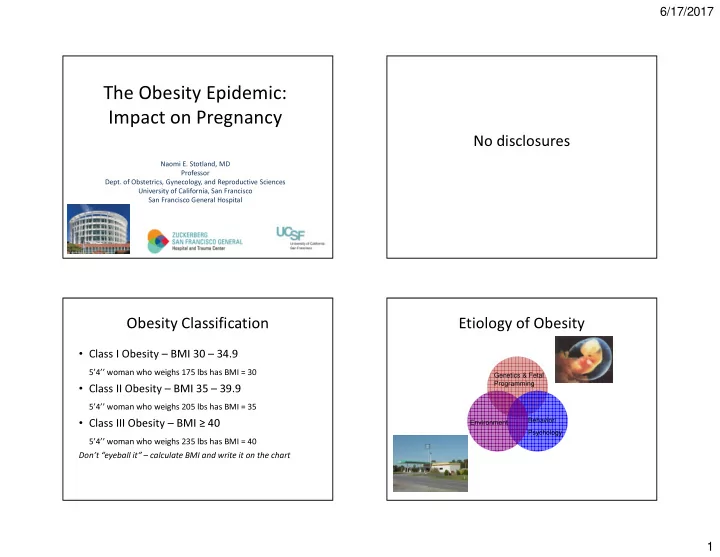
The Obesity Epidemic: Impact on Pregnancy

Naomi E. Stotland, MD Professor

  • Dept. of Obstetrics, Gynecology, and Reproductive Sciences

University of California, San Francisco San Francisco General Hospital

No disclosures Obesity Classification

  • Class I Obesity – BMI 30 – 34.9

5’4’’ woman who weighs 175 lbs has BMI = 30

  • Class II Obesity – BMI 35 – 39.9

5’4’’ woman who weighs 205 lbs has BMI = 35

  • Class III Obesity – BMI ≥ 40

5’4’’ woman who weighs 235 lbs has BMI = 40 Don’t “eyeball it” – calculate BMI and write it on the chart

Etiology of Obesity

Environment Genetics & Fetal Programming Behavior/ Psychology

slide-2
SLIDE 2

6/17/2017 2

Endocrine Disruptors and Obesity

  • Chemicals that bind with hormone receptors

in the human body

  • Example: BPA and estrogen
  • Higher exposure to BPA in utero associated

with higher offspring body weight at age 7 (Hoepner et al, Columbia Center for Children’s Environmental Health)

  • Evidence that animals are also becoming more
  • bese over time

Obesity is associated with metabolic dysfunction

Obesity Chronic inflammation HTN, DM, liver disease

  • Some obese have little to no metabolic dysfunction
  • Many normal weight people have metabolic

dysfunction BMI does not equal Health/disease Persons of every size deserve dignity and respect

slide-3
SLIDE 3

6/17/2017 3

Obesity and Stigma

  • Weight bias = inequities in education,

employment, & healthcare

  • Widespread negative stereotypes: “lazy,

unmotivated, lacking discipline, not competent, non-compliant, sloppy”

  • Implicit bias tests in providers shows strong

preference for thin

  • Obese persons are less likely to undergo

recommended cancer screening

Obesity and Stigma

  • 68% of women with BMI > 55 reported

delaying healthcare because of their weight, and 83% reported that their weight was a barrier to getting care

  • Women reported disrespectful treatment and

negative attitudes from providers, embarrassment about being weighed, and too small gowns, exam tables, equipment

Obesity and Stigma

  • Language is important
  • In one study, patients preferred the term

“weight” to “obesity” or “fat”

  • Focus on patients’ chosen behavioral and

lifestyle goals (rather than emphasizing weight measurement as only measure of success)

  • Avoid blaming and judgmental statements
slide-4
SLIDE 4

6/17/2017 4

“It’s interesting because we recently had someone who was

  • ver 400 pounds who got transferred to us because her out-of-

the-city hospital was too terrified of delivering her. They thought if she needed a C-section or whatever it would be impossible to do it and they just didn't want to deal with her . So we induced her and it was just like passing the hot potato. No one wanted to be around. We induced her for days, we sent her home, we brought her back, we induced her some

  • more. Because there’s a situation – you may not want to pull

the baby out but you do not want to do a C-section either.”

Stigma – Role of Providers

  • Academic CNM, from focus group study

Early Pregnancy Concerns

  • Spontaneous abortion &

recurrent loss more common

  • Fetal anomalies, esp neural tube

defects

  • 20% decrease in detection of

anomalies by ultrasound Early Pregnancy Concerns

  • Cell-free fetal DNA screening may result in test

failure or inaccurate result as obese women may have a lower fetal fraction of the cell-free DNA

  • First and second trimester serum-based

screening tests are adjusted for maternal weight

  • Accurate NT measurement may be more

difficult to obtain

Antepartum Complications

  • GDM and DM2
  • Chronic hypertension
  • Postterm pregnancy
  • Difficult ECV – should be able to

palpate fetal parts

slide-5
SLIDE 5

6/17/2017 5

Intrapartum Complications

  • Prolonged labor
  • Lower likelihood of VBAC success
  • Preeclampsia
  • Higher rates of cesarean delivery
  • Anesthetic complications
  • Macrosomia and shoulder dystocia
  • Stillbirth

Postpartum Complications

  • Longer hospital stays
  • Infections

–Wound infection and endometritis

  • Lower rates of breastfeeding

Long-term Risks to Offspring

  • Obesity
  • Cardiometabolic diseases
  • Autism/developmental delay

Fetal Programming

  • Animal studies support the role of diet during

pregnancy on body composition and metabolism after birth

  • Improving diet during pregnancy may have

long-term benefits for offspring

slide-6
SLIDE 6

6/17/2017 6

Prenatal Care for Obese Women At first prenatal visit

  • Screen for DM2 (repeat at 24 wks if neg)
  • Measure and record BMI in chart
  • Review weight gain goals and strategies with

patient

  • Discuss risks especially re: weight gain
  • If concern for CHTN: baseline Cr, 24hour urine,

LFTs

Fetal growth

  • Obese women at increased risk for both SGA

and LGA

  • If fundus easily palpated, can follow fundal

height

  • If fundus not easily palpated, consider serial

ultrasound for fetal growth

Antenatal Testing

  • Increased stillbirth risk in obese women
  • No RCT to support or refute benefit of

antenatal testing, but many recommend it

  • At ZSFG we start weekly NST/AFI at 32 weeks

for women with BMI of 40 or greater

slide-7
SLIDE 7

6/17/2017 7

Intrapartum Managment When to deliver?

  • No evidence to support nor refute, but we

consider induction of labor at 39-40 weeks in women with BMI ≥ 40, especially if cervix is favorable

  • Elevated risk of IUFD

If induction is not progressing after 24+ hours and maternal/fetal status reassuring (and intact membranes), will stop induction and either try again in a few days or wait for spontaneous labor

  • Retrospective cohort study showed reduced

risk of cesarean delivery and macrosomia among obese women undergoing elective IOL 37-39 weeks versus expectant management

  • RCT needed to address this question

especially neonatal risks

“Trial of Induction”

  • Unpublished cohort study, UCSF
  • Women sent home after failed IOL, reassuring

maternal and fetal status and no urgent indication for delivery

  • ~70% ultimately delivered vaginally
  • ~23% came in later in spontaneous labor, the

rest came back for second induction attempt

  • This is our approach to BMI >= 40
slide-8
SLIDE 8

6/17/2017 8

On admission to L&D

  • Consult anesthesia on admission (or prior)
  • Place internal monitors if needed
  • Assess IV access
  • Prepare for shoulder dystocia, especially if

GDM/DM2 or suspected macrosomia

  • Staffing considerations

Cesarean with BMI >= 40 Preparing for cesarean

  • 20-degree Left lateral tilt is even more important

because of the added weight of the abdominal pannus, but,

  • The tilt puts the midline far from the operating

surgeon and is ergonomically challenging

  • Retraction of the pannus with Montgomery straps

and/or extra surgical assistants

  • Retraction of the extremely large pannus can cause

hypotension, difficult ventilation, and fetal compromise

Cesarean – type of incision and closure?

  • No randomized trial of incision type; no evidence

that vertical skin is preferable – choose based on surgeon’s preference

  • When pannus is massive, a supra-umbilical incision

may be considered – transverse or vertical

  • Some evidence that vertical incisions are associated

with more pain and poorer healing, but study results are mixed

  • Vertical incisions may increase the risk of classical

uterine incision if access to LUS is limited

slide-9
SLIDE 9

6/17/2017 9

Traxi Retractor

Supraumbilical Incision

Cesarean – type of incision and closure?

  • Pre-op antibiotics – at least 2g cefazolin IV
  • Subcutaneous sutures decrease risk of seroma, but

not good evidence in BMI ≥ 50

  • Drains not shown to provide benefit and may

increase infection

  • Staple vs. suture – ongoing clinical trial in obese

women, but current evidence suggests some benefit

  • f suture over staples
  • If staples uses, delayed removal may improve
  • utcomes

Prevent difficult extraction of infant

  • Make all incisions larger than usual – skin,

fascia, and uterus

  • Have vacuum available since fundal pressure

may be difficult to apply

  • Station of presenting part may be lower than

it feels

slide-10
SLIDE 10

6/17/2017 10

DVT Prophylaxis?

  • Mechanical thromboprophylaxis (pneumatic

compression) SCDs pre and post-operatively

  • Early ambulation
  • Enoxaparin 0.5 mg/kg every 12 hours (starting

12h post-op), or 40mg/day

Emergency Cesarean BMI ≥ 40

Need to plan for extra time to

  • move patient to OR table
  • induce anesthesia, and
  • do the surgery

All will take longer, so have to move earlier to C/S especially for fetal indications

BMI<30 9 minutes BMI 30-39 11 minutes BMI 40-49 13 minutes BMI >=50 16 minutes Incision to Delivery Time Increases with Increasing BMI

Length of labor

  • First stage of labor takes longer among obese

women

  • As long as maternal and fetal status

reassuring, may tolerate a slower labor curve in obese patient

  • Second stage length NOT

associated with BMI (nullips)

slide-11
SLIDE 11

6/17/2017 11

Why are cesarean rates so high among

  • bese women?
  • Much of this may be iatrogenic
  • Obese women should be given a chance for a

safe vaginal birth

  • Allow labor to take longer
  • Provide continuous labor support (doulas)
  • Obesity alone (BMI of 30-39/Classes 1-2) may

not “risk a woman out” for midwifery or birth center delivery

Previous C-section: Balancing Risks

Consider patient preferences and values Advantages of vaginal birth VS. Risks of unplanned c-section

ROCK HARD PLACE

Among TOL cohort, low 5 minute Apgar and NICU admission higher BMI ≥40

slide-12
SLIDE 12

6/17/2017 12

Weight Gain During Pregnancy for Obese Women

The IOM Report and Guidelines

IOM Recommendations for Weight Gain in Pregnancy 2009

Pre-pregnancy BMI (kg/m2) IOM Recommended Gestational Weight Gain (kg / lbs) <18.5 (Underweight) 12.5-18 / 28-40 18.5 – 24.9 (Normal) 11.5-16 / 25-35 25.0 - 29.9 (Overweight) 7-11.5 / 15-25 ≥30.0 (Obese) 5-9 / 11-20

Comparison of weight gain by BMI category between PRAMS 2002-2003, and new IOM guidelines

Does Prenatal Advice on Weight Gain Matter?

  • Receiving correct advice about weight gain

was associated with actual weight gain within guidelines;

  • Receiving no advice about weight gain was

associated with gain outside guidelines;

  • About a third of women report receiving no

advice about how much weight to gain.

Cogswell et al. Obstet Gynecol 1999. Stotland et al. Obstet Gynecol 2005.

slide-13
SLIDE 13

6/17/2017 13

Barriers to weight gain counseling

Insufficient nutrition training Belief that counseling is ineffective

Concern about sensitivity of topic

normalize CME, dieticians Literature

What do patients want? What do patients want?

  • Women were advised to gain too much weight
  • r given no advice;
  • Providers perceived as being unconcerned

about excessive gain;

  • Women desire and value weight gain advice

from providers

Bariatric Surgery & Pregnancy

  • Important to know TYPE of procedure to plan

management and predict risks

  • May reduce the risks of macrosomia and GDM
  • May increase risks of SGA and preterm birth
  • May increase risk of cesarean birth
  • Perinatal providers should be aware of possible

complications, especially intra-abdominal emergencies

slide-14
SLIDE 14

6/17/2017 14

Note – 1 “stone” = 14 lbs

Antenatal Considerations

  • Bands can be adjusted to relieve pregnancy-

related nausea and vomiting

  • If weight gain is inadequate, band can be

loosened to allow increased caloric intake

  • Restrictive procedures may increase risk of

gastric ulceration, so NSAIDS may be contraindicated

  • Roux-en-Y may reduce absorption of extended

release medications, so these should be avoided

Antenatal Considerations

  • GDM screening – if Roux-en-Y may need to do

fingersticks rather than glucola to avoid dumping syndrome

  • Dumping syndrome does not usually occur

with gastric banding

  • GI complications include gastric band

erosion/slippage, anastomotic leaks and bleeding, stomal stenosis, and marginal ulceration – high index of suspicion and low threshold for imaging studies

Micronutrient supplementation for Roux-en-Y

  • Vitamin B1
  • Vitamin D
  • Vitamin K
  • Zinc
  • Biotin
  • Iron
  • Folate
  • Calcium citrate
  • Vitamin B12

Usually these can be met by adding a multivitamin/PNV plus calcium and B12

slide-15
SLIDE 15

6/17/2017 15

Most common: Gastric sleeve

Dietary Advice

  • Whole-foods diet, high in fiber and nutrients
  • Reduce or cut out high-calorie, highly-processed, nutrient-

poor foods

  • Cut out high-calorie beverages including juice
  • Replace refined grains with whole grains
  • Replace saturated fat/trans fat with plant-based and fish-

based fats (nuts, avocados, olive oil, salmon)

  • Encourage use of smartphone apps to track calories &

nutrients

  • Allow patient to choose goal, make a plan, write it down

Exercise/physical activity

  • At least 30 min/day 5 days a week
  • Base it on prior level of activity
  • Walking
  • Group activities

Summary

  • Most obese women are gaining more than

recommended weight

  • Excessive weight gain compounds risks of obesity
  • On L&D, be patient but be prepared!
  • We can improve outcomes among obese pregnant

women w/ lifestyle interventions (counseling, diet, exercise)

  • Be aware of risks related to bariatric surgery
  • Discuss weight issues BUT be aware of our biases,

watch language and attitude – focus on health rather than size

slide-16
SLIDE 16

6/17/2017 16

Parting quote: "In the course of my life I have often had to eat my words, and I must confess that I have always found it a wholesome diet." —Recounted by Lord Norman Brook in Working with Churchill

To contact me: Naomi.Stotland@ucsf.edu