The Novel Materials Discovery (NOMAD) Laboratory maintains the - - PowerPoint PPT Presentation
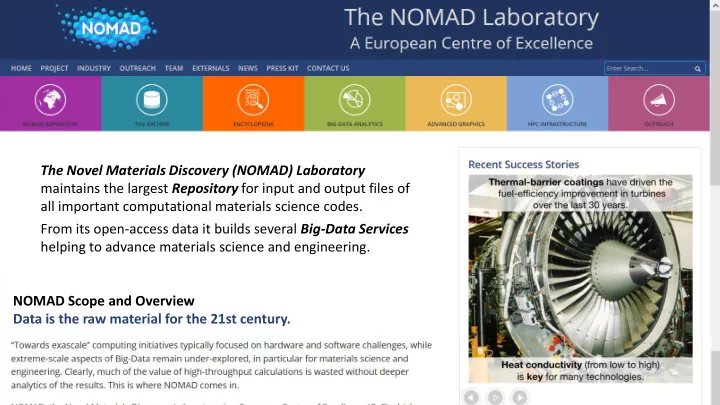
The Novel Materials Discovery (NOMAD) Laboratory maintains the largest Repository for input and output files of all important computational materials science codes. From its open-access data it builds several Big-Data Services helping to advance
The NOMAD Laboratory
A European Centre of Excellence
Arndt Bode Leibniz Comp. Ctr, Garching Alessandro De Vita King’s
- Col. London
Claudia Draxl Humboldt U, Berlin Daan Frenkel
- U. Cambridge
Stefan Heinzel MPS Comp. & Data, Garching Francesc Illas
- U. of Barcelona
Kimmo Koski CSC – IT Center Helsinki Jose Maria Cela,BSC, Barcelona Risto Nieminen Aalto U. Helsinki Ciaran Clissmann pintail Ltd. Dublin Matthias Scheffler, FHI MPS, Berlin Kristian Thygesen
- Tech. U., Lyngby
Angel Rubio MPI MPSD, Hamburg
https://youtu.be/yawM2ThVlGw
Main Services Offered by The NOMAD Repository
- Uploading interfaces: Curl, FTP, Python
- Supporting the most important codes
in computational materials
- Structure calculations in data sets
(folders)
- Share privately with collaborators
- Share anonymously during peer review
- Open Access Sharing:
- DOI support, to link from
publication to data
- DOI support, to link from data to
publication
- Guaranteed storage for 10 years
https://repository.nomad-coe.eu/ https://youtu.be/UcnHGokl2Nc
The NOMAD Archive
90% of the VASP files are from AFLOWlib and OQMD
NOMAD Encyclopedia: How Does It Work, What Does It Offer
Electronic Structure Methodology Structure Thermal Properties
Advanced Graphics
BIG-DATA ANALYTICS We develop and implement methods that identify correlations and structure in big data of
- materials. This will enable scientists and engineers to decide which materials are useful for
specific applications or which new materials should be the focus of future studies.
BIG-DATA ANALYTICS We develop and implement methods that identify correlations and structure in big data of
- materials. This will enable scientists and engineers to decide which materials are useful for
specific applications or which new materials should be the focus of future studies. Querying and visualizing the content of the NOMAD Archive
Developed by Fawzi Mohamed, Luca Ghiringhelli, and Matthias Scheffler
Crystal structure prediction (probably the most fundamental and important challenge in materials science)
- Predicting energy differences between crystal structures
Developed by Angelo Ziletti, Emre Ahmetcik, Runhai Ouyang, Ankit Kariryaa, Fawzi Mohamed, Luca Ghiringhelli, and Matthias Scheffler
- Discovering simple descriptors for crystal-structure classification
Developed by Mario Boley, Bryan Goldsmith, Ankit Kariryaa, and Luca Ghiringhelli
- Building structure maps for crystal-structure classification
Developed by Angelo Ziletti, Ankit Kariryaa, Fawzi Mohamed, Luca Ghiringhelli, and Matthias Scheffler
Predicting ground-states of alloys (convex hull construction)
- Ground-state of binary alloys
Developed by Santiago Rigamonti, Maria Troppenz and Claudia Draxl
- Assessing the crystal-structure stability for a material under different
The Novel Materials Discovery (NOMAD) Laboratory maintains the largest Repository for input and output files of all important computational materials science codes. From its open-access data it builds several Big-Data Services helping to advance materials science and engineering. NOMAD Scope and Overview Data is the raw material for the 21st century.
NOMAD Repository - save and share your data
- Go to nomad-coe.eu, select NOMAD Repository
- Can you find materials you’re working on?
- Upload yours!
- Metadata is added automatically (but you can also add comments)
Data Analytics - suggested tutorials
- Go to nomad-coe.eu, select Big-Data Analytics, and launch a tutorial
- Register or sign in with your temporary account
- Querying and visualizing the content of the NOMAD Archive
- Interactively look for calculations in the NOMAD Archive. Possible to continue with the
tutorial below to apply state-of-the-art machine learning techniques to the query results to find structural similarities in the data.
- On-the-fly data analysis for the NOMAD Archive
- Evaluating the (dis)similarity of crystalline, disordered, and molecular compounds
- Explore the same machine learning method as above, but on a curated dataset.
- Discovering simple descriptors for crystal-structure classification
- Apply subgroup discovery data mining technique on a prepared dataset advanced.
- Analyzing and estimating error bars from high-accuracy references
- Compare and estimate errors in density functional theory calculations.
NOMAD - Take home messages
- Data sharing and preservation
- Discoverability
- Collaboration
- Ease of use (wrt general repo)
- DMP requirements
- Data analysis
- ”data wrangling”
- Notebooks are good
- Use existing workflows and libraries
- Scalable platform
- Team up
https://www.nomad-coe.eu/the-project/outreach/nomad-summer H2020 NOMAD This project has received funding from the European Union’s Horizon 2020 research and innovation programme under grant agreement No 676580.