THE NEW FRONTIER AND THE GREAT SOCIETY KENNEDY AND JOHNSON LEAD - - PowerPoint PPT Presentation

the new frontier and the great society
SMART_READER_LITE
LIVE PREVIEW

THE NEW FRONTIER AND THE GREAT SOCIETY KENNEDY AND JOHNSON LEAD - - PowerPoint PPT Presentation

THE NEW FRONTIER AND THE GREAT SOCIETY KENNEDY AND JOHNSON LEAD AMERICA IN THE 1960S 1960 ELECTION The Democratic nominee for Senator Kennedy, 1958 president in 1960 was a young Massachusetts senator named John senator named John


slide-1
SLIDE 1

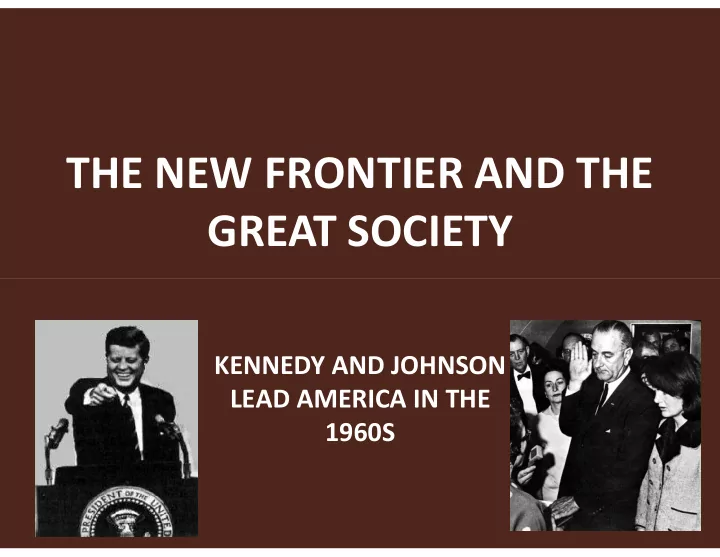
THE NEW FRONTIER AND THE GREAT SOCIETY

KENNEDY AND JOHNSON LEAD AMERICA IN THE 1960S
slide-2
SLIDE 2

1960 ELECTION

  • The Democratic nominee for

president in 1960 was a young Massachusetts senator named John

Senator Kennedy, 1958

senator named John Kennedy

  • He promised to “get America

moving again”

  • Kennedy had a well-
  • rganized campaign and was

handsome and charismatic

slide-3
SLIDE 3

John Kennedy’s Background

  • Born to wealth. One of four sons of

Joseph Kennedy.

  • Harvard Educated, a war hero

–PT-109 –PT-109

  • Pulitzer Prize winning author “Profiles in

Courage.”

  • Former Congressman and then Senator

from Massachusetts

slide-4
SLIDE 4

Kennedy defeats Lyndon Johnson for nomination

  • Johnson is the Senate Majority

leader from Texas

  • Kennedy is the first Catholic
  • Kennedy is the first Catholic

nominated since Al Smith in 1928

  • Kennedy selects Johnson as VP to

balance the ticket.

slide-5
SLIDE 5

REPUBLICAN OPPONENT: RICHARD NIXON

  • The Republicans

nominated Richard Nixon, Ike’s Vice-President

  • The candidates agreed on
  • The candidates agreed on

many domestic and foreign policy issues

  • Two factors helped put

Kennedy over the top: TV and Civil Rights

Nixon hoped to ride the coattails of the popular President

slide-6
SLIDE 6

Nixon leads early because of experience and name recognition

  • Nixon is 47
  • Kennedy 43 & unknown outside Mass.
  • Nixon must defend the Eisenhower
  • Nixon must defend the Eisenhower

record

  • Kennedy complains about a “Missile

Gap”

slide-7
SLIDE 7

TELEVISED DEBATE AFFECTS VOTE

  • On September 26, 1960, Kennedy and Nixon took part in the first

televised debate between presidential candidates

  • Kennedy looked and spoke better than Nixon
  • Journalist Russell Baker said, “That night, image replaced the

printed word as the national language of politics” printed word as the national language of politics”

slide-8
SLIDE 8

JFK: CONFIDENT, AT EASE DURING DEBATES

  • Television had become so

central to people's lives that many observers blamed Nixon's loss to John F. Kennedy on his poor appearance in the televised appearance in the televised presidential debates

  • JFK looked cool, collected,

presidential

  • Nixon, according to one
  • bserver, resembled a

"sinister chipmunk"

slide-9
SLIDE 9

JFK’S OTHER EDGE: CIVIL RIGHTS

  • A second major event of

the campaign took place in October, 1960

  • Police arrested Martin
  • Police arrested Martin

Luther King for conducting a “Sit-In” at a lunch counter in Georgia

  • King was sentenced to

hard labor

Sit-Ins were non-violent protests

  • ver the policy of whites-only

lunch counters in the South

slide-10
SLIDE 10

JFK, NIXON REACT DIFFERENTLY TO KING ARREST

  • While the Eisenhower

Administration refused to intervene, JFK phoned King’s wife and his brother, Robert Kennedy, brother, Robert Kennedy, worked for King’s release

  • The incident captured the

attention of the African- American community, whose votes JFK would carry in key states

slide-11
SLIDE 11

KENNEDY WINS CLOSE ELECTION

slide-12
SLIDE 12

Kennedy wins by narrow margin

  • 118,574 popular vote margin
  • 303 to 219 in electoral votes.

Vote fraud is charged in Illinois and

  • Vote fraud is charged in Illinois and

Texas.

  • Kennedy promises to get the country

moving again.

slide-13
SLIDE 13

Eisenhower’s Farewell Address - Jan. 17, 1961

  • Beware of the Military-Industrial

Complex  It has an unhealthy Complex  It has an unhealthy influence in the councils of government.

slide-14
SLIDE 14

“ASK NOT . . .”

In his inaugural address, JFK uttered this famous challenge: “Ask not what your “Ask not what your country can do for you – ask what you can do for your country”

Delivered Friday, January 20, 1961

slide-15
SLIDE 15

Democrats control Congress...

  • But conservative Republicans & Southern

democrats join forces

  • Liberal elements of New Frontier met

congressional opposition – education, environment, medical – education, environment, medical insurance

  • Kennedy can claim no mandate
  • Focus on Foreign Policy issues and the

economy

slide-16
SLIDE 16

THE CAMELOT YEARS

  • During his term in office,

JFK and his beautiful young wife, Jacqueline, invited many artists and celebrities to the White House

  • The press loved the
  • The press loved the

Kennedy charm and JFK appeared frequently on TV

  • The Kennedys were

considered American “Royalty” (hence “Camelot” reference)

slide-17
SLIDE 17

Americans loved the pictures of John and John and Jackie’s kids playing in the White House.

slide-18
SLIDE 18

THE KENNEDY MYSTIQUE

  • The first family fascinated

the American public

  • For example, after

learning that JFK could read 1,600 words a read 1,600 words a minute, thousands enrolled in speed-reading courses

  • Jackie, too, captivated the

nation with her eye for fashion and culture

slide-19
SLIDE 19

THE BEST AND THE BRIGHTEST

  • JFK surrounded himself

with what one journalist described as the “best and the brightest” available talent

  • Of all of his elite advisors
  • Of all of his elite advisors

who filled Kennedy’s inner circle, he relied most on his 35-year-old brother Robert, whom he appointed attorney general

RFK was John’s closest friend and advisor

slide-20
SLIDE 20

THE NEW FRONTIER

  • Kennedy initiated his

vision in a program he called “The New called “The New Frontier”

  • The economy,

education, medical care for the elderly and the poor, and space exploration were all part of his vision

slide-21
SLIDE 21

Dealing with the Economy

  • 8% unemployment, slow economic growth

demanded attention

  • Kennedy followed Keynesian economics

–Increased govt. spending & urban renewal –Increased minimum wage & set up retraining –Increased minimum wage & set up retraining programs –Sought lower taxes to stimulate economy –Initiated tariff negotiations to stimulate exports

slide-22
SLIDE 22

THE PEACE CORPS

  • One of the first programs

launched by JFK was the Peace Corps Corps

  • The Peace Corps is a volunteer

program to assist developing nations in Asia, Africa and Latin America

  • The Peace Corps has become a

huge success

slide-23
SLIDE 23

RACE TO THE MOON

  • On April 12, 1961, Soviet

cosmonaut Yuri Gagarin became the first human in space space

  • Meanwhile, America’s

space agency (NASA) began construction on new launch facilities in Cape Canaveral, Florida and a mission control center in Houston, Texas

slide-24
SLIDE 24

A MAN ON THE MOON

  • Finally, on July 20, 1969, the

U.S. would achieve its goal

  • An excited nation watched as

Armstrong

  • An excited nation watched as

U.S. astronaut Neil Armstrong took the first steps on the moon

  • Space and defense-related

industries sprang up in Southern and Western states

“One small step for man, one giant leap for mankind”

slide-25
SLIDE 25

KENNEDY ADDRESSES INNER CITY BLIGHT AND RACISM

  • In 1963, Kennedy called for “a national assault on the causes of poverty”
  • He also ordered his brother, Attorney General Robert Kennedy to

investigate racial injustice in the South

  • Finally, he presented Congress with a sweeping civil rights bill and a

sweeping tax cut bill to spur the economy

slide-26
SLIDE 26

TRAGEDY IN DALLAS

  • On a sunny day on November 22,1963, Air Force One landed

in Dallas with JFK and Jackie

  • JFK received warm applause from the crowd that lined the

downtown streets of Dallas as he rode in the back seat of an

  • pen-air limousine
slide-27
SLIDE 27

JFK SHOT TO DEATH

  • As the motorcade

approached the Texas Book Depository, shots rang out

  • JFK was shot in the neck

and then the head

  • His car was rushed to a
  • His car was rushed to a

nearby hospital where doctors frantically tried to revive him

  • President Kennedy was

dead (11/22/63)

slide-28
SLIDE 28

LYNDON BAINES JOHNSON BECOMES PRESIDENT

  • The Vice-President,

Lyndon Baines Johnson, became President after JFK was assassinated JFK was assassinated

  • The nation mourned the

death of the young president while Jackie Kennedy remained calm and poised

A somber LBJ takes the oath

  • f office aboard Air Force One

with the Jackie next to him

slide-29
SLIDE 29

JFK LAID TO REST

  • All work stopped for

Kennedy’s funeral as America mourned its fallen leader

  • The assassination and the
  • The assassination and the

televised funeral became historic events

  • Like 9-11, Americans can

recall where they were when they heard the news

  • f the President’s death

Three-year old John Kennedy

  • Jr. salutes his father’s coffin

during the funeral

slide-30
SLIDE 30

LEE HARVEY OSWALD CHARGED; SHOT TO DEATH

  • A 24-year-old Marine with

a suspicious past left a palm print on the rifle used to kill JFK

  • He was charged and as a
  • He was charged and as a

national television audience watched his transfer from one jail to another, nightclub owner Jack Ruby broke through the crowd and shot Oswald to death

Jack Ruby, right, shoots Oswald, center, to death 11/24/63

slide-31
SLIDE 31

UNANSWERED QUESTIONS

  • The bizarre chain of events led

many to believe that Oswald was part of a conspiracy

  • The Warren Commission

investigated the assassination investigated the assassination and determined that Oswald had indeed acted alone

  • Filmmaker Oliver Stone isn’t so

sure – his film, “JFK,” is filled with conspiracy theories

slide-32
SLIDE 32

THE GREAT SOCIETY

  • A fourth-generation Texan,

Lyndon Johnson (LBJ) entered politics in 1937 as a congressman

  • Johnson admired Franklin
  • Johnson admired Franklin

Roosevelt who took the young congressman under his wing

  • Johnson became a senator in

1948 and by 1955 he was Senate majority leader

Senator Johnson pictured in 1958 with a nerd

slide-33
SLIDE 33

JOHNSON’S DOMESTIC AGENDA

  • As soon as Johnson took
  • ffice, he urged Congress

to pass the tax-cut bill that Kennedy had sent to Kennedy had sent to Capital Hill

  • The tax cut passed and

$10 billion in cuts took effect

slide-34
SLIDE 34

CIVIL RIGHTS ACT OF 1964

  • In July of 1964, LBJ pushed the Civil Rights Act through

Congress

  • The Act prohibited discrimination based on race, color,

religion or national origin, and granted the federal government new powers to enforce the law

LBJ signs the Civil Rights Act as Martin Luther King watches

slide-35
SLIDE 35

VOTING RIGHTS ACT 1964

  • Part of the Civil Rights Act

was to insure voting rights for all Americans

  • The act prohibited literacy

tests or other tests or other discriminatory practices for voting

  • The act insured consistent

election practices

"By the way, what's the big word?"

slide-36
SLIDE 36

THE WAR ON POVERTY

  • Following his tax cut and Civil

Rights Act successes, LBJ launched his War on Poverty

  • In August of 1964 he pushed

through Congress a series of through Congress a series of measures known as the Economic Opportunity Act

  • The Act provided $1 billion in

aid to the inner city

slide-37
SLIDE 37

ECONOMIC OPPORTUNITY ACT

THE EOA legislation created:

  • The Job Corps
  • VISTA (Volunteers in service to

America)

  • Project Head Start for

underprivileged preschoolers underprivileged preschoolers

  • The Community Action

Program which encouraged the poor to participate in public works program

Project Head Start is still going strong

slide-38
SLIDE 38

THE 1964 ELECTION

  • In 1964, the Republicans

nominated conservative senator Barry Goldwater of Arizona to Barry Goldwater of Arizona to

  • ppose Democrat Lyndon

Johnson

  • Goldwater opposed LBJ’s social

legislation

  • Goldwater alienated voters by

suggesting the use of nuclear weapons in Cuba and North Vietnam

slide-39
SLIDE 39

LBJ WINS BY A LANDSLIDE

  • LBJ won the

1964 election by a landslide

  • For many it was an anti-

Goldwater vote Goldwater vote

  • Many Americans saw

Goldwater as a War Hawk

  • The Democrats also increased

their majority in Congress

  • Now Johnson launched his

reform program in earnest

slide-40
SLIDE 40

LBJ easily defeats Goldwater in ‘64

slide-41
SLIDE 41

BUILDING THE GREAT SOCIETY

  • In May of 1964, LBJ

summed up his vision for America in a phrase: “The Great Society” “The Great Society”

  • By the time he left the

White House in 1969, Congress had passed 206 of LBJ’s Great Society legislative initiatives

slide-42
SLIDE 42

EDUCATION

  • Johnson considered education

“the key which can unlock the door to the Great Society”

  • The Elementary and Secondary

Education Act provided $1 billion to help public schools buy textbooks and library materials

  • This Act represented the first

major federal aid package for education ever

slide-43
SLIDE 43

HEALTH CARE

  • LBJ and Congress

enhanced Social Security by establishing Medicare and Medicaid

  • Medicare provided

hospital insurance and low-cost medical care to the elderly

  • Medicaid provided health

benefits to the poor

slide-44
SLIDE 44

HOUSING

  • LBJ and Congress

appropriated money to build 240,000 units of low- rent public housing; established the Department

Weaver

established the Department

  • f Housing and Urban

Development (HUD) and appointed the first black cabinet member, Robert Weaver, as HUD’s first leader

slide-45
SLIDE 45

IMMIGRATION REFORM

  • The Great Society also brought

reform to immigration laws

  • The Natural Origins Acts of the

1920s strongly discriminated against immigration by those against immigration by those

  • utside of Western Europe
  • The Immigration Act of 1965
  • pened the door for many

non-European immigrants to settle in the U.S.

slide-46
SLIDE 46

THE ENVIRONMENT

  • LBJ also actively sought to improve the environment
  • The Water Quality Act of 1965 required states to clean up

their rivers and lakes

  • LBJ also ordered the government to clean up corporate

polluters of the environment

slide-47
SLIDE 47

CONSUMER PROTECTION

  • Consumer advocates also

made gains during the 1960s

  • Major safety laws were

passed in the U.S. auto industry and Congress industry and Congress passed the Wholesome Meat Act of 1967

  • LBJ said, “Americans can

feel safer now in their homes, on the road, and at the supermarket”

slide-48
SLIDE 48

SUPREME COURT REFORMS SOCIETY, TOO

  • Reform and change were not

limited to the Executive and Legislative branches Legislative branches

  • The Judicial Branch led by the

Supreme Court and Chief Justice Earl Warren did much to protect individual rights

slide-49
SLIDE 49

WARREN COURT AND SUSPECT’S RIGHTS

  • In Mapp v. Ohio (1961) the

Supreme Court ruled that illegally seized evidence could not be used in court not be used in court

  • In Escobedo v. Illinois the court

ruled that the accused has the right to have an attorney present when questioned by police

  • In Miranda v. Arizona the court

ruled that all suspects must be read their rights before questioning

slide-50
SLIDE 50

IMPACT OF GREAT SOCIETY

  • The Great Society and the Warren Court changed the United

States

  • No president in Post-WW II era extended the power and

reach of the federal government more than LBJ

  • The War on Poverty helped, the Civil Rights initiative made a

difference and the massive tax cuts spurred the economy