The National Planning Framework and Regional Inequalities Can - - PowerPoint PPT Presentation

the national planning framework and regional inequalities
SMART_READER_LITE
LIVE PREVIEW

The National Planning Framework and Regional Inequalities Can - - PowerPoint PPT Presentation

Western Development Commission The National Planning Framework and Regional Inequalities Can these be addressed? Deirdre Frost June 2017 Outline Context WDC, What we do What regional inequalities are we trying to address?


slide-1
SLIDE 1

Western Development Commission

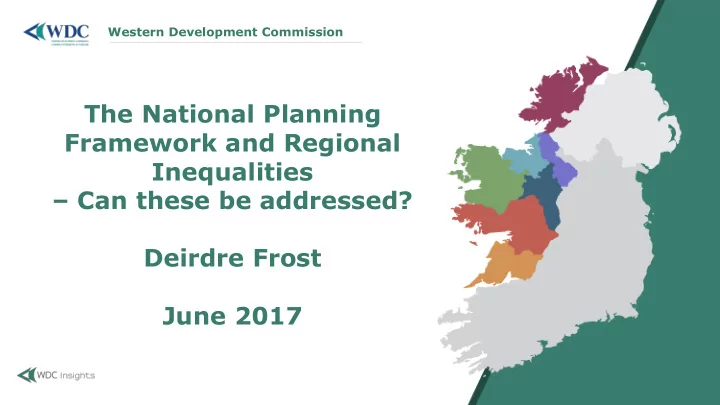
The National Planning Framework and Regional Inequalities – Can these be addressed? Deirdre Frost June 2017

slide-2
SLIDE 2

providing insights on key issues for the Western Region of Ireland

  • Context – WDC, What we do
  • What regional inequalities are we trying to address?
  • Regional & rural development & implications of the NPF
  • The role of the NPF in enterprise & employment strategies
  • Relationship between NPF, infrastructure & capital spending

Outline

slide-3
SLIDE 3

providing insights on key issues for the Western Region of Ireland

  • 7 county Western Region
  • State body – Department of Arts,

Heritage, Regional, Rural & Gaeltacht Affairs

  • WDC Act 1998

‘….foster and promote the economic and social development of the Western Region’

Western Development Commission (WDC)

slide-4
SLIDE 4

providing insights on key issues for the Western Region of Ireland

  • Inform policy-making through analysis
  • f Region’s issues & needs

(e.g. infrastructure, labour market)

  • Promotion – www.lookwest.ie
  • Development of region’s resources

e.g.Creative sector, Tourism, Renewable energy

  • WDC Investment Fund – Risk capital to SMEs

WDC – What we do

slide-5
SLIDE 5

providing insights on key issues for the Western Region of Ireland

Regional Inequalities – Population growth/decline

2016 % Change 11-16

Clare 118,817 1.4 Donegal 159,192

  • 1.2

Galway city 78,668 4.2 Galway county 179,390 2.4 Leitrim 32,044 0.8 Mayo 130,507

  • 0.1

Roscommon 64,544 0.7 Sligo 65,535 0.2 Western Region 828,697 1.0 State 4,761,865 3.8 Rest of State 3,933,168 4.4

slide-6
SLIDE 6

providing insights on key issues for the Western Region of Ireland

Persons per sq km

1841 2016 Leitrim: 97.7 20.2 Roscommon 99.5 25.3 Sligo: 98.4 35.6 State: 96.04 70.0 Population Change – longer term trends

Population Density – 2016 as a % of 1841 pop. Leitrim 21% Louth 101% Roscommon 25% Meath 106% Mayo 34% Wicklow 113% Sligo 36% Kildare 194% Clare 41% Dublin 361% Donegal 54% Galway 59% Western Region 41%

slide-7
SLIDE 7

providing insights on key issues for the Western Region of Ireland

  • Age dependency - 21.1% of WR 0-14 yrs. Same as Rest of State

= 21.1%, EU28 = 15.6%

  • But Pop of working age lower: WR=63.5%, Rest of

State=65.9% EU 28=65.5%

  • Elderly population (65+)in WR 15.4%, Rest of State = 13%,

EU28 = 18.9%

  • Age cohort 25-34 yrs – evidence of outmigration. Greater levels
  • f outmigration from WR. Jobs are key!

What are the Regional Inequalities

slide-8
SLIDE 8

providing insights on key issues for the Western Region of Ireland

  • NPF Issues paper – from ‘business as usual’… to developing other centres
  • WDC Submission
  • The primacy of Ireland’s capital is unusual compared to other advanced

small countries.

Either over or under [urban] concentration … is very costly in terms of economic efficiency and national growth rates (Henderson, 2000).

  • Ireland’s share of largest city in urban population an outlier in OECD countries –

comparable to Argentina, Panama, Costa Rica, Chile, Korea, Thailand, the Congo, Greece and Portugal!!.

  • A key goal of the NPF should be to effectively promote second tier cities.

Regional & rural development implications of NPF

slide-9
SLIDE 9

providing insights on key issues for the Western Region of Ireland

  • The 5 cities serve the East, South, Mid-West & West…. driving development in

their regions.

  • The North West needs a stronger urban centre, Brexit an additional
  • challenge. Sligo & Letterkenny.
  • Urban Growth in West: Galway the only built-up area which experienced

consistent population growth greater than national av. – 96-2016, (41% v 31%)

  • Why? Quality of life appeal, good employment opportunities, strong

educational & health facilities … Absence of a larger growth centre to the North

  • Role of other towns – smaller towns in a largely rural Western Region perform

functions of larger towns or cities in other regions. Regional & Rural development - WDC Submission

slide-10
SLIDE 10

providing insights on key issues for the Western Region of Ireland

  • The regional cities have capacity to ‘take the strain’ – if given

the resources & more effective linkages between them Sufficient Scale?

  • Dublin competed successfully internationally, when it was much

smaller in size.

  • Galway, Cork and Limerick – smaller centres can & do

successfully compete.

  • Importance of intra-regional commuting –improvements in key

parts of transport network.

  • Significant linkages between rural areas & their urban centres.

Regional development – Implications of NPF

slide-11
SLIDE 11

providing insights on key issues for the Western Region of Ireland

  • Important sectors – tourism, agrifood, creative industries, renewable energy.
  • Higher self -employment in WR – Incl and excl agriculture. 22.9% compared to 15.2%

national av.

  • BUT there can be too much focus on distinctive characteristics of rural areas
  • More similarities than differences. Similar types of businesses (for the most part) &

employment

  • Rural-urban linkages: Importance of rural dwellers as a key element of labour

supply of FDI – e.g. over ¼ of rural dwellers commuting to work in Galway city work in IDA business parks in East of Galway city(4,200+).

  • Issues for planners– towns & villages – imp centres for employment, residence &

service provision. Lack of investment in these centres. E.g. footpaths in vicinity of rural towns & villages

Rural areas – Implications of NPF

slide-12
SLIDE 12

providing insights on key issues for the Western Region of Ireland

‘Rural’ employment – Jobs by Sector, Co. Mayo

(Census 2011)

slide-13
SLIDE 13

providing insights on key issues for the Western Region of Ireland

  • Ltd concept of work in Issues paper – Self-employment, e-working, gig economy,

contract work

  • More effective intra-regional transport links – extending labour catchments,

benefitting employers & workers, stronger regional centres.

  • UK Research - Policy can effectively influence the location of FDI in favour of the

north. Scale

  • Size: Not all centres can or should compete for very large scale investments.
  • City regions outside of Dublin, now focal points for internationally mobile investment.
  • But smaller centres successful attracting FDI too.

The role of NPF in enterprise & employment strategies

slide-14
SLIDE 14

providing insights on key issues for the Western Region of Ireland

  • Transport investment promoted development of Dublin – road & rail networks

developed in a radial fashion, motorways too.

  • Poor connectivity between the other centres - constraining economic activity

Investment in national transportation infrastructure creates beneficial effects in spreading economic benefits throughout the regions, but a transportation system that centres on a single city will ultimately reinforce its dominance (Krugman, 1996). Clinch & O’ Neill (2009) citing Krugman note that The entire transportation system in Ireland is a radial one consisting of road, rail and airports links each with Dublin as the hub.

  • Regions without significant transport improvements become relatively inaccessible.

E.g North west.

  • Weaker links between regional centres:Cork – Limerick, Galway - Sligo - Letterkenny
  • Capitalise on investments already made e.g.capacity at Shannon & Knock airports.

The NPF, infrastructure and capital spending

slide-15
SLIDE 15

providing insights on key issues for the Western Region of Ireland

Accessibility – Motorway network and drivetimes

Motorways Drive Time (Minutes)

1 - 15 16 - 30 31 - 60 61 - 120 121 and more

slide-16
SLIDE 16

providing insights on key issues for the Western Region of Ireland

  • Low pop. density BUT geographically small & compact, unchallenging

terrain.

  • Broadly dispersed, but infrastructure deployed coast to coast and serve

the entire country in between.

  • Cost of infrastructure higher in congested, brownfield sites.
  • Infrastructure investment influences other infrastructure deployment

e.g. broadband & motorways – a detrimental impact on unserved locations

  • Transport investment by mode e.g. road & rail investment: cumulative

effect on specific routes/regions not considered.

NPF, Infrastructure & Capital Investment – key considerations I

slide-17
SLIDE 17

providing insights on key issues for the Western Region of Ireland

  • Short term needs, long-term impacts. Investment decisions now have long

term impacts.

  • Investments by the ‘wider state sector’
  • Appropriate Appraisal and Evaluation Methods. Traditional CBA (cost benefit

analysis) naturally favours the larger population centres as the impacts affect a greater number.

  • Need to revise methodology to support wider spatial balance and NPF goals.
  • Consider Social Return on Investment (SROI) capturing a broader measure e.g.

environmental and social value not currently reflected in conventional financial accounts)

NPF, Infrastructure & Capital Investment – key considerations II

slide-18
SLIDE 18

providing insights on key issues for the Western Region of Ireland

Necessary…...but maybe not sufficient!?

  • A single body with responsibility & designated budget
  • All other spending, investment & policy decisions in line with NPF
  • Currently sectoral policy & planning is driver of regional development
  • Clear relationship between delivery of the NPF & the RSES in each of

the three regions.

  • ‘Buy in’ – all to have a stake.

Implementation of NPF

slide-19
SLIDE 19

https://wdcinsights.wordpress.com/ www.wdc.ie @WDCInsights

Thank You Q&A

All publications at www.wdc.ie/publications/ Sign up for Insights mailing list email policyanalysis@wdc.ie Follow blog at //wdcinsights.wordpress.com/ http://www.wdc.ie/policy/wdc-insights-blog/ deirdrefrost@wdc.ie