
SLIDE 1
The ¡Lederberg-‑Tatum ¡experiment ¡showing ¡bacterial ¡ conjuga9on ¡ ¡
Figure ¡7.9 ¡
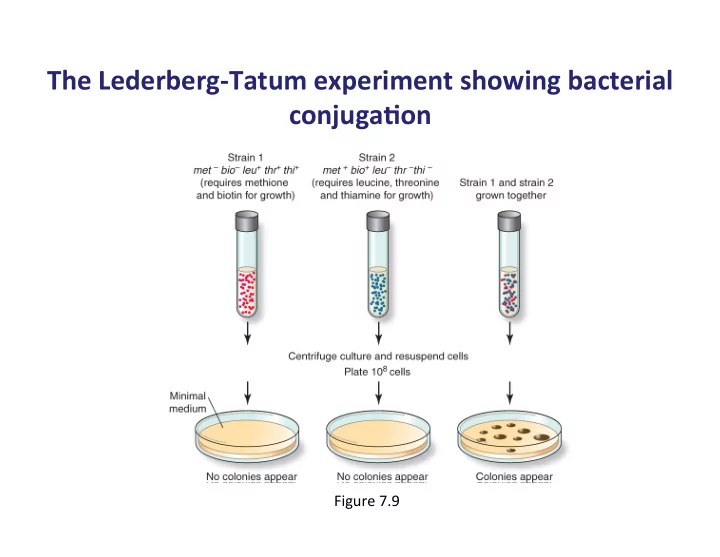
The Lederberg-Tatum experiment showing bacterial conjuga9on - - PowerPoint PPT Presentation
The Lederberg-Tatum experiment showing bacterial conjuga9on Figure 7.9 Table 6.2 Figure 10.16 IS 3 Tn 1000 99.2kbp/0 tra region IS 3 IS 2 F plasmid 75
Figure ¡7.9 ¡
Table 6.2
Figure 10.16
Figure 10.17
Pilus ¡with ¡ aFached ¡ phage ¡virions ¡
Figure ¡11: ¡F ¡pili ¡connec2ng ¡ma2ng ¡E. ¡coli ¡cell. ¡
Photo ¡courtesy ¡of ¡Professor ¡Ron ¡Skurray, ¡School ¡of ¡Biological ¡Sciences, ¡ University ¡of ¡Sydney ¡
Figure 10.15
Normal ¡event: ¡ Rare ¡event: ¡
Galactose ¡ genes ¡of ¡ host ¡DNA ¡ Host ¡ ¡ chromosome ¡ Lysogenized ¡ cell ¡ Phage ¡DNA ¡ Normal ¡ phage ¡ Defec9ve ¡phage ¡ that ¡can ¡transduce ¡ galactose ¡genes ¡
Induc9on ¡ Phage ¡DNA ¡ circularizes ¡ and ¡detaches ¡ from ¡host ¡DNA ¡ A ¡por9on ¡of ¡ host ¡DNA ¡is ¡ exchanged ¡for ¡ phage ¡DNA ¡ Detached ¡ DNA ¡ replicates ¡ Phage ¡replica9on ¡ is ¡completed. ¡ Cell ¡lyses ¡
Figure ¡7.12 ¡
Adapted ¡from ¡L. ¡S. ¡Frost, ¡et ¡al., ¡Nat. ¡Rev. ¡Microbiol. ¡3 ¡(2005): ¡722-‑732. ¡
Figure ¡7.13 ¡
Figure ¡10: ¡Conjugal ¡transfer ¡of ¡DNA ¡mediated ¡by ¡bacterial ¡sex ¡plasmids. ¡
Figure 10.18
Bacterial ¡ chromosome ¡ F ¡plasmid ¡ Pilus ¡
F+ ¡cell ¡
(donor) ¡
F-‑ ¡cell ¡
(recipient) ¡
Pilus ¡retracts ¡
F+ ¡cell ¡ F+ ¡cell ¡
Cell ¡pairs ¡stabilized. ¡ F ¡plasmid ¡nicked ¡in ¡one ¡strand ¡ Transfer ¡of ¡one ¡strand ¡from ¡F+ ¡cell ¡to ¡F-‑ ¡cell. ¡ F ¡plasmid ¡simultaneously ¡replicated ¡in ¡F+ ¡cell ¡ Synthesis ¡of ¡complementary ¡strand ¡ begins ¡in ¡recipient ¡cell ¡ Comple9on ¡of ¡DNA ¡transfer ¡ and ¡synthesis. ¡Cells ¡separate ¡
Primer ¡ Cell ¡walls ¡ DNA ¡polymerase ¡ Retained ¡strand ¡ DNA ¡polymerase ¡ Unwinding ¡protein ¡ (Tral) ¡ Plasmid-‑encoded ¡ membrane ¡proteins ¡ Specific ¡outer ¡ membrane ¡protein ¡
Donated ¡strand ¡ Primer ¡
Donor ¡ Recipient ¡
Figure 10.19
Figure 10.20
Figure ¡7.16 ¡