The Knowledge Level Paper written by Allen Newell published in - - PowerPoint PPT Presentation

the knowledge level
SMART_READER_LITE
LIVE PREVIEW

The Knowledge Level Paper written by Allen Newell published in - - PowerPoint PPT Presentation

The Knowledge Level Paper written by Allen Newell published in IT3706 Knowledge Representation Journal of Artificial Intelligence in 1982 Concerns the question of what knowledge Lesson 6: The Knowledge Level is in AI. Introduces a


slide-1
SLIDE 1

IT3706 Knowledge Representation

Lesson 6: The Knowledge Level

The Knowledge Level

Paper written by Allen Newell published in

Journal of Artificial Intelligence in 1982

Concerns the question of what knowledge

is in AI.

Introduces a high-level view for

characterizing intelligent behavior in agents.

Two views on AI

The Tasks

Puzzle solving Natural language processing Planning Diagnosis ...

The Components

Perceptual system Memory component Reasoning system Acting system ...

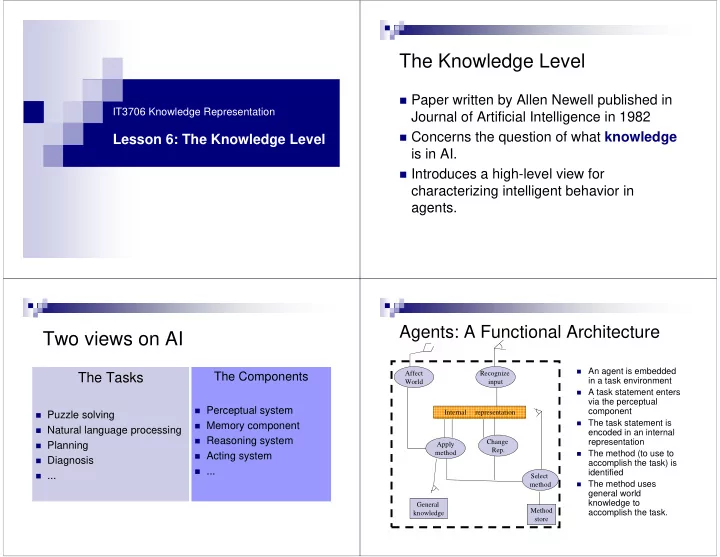
Agents: A Functional Architecture

Affect World Recognize input Apply method Change Rep. Select method General knowledge Method store Internal representation An agent is embedded

in a task environment

A task statement enters

via the perceptual component

The task statement is

encoded in an internal representation

The method (to use to

accomplish the task) is identified

The method uses

general world knowledge to accomplish the task.

slide-2
SLIDE 2

So, what’s the problem?

Questionnaire given to Knowledge

Representation researchers show that there are very little consensus.

Representation has been given a ”magical” role

in intelligence.

Seen as the locus of

real intelligence (Turing machine)

The dominos-on-chessboard

example (next slide). What if the top left and bottom right squares are removed?

Covering the Chessboard

Task is to cover chessboard with dominos covering two squares. With normal board, this is easy. What if the top left square is removed?

Looking at ”Knowledge” and ”Representation”

Representation: Quite specific meaning – almost

a technical term in AI.

Knowledge: No agreement of what knowledge

is.

Newell wants to investigate:

What is the nature of knowledge? How does it relate to representation? What does a system have when it has knowledge?

Computer System Levels

A computer system can

be analyzed and understood on different levels.

Each level is

implemented in the level below.

A higher level is

autonomous

Example: A programmer

does not need to know how logic circuits work) Device Level Circuit Level Logic Circuit Level Register Transfer Level Symbol Level

slide-3
SLIDE 3

Computer System Levels

A level is characterized by:

A medium (that which is

processed)

Components (provides the

primitive processing)

Laws of composition (how

components may be assembled to a system)

Laws of behavior (determines

how the system behaves given how the components behave and how they are composed) Device Level Circuit Level Logic Circuit Level Register Transfer Level Symbol Level

Computer System Levels

Medium

Symbols and expressions (programs) Bit vectors Single bits Current and voltage Electrons and magnetic domains Device Level Circuit Level Logic Circuit Level Register Transfer Level Symbol Level

Computer System Levels

Symbol Level Register Transfer Level System Medium Components Composition Laws Behavior Laws Digital Systems Bit Vectors Registers, Functional units Transfer Path Logical Operators Computers Symbols (programs) Memories, Operations Designations, Associations Sequential Interpretations Device Level Circuit Level Logic Circuit Level Register Transfer Level Symbol Level

The Knowledge Level Hypothesis

”There exists a distinct computer systems level, lying immediately above the symbol level, which is characterized by knowledge as the medium and the principle of rationality as the behavior law. ” (p. 99) Principle of Rationality: ”If an agent has knowledge that

  • ne of its actions will lead to
  • ne of its goals, then the agent

will select that action.” (p. 102)

Knowledge Level

slide-4
SLIDE 4

The Knowledge Level

Goals Knowledge Principle of Rationality Observer Agent ”He will be able to solve the problem – he knows how and wants to do it.”

The Knowledge Level

The Knowledge Level provides the means to ’rationalize’ the

behavior of a system from the standpoint of an external observer.

”He is running because he knows the store will close at 9.” This observer treats the system as a ’black box’ but maintains that it

acts as if it possesses certain knowledge about the world and uses this knowledge in a perfectly rational way toward reaching its goals.

”He will be here, this is the last showing and he really wanted to watch

the movie.”

We can specify competence on a high level by specifying goals and

knowledge before going into implementation details.

”The agent should be able to play chess well, so it needs to know some

good openings and what pieces positions on the board are important.”

The Knowledge Level Defined

System: Agent Components: Goals, Actions, Bodies Medium: Knowledge Behavioral law: The principle of rationality Compositional law: None – no structure! ”To treat a system at the KL is to treat it as having some knowledge and some goals, and believing it will do whatever is within its power to attain its goals, in so far as its knowledge indicates” (p. 98)

Knowledge Level and Symbol Level

The Knowledge Level can be ”reduced” i.e.

Implemented in the Symbol Level.

Knowledge: What is stored in the Knowledge

Representation system (frame-based system, rules- based systems, logic ...) and all possible inferred facts

Goal: Special kind of knowledge, or implicit. Agent: The complete Symbol Level system Principle of Rationality: The Reasoning Strategy

slide-5
SLIDE 5

Knowledge Level and Symbol Level

The crucial difference between KL and SL is that

the Symbol Level is system oriented, whereas the Knowledge Level is world oriented.

A Knowledge Level model is in terms of

knowledge about the world and the environment in which the agent's problems and actions occur.

Consequences

Knowledge is intimately linked to rationality – ’rational

systems can be said to have knowledge’

Knowledge is a competence-like notion, having the

ability to generate action

The knowledge level is an approximation Knowledge serves as a specification of what a symbol

structure should be able to do

Representations exist at the symbol level and

realizes/mechanizes a body of knowledge.

Components (actions, goals, bodies of knowledge) of KL

and its medium (knowledge) can be defined in terms of systems at the symbol level.

Summary

A knowledge level model is a model of behavior in terms

  • f knowledge, just like a symbol level model is a model
  • f interaction in terms of symbols and representations.

Representation = Knowledge + Access Emphasis on knowledge instead of representation and

implementation allow allows one to make meaningful statements about system behavior without reference to the structures and mechanisms within the agent that realize that behavior.