
SLIDE 1
The Importance of School Libraries "What a school thinks about - - PDF document
The Importance of School Libraries "What a school thinks about its library is a measure of what it thinks about education." ~ Harold Howe, former U.S. Commissioner of Education School Librarians Matter
~ Harold Howe, former U.S. Commissioner of Education
https://www.youtube.com/watch?v=KTslgjLEzLw
2015 Washington State Study Students who attend schools with certified teacher- librarians and quality library facilities:
advanced and accessible library facilities.
during the school day and outside of school.
technology skills and technology fluency skills https://wala.memberclicks.net/assets/WLMA/Advoca cy/wslitreport_final%204_11_15final.pdf
Study Ties College Success to Students’ Exposure to a High School Librarian “There appears to be a relationship between what students were calling research boot camp in grade nine and the confidence they feel in conducting research at a college level.” ~Kate Lawrence, EBSCO’s senior director of user research
Lauren Barack, September 19, 2014 School Library Journal
Top 10 of 2014, No. 1: Libraries, Reinvented eSchool News January 2nd, 2015 Of the 10 most significant ed-tech developments of 2014, school libraries are No. 1. School librarians are emerging as leaders as they help teachers learn valuable technology integration skills. They also teach students how to research and evaluate information.
http://www.eschoolnews.com/2015/01/02/top-10-libraries-239/?
2011 Rutgers Study Finds Effective School Libraries Impact Entire School by:
Establishing a learning environment where students are guided by professionals to effectively utilize information and technology tools in ethical and safe ways
Offering a central, safe place that removes barriers and constraints to learning with information resources and information technology
Offering services that are different from those provided in the classroom: It connects information and expertise at the intersection of digital and print information in and beyond the walls of the school.
2012 Pennsylvania Study
likely to score “Advanced” and less likely to score “Below Basic” on reading and writing tests.
scoring “Advanced” in writing is two and a half times higher for schools with a full-time, certified librarian than those without one.
http://paschoollibraryproject.org/research
~ Barbara Barnard Stein and Celia
Teacher Librarian, October, 1999, pp. 32- 35.
“The most basic was that students were just as unaware of the extent of their own information illiteracy as everyone else.”
~Steve Kolowich, Inside Higher Ed, August 22, 2011
What topics HS Librarians cover in school and what topics are essential for College Topics HS College
Database versus “free” web 92.2% 92.2% Evaluate resources 90.7% 93.8% How to use a catalog/OPAC 90.7% 88.4% Academic integrity 83.7% 96.1% Primary versus secondary source 81.4% 81.4% Types and use of print resources 77.5% 78.3% When/where to cite 74.4% 89.1% Subject versus keyword search 74.4% 75.2% Journal versus magazine 72.9% 76.0% Identify possible sources 72.1% 81.4%
High School to College surveys were conducted by: Martha Daly, Librarian Connelly School of the Holy Child Potomac, MD (2010)
“There is one clear and consistent finding that is supported by our research: a school library media program with a full-time library media specialist, support staff, and a strong computer network leads to higher student achievement.”
~ Hamilton-Pennell, Christine, et.al. “Dick and Jane Go to the Head of the Class,” School Library Journal, April, 2000, p.44-47
Their vital work is largely unrecognized. What is worse, it is being compromised, as local, state and federal funding for school libraries continues to shrink. While this might improve the bottom line for schools, it is depriving students
learn, participate and compete in today's world. Let's not sacrifice our future. We are a world starving for
libraries. Brad Meltzer
http://www.huffingtonpost.com/brad-meltzer/school-libraries- _b_1411914.html
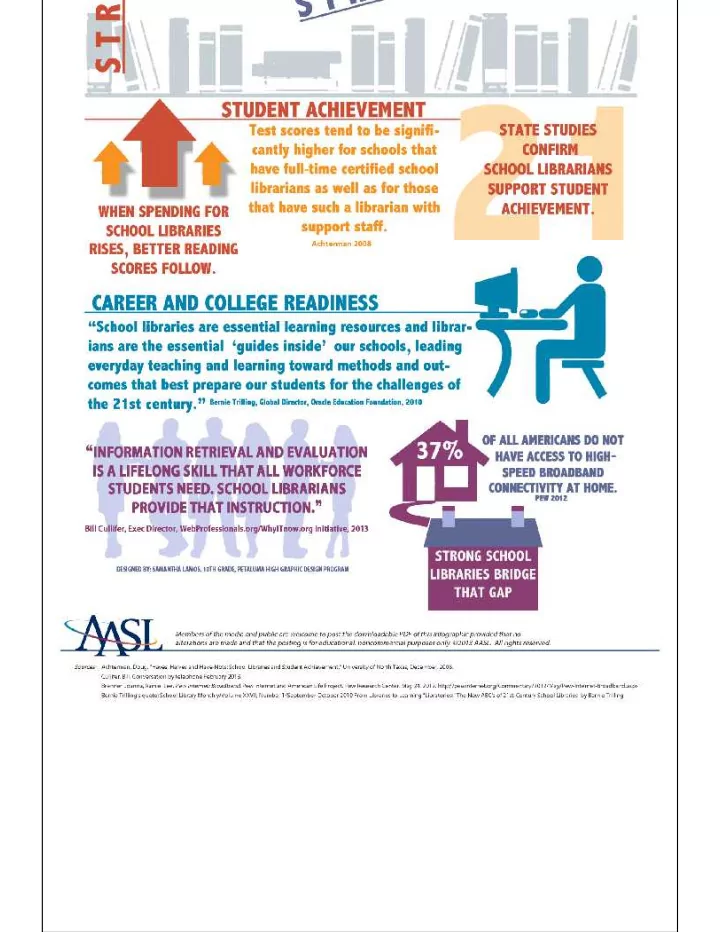
National Forum on Information Literacy (NFIL) POLICY STATEMENT ON THE IMPORTANCE OF CERTIFIED SCHOOL LIBRARIANS December 11, 2014 CAREER AND COLLEGE READINESS implies that high school seniors have an advanced ability to find, use, and communicate information in various contexts. However, employers and colleges report a lack of 21st century skills related to information literacy in new employees and first- year students. School librarians are those best qualified to partner with classroom teachers in cultivating these abilities in students; classroom teachers do not learn how to teach these competencies during teacher preparation programs. All teachers should work with a full-time certified or licensed school librarian located in their schools to partner on teaching students to learn by effectively using information— the key to lifelong learning. http://infolit.org/nfil-policy-statement-school-librarians/
Our students deserve to have a Brunswick High School Media Center website that contains updated information and links. They deserve to have a talented and knowledgeable voice sharing new fiction and nonfiction books, resources and reference
support of a trained and qualified expert who can assist with building reading strength and bridging the gap between our schools and grade levels. ~Mrs. Kristin Weight, Brunswick High School English Teacher
I can understand with the advent of technology this may seem like an easy area to reduce costs but with the onset of CCSS it is a position that now has an even more important role in the success of a building as a learning institution. The role of the School Librarian/Media Specialist has been greatly changed. These individuals provide support to staff and students.
~Matthew J. Krise, Brunswick Ohio
While there is a responsibility of the individual teachers in the school system to help prepare students to understand technology and research for the future, their primary responsibility is to the curriculum they teach. Having a resource specialist who can help keep both the students and the faculty up to date on what is expected at the next level will be vital to the success of students in college or
reconsider the need for a resource specialist, and decide to hire a certified librarian. Michael Pandora Class of 2008
Cherie Pandora- BS Ed, MLS, Ed.Spec. Retired teacher-librarian, adjunct instructor Parent & community member cherylpp@frontier.com Holly Bunt- BS Ed, MLS Western Reserve Academy Brunswick High School Graduate Community member bunth@wra.net Michele Kuhar- BME, MM, MLS Retiring teacher-librarian Community member mlkuhar@bright.net