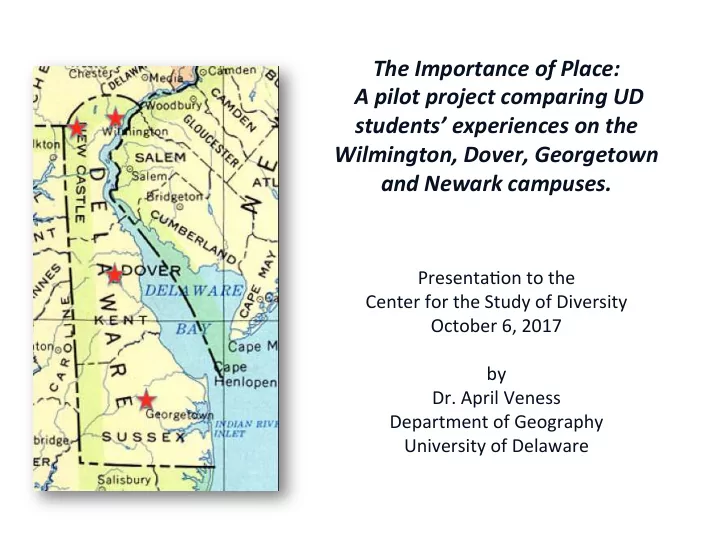
SLIDE 1 Presenta(on to the Center for the Study of Diversity October 6, 2017 by
Department of Geography University of Delaware
The Importance of Place: A pilot project comparing UD students’ experiences on the Wilmington, Dover, Georgetown and Newark campuses.
SLIDE 2
TIMELINE:
Winter-Spring 2016 – mee(ngs with Associate in Arts Program directors/advisors and Instruc(onal Technology staff Summer 2016 – presenta(on to AAP faculty and staff at their bi-annual mee(ng Fall 2016 – recruitment of AAP research liaisons from all four campuses Winter 2017 – orienta(on session for Geog445 and AAP liaisons on Newark campus Spring 2017 – research collabora(on between Geog445 and AAP students Summer 2017 – presenta(on of findings from collabora(on to AAP faculty and staff at their bi-annual mee(ng Fall 2017 – presenta(on of findings to Center for Study of Diversity
SLIDE 3
Is the college experience for first and second year students on UD’s four campuses the same?
RECRUITMENT
SLIDE 4 If there are differences in UD students’ experiences
- - based on where students do their
coursework and live -- what are those differences?
SLIDE 5
If there are campus-based differences in students’ experiences, to what degree do these differences impact one’s educa(onal trajectory and career aspira(ons?
SLIDE 6
If these types of ques(ons interest you, and you’d like to contribute informa(on about your UD experience to this project, then we want to hear from you.
UD-Newark UD-Georgetown UD-Wilmington UD-Dover
Apply to receive one credit of Independent Studies coursework in the spring semester, an be a research liaison to this project. A research liaison will work directly with professor Veness, her geography students and several former AAP students comple(ng their bachelor’s degrees on the Newark campus. Together you will learn how research is conducted and how UD students’ experience their college life on the four campuses.
SLIDE 7 Research Ques(on: How do the following factors collec(vely shape a UD student’s college experience?
- 1. geographical locaFon -- where the UD campus is located in the state of
Delaware
- 2. physical seIng -- or design/layout of outdoor and indoor campus spaces
- 3. social milieu -- or nature of demographics and interpersonal interac(ons
- 4. sense of place -- or intelligibility of spa(al cues, sense of belonging
SLIDE 8 What makes a great place?
Four key a>ributes:
- sociability
- uses and acCviCes
- access and linkages
- comfort and image
Many intangibles:
- pride, cooperaCon,
- fun, realness,
celebratory feeling
- readable, connected
- Sit-able, walk-able
a>racCve, safe spaces
- 1. Selected findings from photo elicitaCon and field observaCons
What is Place-making? - Project for Public Spaces, 2017.
h]ps://www.pps.org/reference/what_is_placemaking/
SLIDE 9 Key elements of place that reinforce belonging:
- Landscapes
- Rela(onships
- Storytelling
- Shared mission
- Brand
Rituals, ceremonies, seasonal events, and shared ac(vi(es create belonging. Brands augment experience, crea>ng a sense of place where people thrive. It can create a feeling of hearth and home on campus. It can provide a grounding place for those who live on campus, or for commuters, a place to hang out in between events. Use elements of geography, loca>on, and key spaces to support the brand story.
Hayworth, 2015. Compelling Branded Environments in Higher Educa>on, p.4.
SLIDE 10 There are four disCnct types of sacred spaces:
- 1. ritual or ceremonial spaces
- 2. processional or exploring spaces
- 3. perspec(ve-dominant spaces
- 4. refuge spaces
Colleges and universiFes should never underesFmate the power of special, transformaFonal, and even sacred spaces
From: Broussard, 2009, The Power of Place on Campus, Chronicle of Higher Educa(on, 55(34): B12-13
SLIDE 11 Key elements of place that reinforce belonging:
- Landscape
- Rela(onships
- Storytelling
- Shared mission
- Brand
How feasible is it to gain the same sense of belonging if you are taking classes on a campus shared with students from another college? What place-making ac(ons can override elements of design that take away from belonging.
On AAP campuses, do UD students have producCve place-making
- pportuniCes that enhance a sense of belonging?
SLIDE 12
SLIDE 13
SLIDE 14
SLIDE 15
SLIDE 16 Survey Sample: 251 UD students
Newark student sample 1st year students, ~15% 2nd year students, ~35% 3rd year students, ~33% 4th year students, ~17%
- 2. Selected findings from online survey –
differences in makeup of student body
SLIDE 17
Gender of UD students in sample
Dover, n=82 Newark, n=92 Georgetown, n=33 Wilmington, n=46
39 24 25 63
52% AAP students female F16
SLIDE 18 Ethnicity of UD students in the sample
Dover Georgetown Newark Wilmington
F16 enrollment stats ~ 71.6% white ~ 7.2% Hispanic ~ 4.4% Af.-American ~ 7.8% Asian ~ 7.7% other F16 enrollment stats ~ 54.2% white ~ 16.4% Hispanic ~ 16% Af.-American ~ 4.2% Asian ~ 8% other F16 enrollment stats ~ 60% white ~ 16.5% Af.-American ~ 10% Hispanic ~ .8% Asian ~ 4.6% other F16 enrollment stats ~ 73.3% white ~ 5.4% Af.-American ~ 7.6% Hispanic ~ 5.1% Asian ~ 4.3 other
SLIDE 19
Legal residence of students in sample
Dover, n=82 Georgetown, n=33 Newark, n=92 Wilmington, n=44
DE DE DE DE
SLIDE 20
Students in sample who are first generaCon
Dover Georgetown Wilmington Newark
Yes n=26 Yes n=10 Yes n=17 Yes, n= 8 2 former AAP students
1st gen F16 2,300 (13%)
SLIDE 21 Dover Georgetown Newark Wilmington
Did you receive credits at UD for any coursework you did while in high school?
- 2. Selected findings from online survey –
differences in college experience
SLIDE 22
My HS prepared me well for the demands of UD coursework.
Dover, n=84 Georgetown, n=33 Newark, n=92 Wilmington, n=44
5
66% (29) feel prepared 63.6% feel prepared 73% feel prepared 57% feel prepared
SLIDE 23
Dover Georgetown Newark Wilmington
How would you rate the difficulty of the coursework you've had so far?
SLIDE 24
Dover Georgetown Newark Wilmington
How would you rate the educaFonal value of the coursework you've had so far?
SLIDE 25
Percentage of UD students who work
Dover, n= 84 Georgetown, n= 33 Newark, n= 92 Wilmington, n= 44
59% Newark students work (53) 55% are DE residents (29/53) (34% have on-campus jobs) 45% are out-of-state (24/53) (71% have on-campus jobs) 84% work 85% work 82% work
SLIDE 26
Number of hours per week UD students engage in paid work
Dover Georgetown Wilmington 41% (38) of students sampled in Newark don’t work while taking classes
47% (18) of those 38 non-working students are Delaware residents.
28% (5) of those 18 non-working Delaware resident students pay for school with $ from family. 72% pay for their schooling with loans, etc.
53% (20) of those 38 non-working students are out-of-state residents.
11 (55%) of those 20 non-working students from out-of-state pay for school with $ from family. 45% of those non-working out-of-state students pay for their schooling with loans, etc.
Newark
SLIDE 27
Dover Georgetown Newark Wilmington
How would you rate the approachability of UD faculty and support staff you've met?
SLIDE 28
Dover Georgetown Newark Wilmington
How would you rate the accessibility of UD faculty and support staff you’ve met?
SLIDE 29
Dover Georgetown Newark Wilmington
How would you rate the helpfulness of UD faculty and support staff you've met?
SLIDE 30 Dover Georgetown Newark Wilmington
How would you rate the overall pleasure you've experienced while a student on your campus?
2 5
93% very/somewhat pleasurable 79% UD very/somewhat pleasurable 82% UD very/somewhat pleasurable 60% UD very/somewhat pleasurable
7 4
58% say Dover first choice of college campuses. 40% say Georgetown first choice of college campuses 96% say Newark first choice of college campuses. 26% say Wilmington first choice of college campuses.
SLIDE 31 UD Campus I don’t feel I am a recognized and valued part of the UD community. When I am on campus taking classes I feel a bit confused and disconnected. I am reluctant to say I am an Associate in Arts student? When I am on campus I feel uncomfortable—I don’t enjoy spending Cme here.
Newark 15% 15% NA 8% Wilmington 27% 47% 62% 56% Dover 34% 32% 34% 45% Georgetown 40% 18% 28% 58%
Distance decay: The further the AAP campus is from Newark, the weaker the feeling of being recognized and valued (by UD- Newark) RelaCve deprivaCon: The closer the AAP campus is to Newark, the stronger the feeling of being deprived of connec(on and posi(ve status (rela(ve to UD- Newark).
- 2. Selected findings from online survey –
impact of geographical locaCon on differences in college experience
SLIDE 32 Wilmington AAP students are more dissaCsfied than other UD students. Why?
- Received no HS credit at UD and HS did not prepare them for college coursework
- Coursework in AAP too easy or, for a couple of them, too hard
- AAP faculty/staff unapproachable, unhelpful.
- Feel disconnected, unwelcomed, unvalued.
- Some proud to be UD, others not.
Possible explana(ons: LocaCon of the campus—urban, rela(ve proximity to Newark means many students know what their Newark counterparts have and they don’t have. Layout of the campus—UDDC is an important focal point, but AAP offices and classrooms are spread over mul(ple sites with no easily iden(fiable/comfortable connec(ons. Physical design of campus space—exterior landscape is not welcoming, no green space, not branded; interior space offers few niches for ritual, refuge, or perspec(ve, or explora(on. UD branding is not even. NegaCve feelings on campus—students are “biding (me” (Veness: “doing (me”?) un(l they can get to the promised land/Newark. Li]le camaraderie. W-AAP students have a social-spa(al posi(on that is both posi(ve and nega(ve, thus their status is riddled with contradic(on and tension.
SLIDE 33 a) ExpectaCons don’t match lived reality Expecta(ons
- fun—like Hollywood depicts it. Living
- n campus
- freedom—from imposed structures,
less responsibility
- friendships—with lots of many
students
- lots of course choices/large classes
- academic challenge
- impersonal professors
- expanded horizons, opportuniCes
Reality:
- What I thought I’d get in college is
not matching to what I’m experiencing as a UD experience.
- I thought I’d get as many classes as
I wanted, feel connected; we don’t get that.
- It’s like 13th grade--comfy, like high
school.
- I recognize friends from high
school . No real social life.
- 3. Selected findings from focus group sessions and interviews--
with current and former AAP students
SLIDE 34 b) Complicated spaCal arrangements & social interacCons between UD & Del Tech. DOVER:
- I feel isolated from UD students.
- We want to stay in the area that is claimed by UD. But we avoid the library, and can’t
access other spaces.
- If the environment was more welcoming then the likelihood of us staying longer (on
campus) would increase.
- The environment is not promoFng UD, it’s just Green and Del Tech.
GEORGETOWN:
- No UD clubs and hard to get into Del Tech clubs.
- Del Tech administraFon won’t help AAP students with any UD course assignments.
They always use phrase: “You are not part of Del Tech—use UD resources.”
- We have Del Tech ID, which is helpful for some things. But we don’t’ feel welcomed by
students and systems of Del Tech.
- We are begrudgingly accepted by Del Tech. I feel like a hybrid student (UD/Del-Tech).
SLIDE 35
- This program isn’t Del Tech and that’s all that maUers. I have friends in Del Tech and
it’s like “What is going on down there?” It’s secondary high school (Af-Am).
- UD-AAP students might feel they are slightly superior/more intelligent than Del Tech
- students. “You’re here, but you’re not really a part of Del Tech,” said a friend who goes
to Del Tech and sees people in UD apparel (Af-Am).
- People feel it’s necessary to maintain and reinforce student idenFty by wearing UD
apparel, since some>mes the lines get blurred between DT and UD-AAP (Af-Am).
- Both UD-Newark and Del Tech students see us differently: damned if we do, damned
if we don’t. I don’t feel like I belong in either environment (W).
- At first it was weird having UD classes in Del Tech space, but now it’s just business.
- We encounter a negaFve energy that UD doesn’t recognize. For example, those
pictures of UD’s [main campus, that are on the walls in our buildings] are corny, weird. They are trying to make [AAP] something that it’s not. [Other] people are trying to make AAP like Del Tech, so we are literally stuck in between. Need more AAP stuff (Af-Am).
- In the back of everyone’s mind this isn’t want we want; some people really wanted the
college experience. But I already knew it was what it was… Hopefully it’ll be becer when I get there [Newark] (Af-Am). WILMINGTON:
SLIDE 36 UD-Newark students in GEOG445 and GEOG466 Zoe Callaway, John Cogan, Lauren Glinko, Ka(e Hewton, Holden Kata, Conner Lomis, Stephen McGuire, Briana McLean, Michael Pak, Trevor Poole, Jayme Soyak, Bryce Stevenosky, Katy Super, Shawn Webster, Mike Yao and Nathan Thayer, course TA. UD-AAP students in GEOG266 Brent Becke], Daniel Brace, Rigoberto Flores, Rebecca Fuzy, Mei Moore, Carlie Smythe, Kendall Smythe, Billy Swann, Caroline West.
Acknowledgements
UD’s Center for the Study of Diversity UD’s Associate in Arts Program UD’s InstrucConal Technology Services
- The 200+ AAP students who
par>cipated in the project.
- The ~100 Newark students who
par>cipated in the project.