SLIDE 1 Sylvain Veilleux (U. Maryland, Joint Space-Science Institute)
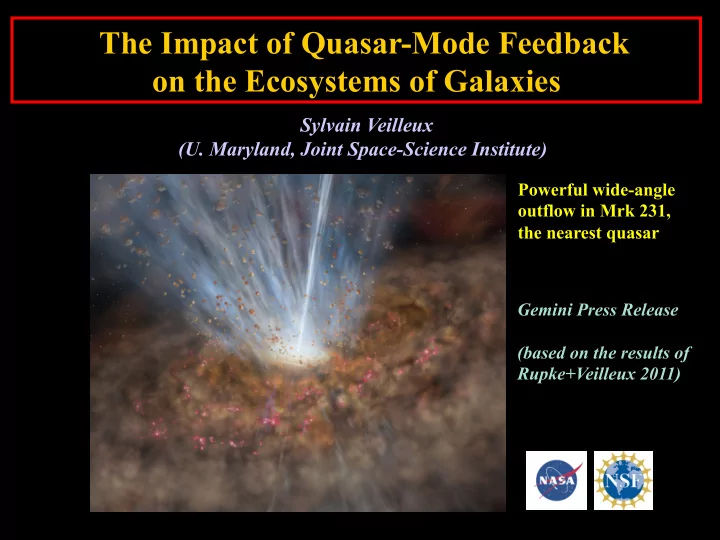
Gemini Press Release (based on the results of Rupke+Veilleux 2011) Powerful wide-angle
the nearest quasar
The Impact of Quasar-Mode Feedback
- n the Ecosystems of Galaxies
SLIDE 2
The Elephant in the Room
SLIDE 3
My Hat Today
SLIDE 4
1. What is the origin and fate of the CGM? 2. What are the morphological & physical properties of the CGM? 3. What are the physical processes that shape the CGM on both large (kpc) and small (pc) scales? 4. What is the relation between the CGM and galaxy properties? 5. How does the CGM evolve and what can we learn by comparing different epochs and tracers?
Key Questions
SLIDE 5
– LAGN ~ (ε/0.10) (dMBH / dt) c2 ~ 1012 (ε/0.10) (dMBH / dt) Lsun – EAGN ~ (ε/0.10) MBH c2 ~ 1061 (ε/0.10) (MBH/108 Msun) ergs
- Binding energy of the bulge: Egal ~ Mgal σ2 (isothermal)
- BH – bulge relation: MBH ~ 0.0014 Mgal
- EAGN / Egal ~ 1.4 x 10⁻⁴ (c / σ)2 > 80 if σ < 400 km s-1 à
à potentially lethal!
– Illuminate, ionize, and heat the ISM, CGM, and IGM
- Mechanical feedback: quasar-driven outflow
– Radiation pressure – Radiative heating → Compton-heated wind (T ~ 106 – 107 K) – Magnetic fields in accretion disks / BH → loosely collimated jets
in radio-quiet quasars
The Impact of Quasar-Mode Feedback
- n the Ecosystems of Galaxies
(e.g., SV, Cecil, Bland-Hawthorn+05; Fabian 12)
SLIDE 6
- Quasar Radiative Feedback
- Quasar Mechanical Feedback
Plan
SLIDE 7
- Quasar Radiative Feedback
- Quasar Mechanical Feedback
Plan
SLIDE 8 He II and Thermal Proximity Effects
(e.g., Boera+14; Khrykin+17)
- Photoionization of He II to He III à
à suprathermal electrons à à ΔT à à H I line broadening
- ΔT is sensitive to the initial He II ionization fraction, xHeII,0
- Sizes of proximity zones are sensitive to quasar lifetime, tQ
(e.g., Shull+10; Syphers+Shull14; Khrykin+16) He II Lyα Forest
SLIDE 9
Giant Lyα Nebulae fluorescently illuminated by Quasars
(Borisova+16) (Cantalupo+14)
Kinematically quiet, dense (> 1 cm-3), cool (~104 K), small (< 20 pc), metal-poor (< 0.1 Zsolar) clumps à à Mgas ~ 1011 – 1012 Msun
SLIDE 10 CGM Photoionized by “Quasars”: Asymmetric & Detached
(SV+03 [TTF]; Yoshida+02) NGC 1068 NGC 4388 NGC 7213 (Putman+03; Bland-Hawthorn+13) (Schawinski+10) 11 x 16 kpc
14 kpc Hanny’s Voorwerp MW: Magellanic Stream
50-100 kpc γ-bubble ~11 kpc ~35 kpc ~19 kpc
Δt ~ 1-3 Myr Δt < 70 kyr
SLIDE 11 (Kreimeyer & SV 13 [MMTF])
20 kpc ~15”
CGM Photoionized by Quasars: MR 2251-178 (z~0.06)
MMTF [O III] λ5007 140 kpc
Hα Cont [O III] Cont [N II]
Kinematically quiet + velocity gradient (distinct from inner quasar host) (0.7” ~ 900 pc)
SLIDE 12
ne ~ 0.1 cm-3, log U ~ [-3,-1], Z ~ 0.5-1 Zsolar , dust-free?, matter-bounded → fesc(ionizing radiation) ~ 65-95% (total)
(Kreimeyer & SV 13 [MMTF])
CGM Photoionized by Quasars: MR 2251-178 (z~0.06)
[O III]/Hβ
Dusty Dust-free
SLIDE 13
- Quasar Radiative Feedback
- Quasar Mechanical Feedback
Plan
SLIDE 14 Quasar-Mode Feedback à à tSZ Signal on CMB?
Ruan+15 Verdier+16 Crichton+16 Soergel+17
(Ruan+15; Crichton+16; Verdier+16; Spacek+16,17; Soergel+17; Chowdbury+Chatterjee17)
- Data from WMAP, Planck, ACT + Herschel, Akari
- Stacked maps of ~104 SDSS / BOSS RQ quasars:
à à stronger signal at z > 2 à à Eth ranges from (1 ± 0.2) 1062 to a few 1060 erg à à Eth (AGN) ranges from ~ Ebinding to negligible!
- Uncertainties: dust emission from the quasar host and
galaxies along the line of sight, including the MW
SLIDE 15 Extended Na I Outflow in Nearest Quasar Mrk 231
- Gemini/IFU: Na I D 5890, 5896 Å absorption
- R ≥ 2-3 kpc from the nucleus
- | Vout | in excess of 1100 km s-1
- dM/dt ≥ 160 Msun yr-1 ~ 1.1 SFR
- dp / dt ≥ 5 LSB / c , ≥ 3 LAGN / c, ≥ 2 LIR / c
- Lmech = dEkin/dt ≥ 1043.6 ergs s-1 ~ 1.1 x dESB/dt ~ 0.5% LEdd (AGN)
(Long-slit: Rupke, SV, & Sanders 05c; IFU: Rupke & SV 11, 13a) Mrk 231
2011 Gemini Press Release
à à AGN driving
SLIDE 16
- Herschel/PACS + Spitzer spectra: multiple OH transitions
- P-Cygni profiles!
- Outflow: |Vout | in excess of 1000 km s-1
- dM/dt ~ 620 - 1100 Msun yr-1
- dp/dt ~ 6 LBOL(AGN) / c
- dEkin/dt ~ 1% LEdd(AGN)
- Molecular Outflow in Mrk 231
Herschel: unresolved P-Cygni profiles of OH (e.g., Fischer+10; Sturm+11; Gonzalez-Alfonso+14, 17)
SLIDE 17
- Vout up to ~750 km s-1
- Mout ~ 6 x 10⁸ Msun
(H2/CO ~ 0.1 x Galactic value)
- Kpc scale
- dM/dt ~ 700 Msun yr-1
IRAM: Spatially resolved molecular line emission (Feruglio+10; Aalto+12; Cicone+12; Alatalo+10; Feruglio+15; Lindberg+16; …)
Molecular Outflow in Mrk 231
Red Wing Blue Wing Feruglio+15
SLIDE 18 §
Statistics: ~70% of local U/LIRGs have molecular winds (Θ ~145o)
§
Outflow velocities: <v50> , <v84>, <vmax> ~ -200, -500, -925 km s-1
§
Energetics: Size ~ 0.1 – 10 kpc dM/dt ~ 10 – 1000 Msun yr-1 dp/dt ~ (0.1 – 20) LIR/c dE/dt < 2% LIR Molecular gas = energetically dominant phase of these
§
Trends with SFR and AGN luminosities: suggest that we are seeing starburst + quasar feedback in action Herschel Surveys: unresolved P-Cygni profiles of OH (e.g., SV, Melendez+13; Spoon+13; Gonzalez-Alfonso+14, 15, 17; Stone, SV+16) MM-wave Interferometric Surveys: kpc-scale CO line emission (e.g., Feruglio +10,+15; Aalto+12ab; 15, 16; Alatalo+11, 15; Cicone+12, 14; Garcia-Burillo+14,15; Lindberg+16; SV, Bolatto+17)
Molecular Outflows in U/LIRGs & Quasars
SLIDE 19
(SV, Melendez+13; Cicone+14; Stone, SV+16) Red = ULIRGs Blue = BAT AGN à AGN driving of the most extreme molecular winds
OH CO
Molecular Outflows in U/LIRGs & Quasars
SLIDE 20 (Rupke, Gultekin, & SV 2017)
dE/dt ~ MBH
1.66±0.45 dE/dt ~ σ9.0±3.8
Multi-Phase Outflows in Local Quasars and Seyferts
u u Seyfert galaxies
SLIDE 21
Extreme Warm (T ~ 104 K) Ionized Outflows
(Alexander+10; Liu+13ab, 14; Greene+14; Hainline+14; Husemann+15; Harrison+12, 14,16; Carniani+15, 16; Perna+15; Cresci+15; Brusa+16; Rupke + SV 2013, 2017) (Bischetti+17) (Zakamska+16)
log LAGN dEkin/dt Dusty Outflows in Red Quasars
vmax([O III]) à à3000+ km s-1 Ekin ~ 1059 (ne/102 cm-3)-1 erg W90([O III])
SLIDE 22 § ALMA: CO (1 – 0) emission from rotating disk + outflow
- Aperture photometry & UV plane fitting: Rmax ~ 15 kpc
12
Sizes: Quasar-Driven Molecular Outflow in F11119+3257
(SV, Bolatto, Tombesi+17)
[-820, -380] km/s [+280, +800] km/s
15 kpc
SLIDE 23 Sizes: Neutral Outflows from Resonant Na I Emission
(Rupke & SV 2015)
Mrk 231
Type-2 Quasar / ULIRG F05189-2524
§
Complementary to Na I D absorption (no need for background galaxy continuum emission)
§
Provide new constraints on the sizes of local winds à à So far, R < 5 – 10 kpc (limited by IFU FOV)
galaxy clumpy outflow Blueshifted absorption Redshifted emission
(Hailey Finley’s talk: Fe II)
SLIDE 24 Matter-bounded?
log R-15 (pc) log (L 8 µm) log R-15 (pc)
10 kpc 30 kpc
Sizes: Warm Ionized Outflows
(Alexander+10; Liu+13ab, 14; Greene+14; Hainline+14; Husemann+15; Harrison+14; Carniani+15, 16; Perna+15; Cresci+15; Brusa+16; Rupke + SV 2013, 2017; Bischetti+17)
13 kpc
[O III] blue wing (Liu+14; Hainline+14) z ~ 0.6 z ~ 2 (Cresci+15)
SLIDE 25 850 µm
Mrk 231
SV, Teng+14
20 kpc ~ 40”
65 x 50 kpc 110 x 80 kpc Starburst-driven outflow Quasar-driven outflow
Nardini+13 Yoshida+16
NGC 6240
X-rays Hα + X-rays
Sizes: Hot Ionized CGM
SLIDE 26
850 µm
Koda+06
Sizes: Hot Ionized CGM
Hα + X-rays
Yoshida+16
Mrk 231 NGC 6240
Major galaxy mergers
R band R band
SLIDE 27
Predictions from Numerical Simulations of Major Galaxy Mergers
(Cox, di Matteo+06) ~0.4 keV ~ 4.6 million K ~0.2 keV ~ 2.3 million K 1 0.5 0.1
SLIDE 28 (Nardini+13; Wang+14)
20 kpc ~ 40”
Two-phase plasma: (1) T ~ 8 x 10⁶ K, Fe ~ 0.5 solar (dominant; SB-processed) (2) T ~ 3 x 10⁶ K, Fe ~ 0.1 solar (fainter; pre-existing) Ethermal ~ 5 x 1058 erg Extended Fe XXV 6.7 keV à àfast ~2200 km s-1 shocks (Si, O, Mg) / Fe = 4-5 x solar (~ uniform) Starburst-processed gas is slowly expanding into, and mixing with, a preexisting halo medium of lower metallicity and temperature
Hot Ionized CGM: NGC 6240
SLIDE 29 (SV, Teng+14)
20 kpc ~ 40”
Two-phase plasma: T ~ 3 and 8 x 10⁶ K
Fe ~ 0.4 solar Ethermal ~ 2 x 1058 erg (Si, O, Mg) / Fe = 2-4 x solar (~ uniform) à à mixed by on-going & past (~108 yrs)
Hot Ionized CGM: Mrk 231
Single-phase plasma: T ~ 8 x 10⁶ K only Ethermal ~ 1 x 1057 erg < Ewind, ESB, EAGN Absorbing screen à à Na I D outflow? Extended Fe XXV 6.7 keV à àfast shocks?
R = 6 – 30 kpc R < 6 kpc
SLIDE 30 § Quasar-mode radiative feedback
- He II Proximity and Thermal Effects: Out to several 10’s of Mpc
- MR 2251-178: A local analog to giant Lyα nebulae around high-z quasars
- Beware: Environmental effects (tidal debris, stripped satellites, ram-
pressure filaments) + quasar ionization cones and flaring complicate the interpretation of these nebulae
§ Quasar-mode mechanical feedback
- Globally: tSZ effect from radio-quiet quasars gives Eth(AGN) ~ 0 à
à Ebinding Stay tuned for the jury’s decision…
- Ubiquitous outflows: Multi-phase, fast (up to ~3000 km s-1), massive
(10 – 1000+ Msun yr-1), and powerful (up to ~5% LAGN)
à 30+ kpc (at high z)
- Hot Ionized CGM of Mrk 231: Evidence for heating from fast shocks as
well as metal transport by the on-going and past outflow event(s)
Summary