
SLIDE 1
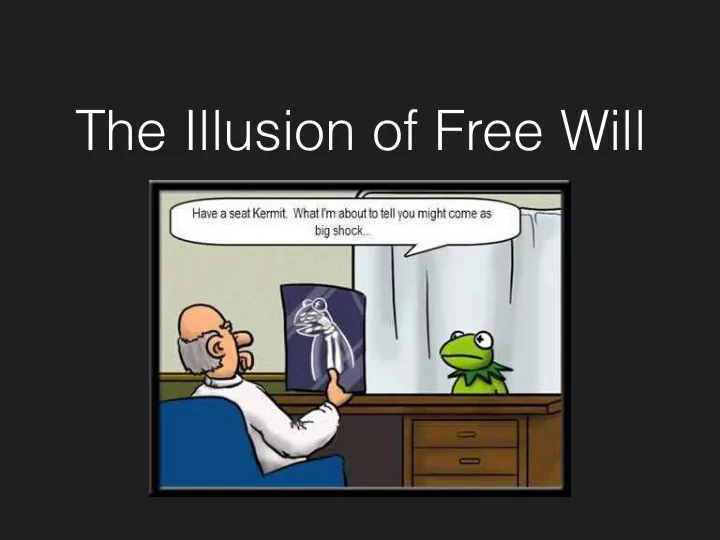
The Illusion of Free Will Let us then understand free will as the - - PowerPoint PPT Presentation
The Illusion of Free Will Let us then understand free will as the capacity unique to persons that allows them to control their actions. - Internet Encyclopedia of Philosophy A belief that there is a component to biological behaviour
“Let us then understand free will as the capacity unique to persons that allows them to control their actions.”
“A belief that there is a component to biological behaviour that is something more than the unavoidable consequences of the genetic and environmental history of the individual and the possible stochastic laws of nature”
asked to wiggle a finger whenever they like while looking at a clock
consciously decided to move their finger
decision to move their finger corresponded with the beginning of the EEG signal
“As of 2008, the upcoming outcome of a decision could be found in study of the brain activity in the prefrontal and parietal cortex up to 7 seconds before the subject was aware of their decision.”
choose what they choose. But they always have a story to explain their choices
Experimental evidence
evidence
“Intrusive Thoughts”
Daydreaming
Misconceptions
bodies, and we are not exempt from the laws of physics and causality
act, but where do our wants come from?
precedes feeling of making a choice
positive or negative
through CBT, education, meditation, etc
could have done otherwise
environment, childhood, random events and a multitude of other factors
“I do not believe in free will. Schopenhauer's words: 'Man can do what he wants, but he cannot will what he wills,' accompany me in all situations throughout my life and reconcile me with the actions of others, even if they are rather painful to me. This awareness of the lack of free will keeps me from taking myself and my fellow men too seriously as acting and deciding individuals, and from losing my temper.”
http://www.einstein-website.de/z_biography/ credo.html