How to Study the Bible Lesson 1 [2] Them [2] Them Type [3] The - - PDF document

how to study the bible
SMART_READER_LITE
LIVE PREVIEW

How to Study the Bible Lesson 1 [2] Them [2] Them Type [3] The - - PDF document

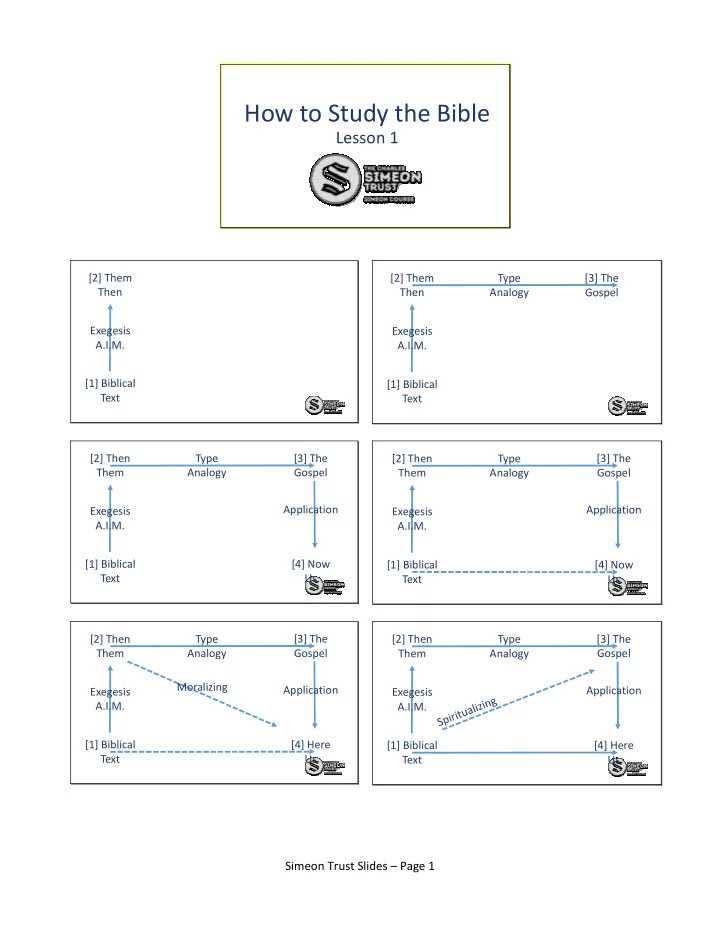
How to Study the Bible Lesson 1 [2] Them [2] Them Type [3] The Then Then Analogy Gospel Exegesis Exegesis A.I.M. A.I.M. [1] Biblical [1] Biblical Text Text [2] Then Type [3] The [2] Then Type [3] The Them Analogy Gospel


slide-1
SLIDE 1

Simeon Trust Slides – Page 1

How to Study the Bible

Lesson 1

[1] Biblical Text [2] Them Then Exegesis A.I.M. [1] Biblical Text [2] Them Then [3] The Gospel Type Analogy Exegesis A.I.M. [1] Biblical Text [2] Then Them [3] The Gospel [4] Now Us Exegesis A.I.M. Type Analogy Application [1] Biblical Text [2] Then Them [3] The Gospel [4] Now Us Exegesis A.I.M. Type Analogy Application [1] Biblical Text [2] Then Them [3] The Gospel [4] Here Us Moralizing Exegesis A.I.M. Type Analogy Application [1] Biblical Text [2] Then Them [3] The Gospel [4] Here Us Exegesis A.I.M. Type Analogy Application

slide-2
SLIDE 2

Simeon Trust Slides – Page 2

How to Study the Bible

“Old Testament Narrative” Lesson 2

[1] Biblical Text [2] Then Them [3] The Gospel [4] Here Us Exegesis A.I.M. Type Analogy Application Moralizing

The Joseph story is longer and more complete than that of any

  • ther patriarch or matriarch.

Less a collage of fragments, it is a whole work of art. is between Joseph and his siblings

  • Potiphar’s wife (Gen. 39)

Baker & Cupbearer (Gen. 40, 41) Pharaoh (Gen. 41) [1] Setting (Gen. 37:1-11) [2] Conflict (Gen. 38-44) [3] Climax/Resolution (Gen. 45-49) [4] Reset (Gen. 50)

slide-3
SLIDE 3

Simeon Trust Slides – Page 3

How to Study the Bible

“On the Line” Lesson 3

[1] Biblical Text [2] Then Them [3] The Gospel [4] Here Us Exegesis A.I.M. Type Analogy Application Moralizing

[1] Setting (Gen. 37:1-11) [2] Conflict (Gen. 38-44) [3] Climax/Resolution (Gen. 45-49) [4] Reset (Gen. 50)

Staying on the Line

Principle: We must stay on the line of Scripture, never straying above it or below it.

Staying on the Line

Deuteronomy 4:2 "You shall not add to the word which I am commanding you, nor take away from it, that you may keep the commandments of the LORD your God which I command you.”

Phariseeism Conservatism Legalism Licentiousness Liberalism Antinomianism

Staying on the Line

Explanation: We are often tempted to require more than the Scriptures, venturing into religious pietism and expressing a zeal that becomes a kind of

  • legalism. We judge others who do not

maintain our extra-Biblical traditions and standards.

Staying on the Line

In so doing, we add to the Scriptures. We can also be tempted to dip below the line into liberalism and pragmatism, ignoring both the content and point of

  • Scripture. In so doing, we subtract from

the Scriptures.

slide-4
SLIDE 4

Simeon Trust Slides – Page 4

Staying on the Line

As teachers of God’s Word, we must commit ourselves to saying nothing more or less than the Scriptures say. It is a matter of obedience (Deuteronomy 4:2).

Staying on the Line

Strategies: consider the text in light of both extremes, anticipate how those who furthest above and the furthest below might treat the text, test consistency of your reading with the rest

  • f Scripture.

Staying on the Line

Practice Texts: Genesis 3:1-3, Mark 7:6- 13, John 3:16-21

slide-5
SLIDE 5

Simeon Trust Slides – Page 5

How to Study the Bible

“Text and Framework” Lesson 4

[1] Biblical Text [2] Then Them [3] The Gospel [4] Here Us Exegesis A.I.M. Type Analogy Application Moralizing

[1] Setting (Gen. 37:1-11) [2] Conflict (Gen. 38-44) [3] Climax/Resolution (Gen. 45-49) [4] Reset (Gen. 50)

Staying on the Line

Deuteronomy 4:2 "You shall not add to the word which I am commanding you, nor take away from it, that you may keep the commandments of the LORD your God which I command you.”

Phariseeism Conservatism Legalism Licentiousness Liberalism Antinomianism

Text and Framework

Principle: We must let the Bible shape

  • ur frameworks rather than letting our

frameworks shape our ‘interpretations’

  • f the Bible.

Text and Framework

F T

T F

“The teacher’s temptation is to use the Scripture like the drunk uses a street light: more for support than illumination.”

Text and Framework

Explanation: Whether Calvinism or Arminianism, politically left or right, therapeutic or prosperity driven, cultural and social, we all have frameworks— ideas and frames of mind that we bring to the text.

slide-6
SLIDE 6

Simeon Trust Slides – Page 6

Text and Framework

Our own experiences, training, and desires bring them to the foreground every time we open the Bible. Some frameworks can be helpful. Others are

  • not. In order to get at the meaning of a

text, we must let the text be sovereign.

Text and Framework

We must adjust the framework rather than fall into the trap of ignoring or bending the text until it says “what we want it to say.” We must hear it for “what it says.”

Text and Framework

Strategies: identify your own frameworks (ideological, political, theological, etc.), constantly approach the text with fresh eyes, consult many different translations of the Bible (e.g. dynamic, literal, paraphrase)

Text and Framework

Practice Texts: Mark 2:1-12, Hebrews 6:1-8, James 2:14-26, 1 Corinthians 13:1-7

slide-7
SLIDE 7

Simeon Trust Slides – Page 7

How to Study the Bible

“Traveling Instructions” Lesson 5

[1] Biblical Text [2] Then Them [3] The Gospel [4] Here Us Exegesis A.I.M. Type Analogy Application Moralizing

[1] Setting (Gen. 37:1-11) [2] Conflict (Gen. 38-44) [3] Climax/Resolution (Gen. 45-49) [4] Reset (Gen. 50)

Staying on the Line

Deuteronomy 4:2 "You shall not add to the word which I am commanding you, nor take away from it, that you may keep the commandments of the LORD your God which I command you.”

Phariseeism Conservatism Legalism Licentiousness Liberalism Antinomianism

Text and Framework

F T

T F

“The teacher’s temptation is to use the Scripture like the drunk uses a street light: more for support than illumination.”

Traveling Instructions

Principle: We must understand how the

  • riginal audience understood a text in
  • rder to know how it applies today. We

must understand the context (historical, literary, canonical, etc.) of our text.

Traveling Instructions

Text Context Today

Text Context

[Corinth]

Application

[Waukesha]

slide-8
SLIDE 8

Simeon Trust Slides – Page 8

Traveling Instructions

Explanation: In handling God’s Word, there is great pressure to be relevant. This pressure means that we are tempted to read what is written and then apply it immediately. In other words, we go straight from the text to application.

Traveling Instructions

But, by understanding the text in its context or how it would have been understood by the original audience (them then), we can better understand the right application of the text (us now).

Traveling Instructions

Strategies: read the chapter on both sides of your text, read the entire book, if paired with another then read both books (e.g. 1 and 2 Corinthians)

Traveling Instructions

Practice Texts: 1 Corinthians 13:1-7, 2 Corinthians 6:14-7:1, Mark 8:22-30

slide-9
SLIDE 9

Simeon Trust Slides – Page 9

How to Study the Bible

“Melodic Line” Lesson 6

[1] Biblical Text [2] Then Them [3] The Gospel [4] Here Us Exegesis A.I.M. Type Analogy Application Moralizing

[1] Setting (Gen. 37:1-11) [2] Conflict (Gen. 38-44) [3] Climax/Resolution (Gen. 45-49) [4] Reset (Gen. 50)

Staying on the Line

Deuteronomy 4:2 "You shall not add to the word which I am commanding you, nor take away from it, that you may keep the commandments of the LORD your God which I command you.”

Phariseeism Conservatism Legalism Licentiousness Liberalism Antinomianism

Text and Framework

F T

T F

“The teacher’s temptation is to use the Scripture like the drunk uses a street light: more for support than illumination.”

Traveling Instructions

Text Context Today

Text Context

[Corinth]

Application

[Waukesha]

Melodic Line

Principle: We will handle a specific text better if we understand what the whole book is about.

slide-10
SLIDE 10

Simeon Trust Slides – Page 10

Melodic Line Melodic Line

Explanation: Books of the Bible and the Bible (as a whole) have a coherent, sustained message—or big idea—similar to the unique melody of a song. It is waiting to be heard. It unites the whole book, big theme and big aim, concisely stating what the whole book is about.

Melodic Line

Every passage will, in some way, be related (directly or indirectly, as support

  • r even contrast) to the melodic line.

Our task is to listen well enough and long enough to hear the melody.

Melodic Line

Strategies: read and reread, identify a top and tail (e.g. Romans 1:5 and 16:26), find a purpose statement (e.g. Luke 1:1-4, John 20:30-31) or thesis statement, find repeated words and phrases and ideas (e.g. “joy” and “fellowship” in Philippians), follow the Old Testament quotations.

Melodic Line

Practice Texts: John 2:1-12, 2 Corinthians 8:1-15, 1 Samuel 8

slide-11
SLIDE 11

Simeon Trust Slides – Page 11

How to Study the Bible

“Bone and Marrow” Lesson 7

[1] Biblical Text [2] Then Them [3] The Gospel [4] Here Us Exegesis A.I.M. Type Analogy Application Moralizing

[1] Setting (Gen. 37:1-11) [2] Conflict (Gen. 38-44) [3] Climax/Resolution (Gen. 45-49) [4] Reset (Gen. 50)

Text and Framework

F T

T F

“The teacher’s temptation is to use the Scripture like the drunk uses a street light: more for support than illumination.”

Traveling Instructions

Text Context Today

Text Context

[Corinth]

Application

[Waukesha]

Melodic Line Bone and Marrow

Principle: We must teach the emphasis

  • f our text well by first apprehending

the structure.

slide-12
SLIDE 12

Simeon Trust Slides – Page 12

Bone and Marrow Bone and Marrow

Explanation: Every text has a structure. This structure will reveal an emphasis. The emphasis must shape our message. We must find the organizing principle of the author and let it dictate the shape and emphasis of our talk. This is the skeleton.

Bone and Marrow

We must get the ‘bones’ straight in order for the body of our message to be healthy. We must teach the emphasis that the author—the Holy Spirit—put into the text. Only then will we see the “life” of the

  • passage. Look at the text with x-ray eyes

in order to see its skeletal structure.

Bone and Marrow

Strategies: use a literal English translation of the Bible, read and reread and read out loud, look for repetitions or clear thesis statements (sometimes in the form of a rhetorical question), identify your text type as discourse (look for grammar, key words, transitional words, chiasmus, verbs),

Bone and Marrow

narrative (look for plot, surprises, setting, characters, comparisons and contrast), or poetry (look for grammar, comparisons and contrasts, imagery, changes in who is speaking, parallelism)

Bone and Marrow

Practice Texts: Genesis 11:1-9, Amos 1:3-2:4, Mark 5, Luke 15, Ephesians 5
slide-13
SLIDE 13

Simeon Trust Slides – Page 13

How to Study the Bible

“Traveling through the ” Lesson 8

[1] Biblical Text [2] Then Them [3] The Gospel [4] Here Us Exegesis A.I.M. Type Analogy Application Moralizing

[1] Setting (Gen. 37:1-11) [2] Conflict (Gen. 38-44) [3] Climax/Resolution (Gen. 45-49) [4] Reset (Gen. 50)

Staying on the Line

Deuteronomy 4:2 "You shall not add to the word which I am commanding you, nor take away from it, that you may keep the commandments of the LORD your God which I command you.”

Phariseeism Conservatism Legalism Licentiousness Liberalism Antinomianism

Text and Framework

F T

T F

“The teacher’s temptation is to use the Scripture like the drunk uses a street light: more for support than illumination.”

Traveling Instructions

Text Context Today

Text Context

[Corinth]

Application

[Waukesha]

Melodic Line

slide-14
SLIDE 14

Simeon Trust Slides – Page 14

Bone and Marrow

Traveling through the

Principle: If we are to teach the Bible as Christians, we must show the gospel (the death and resurrection of Jesus Christ and what it means) at every point. Otherwise, we resort to frameworks.

Traveling through the

The Old Testament The New Testament

Traveling through the

Explanation: After the resurrection, in Luke 24, Jesus shows the disciples how the Old Testament Scriptures point to him and his work on the cross. He also declares that they will be (apostolic) witnesses of this gospel to the end of the earth.

Traveling through the

And the content of those Scriptures and that witness has to do with four things: his suffering and resurrection, repentance and forgiveness. In other words, the text of the Old and New Testaments center on the cross of Jesus Christ.

Traveling through the

If we are to faithfully teach God’s Word in light of the gospel, we must find the relationship between our text and the cross.

Traveling through the

Strategies: develop a good sense of Biblical Theology, consider plot lines and theological themes, typology, and analogy (including contrast and irony), New Testament references.

Traveling through the

Practice Texts: Mark 4:35-41, Colossians 1:15-23, Psalm 2, John 13:1-15, 1 Samuel 2:1-11