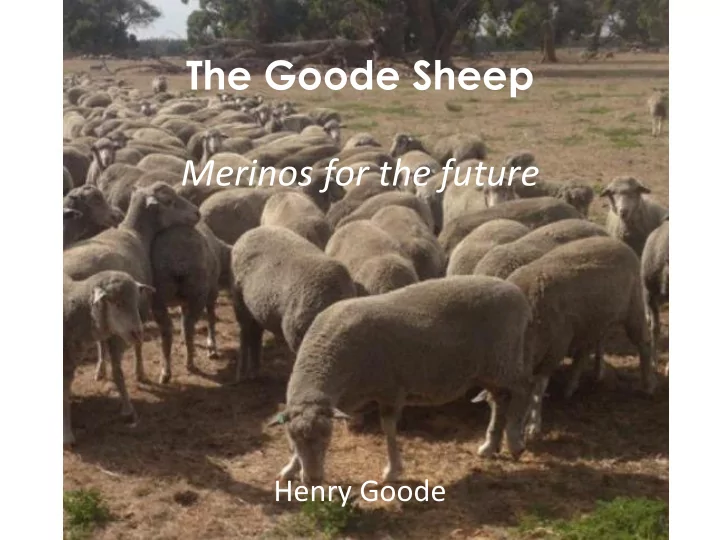
The Goode Sheep Merinos for the future Henry Goode Property - - - PowerPoint PPT Presentation

the goode sheep merinos for the future
SMART_READER_LITE
LIVE PREVIEW

The Goode Sheep Merinos for the future Henry Goode Property - - - PowerPoint PPT Presentation

The Goode Sheep Merinos for the future Henry Goode Property - Barooka Approx 2800 hectares Mt Benson region Dad & Myself work on farm, brother Tom occasional 5600 breeding ewes 2000 mated ewe lambs 350 shorthorn cow


slide-1
SLIDE 1

The Goode Sheep Merinos for the future

Henry Goode

slide-2
SLIDE 2

Property - Barooka

  • Approx 2800 hectares
  • Mt Benson region
  • Dad & Myself work on farm, brother Tom occasional
  • 5600 breeding ewes
  • 2000 mated ewe lambs
  • 350 shorthorn cow herd
  • 210ha centre pivot irrigation

– Lucerne for grazing – 40ha Leased to potato grower

slide-3
SLIDE 3

Sheep overview

  • Recently moved from 50% merino 50% first

cross prime lambs

  • To 100% self-replacing merino operation
  • Glendemar MPM (Multi-Purpose Merinos)

genetics for 15 years

– Very plain bodied easy-care sheep – Adult sheep average 18-20 micron – Ewe size 60kg at CS3

slide-4
SLIDE 4

Sheep overview

  • Found a progressive stud with aims that suit us
  • Buy rams each year
  • Breed own rams from small nucleus flock as not

economical to buy all ram replacements

  • Hogget's classed off-shears in November bare

shorn

  • Currently averaging 100% lambing to ewes mated
  • Through fine-tuned nutrition and management,

plan to increase to 120% and beyond

slide-5
SLIDE 5

Genetics – ASBV’s

  • Fat (YFAT)
  • Ewe fertility, lamb survival, ability to cope with tough

times

  • Eye Muscle Depth (PEMD)
  • Improved carcase shape, dressing %, ewe reproduction
  • Growth (PWT)
  • Fast lamb turnoff and ability to mate ewe lambs
  • Staple Length (YSL), Clean Fleece Weight

(CFW)

  • Free growing, bold crimping, white wool
slide-6
SLIDE 6

14 month old ewe hogget

slide-7
SLIDE 7

No mulesing

  • No mulesing for 10 years
  • Result of classing for thin skins, no wrinkle,

clean points and bare breech

  • Free growing, soft, white wool followed

because of this

slide-8
SLIDE 8

No mulesing

  • Te pari docking iron used for 10 years
  • Rotating anvil stretches wool during

docking

  • End of tail heals with bare skin rather

than wool

  • Prevents dags forming on end of tail

– Reduce tail strike

slide-9
SLIDE 9

Modern merinos

  • Since beginning with Glendemar genetics

– Reduced ewe frame, weight by 10kg – Easier handling and shearing ewes – Reduced micron by 5 micron – Increased wool length by 20% – Faster growing, robust lambs with carcase that would rival some XB’s – Near non-existent body and tail strike – Less chemicals and labour – No mulesing or jetting – Sacrificed wool cut by 10%

slide-10
SLIDE 10

Joining ewes

  • Ewes managed using LTEM

principles

  • Join in mostly large mobs 1000+
  • Lupin/Lucerne flushing
  • Teasers for 2 weeks to induce

ram effect

  • 5 week joining
slide-11
SLIDE 11

Labour saving and accurate feeding

slide-12
SLIDE 12

Lambing

  • Preg-scan for twins/singles at day 90
  • Main lambing 15th June
  • Pushed out 2 weeks later this year
  • Twin ewes

– preferentially feed to increase birthweights and CS – Lamb down in mobs 150 or less – Allocate best paddocks for feed on offer (FOO) and shelter – Ideally 1500-2000kgDM/ha

slide-13
SLIDE 13

Lambing

  • Single ewes

– Maintain CS 3 until lambing – Lamb down in mobs no more than 250 – 800+kgDM/ha

  • Wet and dry ewes at marking

– Drys sold after shearing

slide-14
SLIDE 14

Weaning

  • Lambs are weaned at 8-12 weeks
  • ld

– Usually average approx. 25kg liveweight – Run in large mobs on irrigated and dryland lucerne, cocksfoot, phalaris mixes

  • Wether lambs turned off from 6 to

10 months old, 21kg/cw sold into the trade

slide-15
SLIDE 15

2017 Ewe lambs

  • Ewe lambs run on dry-land

Lucerne all summer

  • Were weighed at 8 months old

– 15% drafted off (lambs below 45Kg) – The main mob averaged 54kg lw – Estimated 15kg heavier than at same time than previous years

slide-16
SLIDE 16

2017 Ewe lambs

  • Teased for 2 weeks
  • Lambs joined at 8 months old
  • Rams in at 5% for 5 week joining still running
  • n Lucerne
slide-17
SLIDE 17

6 month shearing

  • Began 6 month shearing in 2015
  • Were being discounted for overgrown wool,

around 120mm+

  • Now shear May, November
slide-18
SLIDE 18

Benefits 6 month shearing

  • Tensile strength increased from 25

Newtons to around 60 Newtons

– Eliminated tender wool

  • Cutting 60-70mm each shearing

– Ewes cut approx 3kg 6 monthly – Better meeting market for length specifications

  • Increased amount of fleece wool

by 10%

  • Less skirtings
slide-19
SLIDE 19

Benefits 6 month shearing

  • Now crutch on average 10% of

flock pre-shearing

  • Spend same amount of time in

shed because of minimal crutching

  • Sheep ‘do better’ and are easier

to manage

  • Hope ewes find better shelter to

lamb in

  • 3 processors trying to source our

un-mulesed wool

slide-20
SLIDE 20

Future goals

  • Wean 120% lambs from ewes mated
  • Cut 4kg wool every 6 months
  • Cut 90mm of wool every 6 months in 10 years time
  • Turn off all wether lambs by 9 months at 24kg/cw
  • Implement RFID tags throughout flock
  • Receive individual carcase feedback from abattoirs

including individual grading

  • Continue to produce ethically treated and

sustainable products for the consumers

slide-21
SLIDE 21
slide-22
SLIDE 22
slide-23
SLIDE 23

Thank you