
SLIDE 1
The Golden Age
- f Weimar
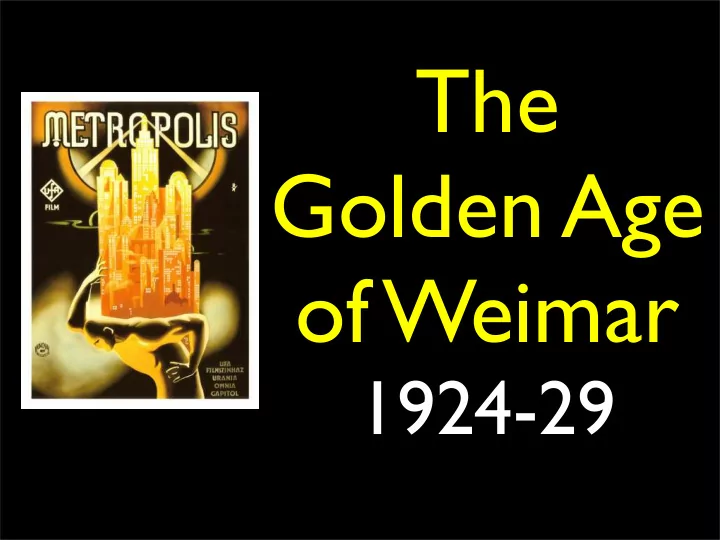
The Golden Age of Weimar 1924-29 After the turmoil of 1918-23, - - PowerPoint PPT Presentation
The Golden Age of Weimar 1924-29 After the turmoil of 1918-23, liberal constitutional democracy survived in Germany, that is until the disastrous Wall Street Crash of 1929. These years became known as the Golden Years of the Weimar
1924 – 1929 The Golden Age of Weimar?
PREP ESSAY QUESTION: What evidence is there that life improved for the majority of Germans between 1924-29?
Politically Economically Culturally
The period between 1924 and 1929 is known as a ‘Golden Age’ or ‘The Years of Hope’ Economic and political stablility returned This was largely due to the policies of Gustav Stresemann He improved Germany’s situation both economically and politically
1878 – 1929 German liberal politician, leader of the German People’s Party (DVP) Served as Chancellor (Aug 1923-Nov 1923) Foreign Minister (1923-29) Credited with stabilising the Germany economy following “The Year of Crises in 1923, which included the invasion of the Ruhr by the French, hyperinflation, communist uprisings in Thuringia and Saxony, and the Beer Hall Putsch (started by Hitler in Munich)
Called off the passive resistance at the Ruhr Ended the hyperinflation crisis by introducing a new currency backed by US loans Reassured Germans that the democratic system was willing and able to solve urgent problems Restarted reparation payments, importantly, this led to assistance from the US and a greater willingness of
Ended German diplomatic isolation
Stresemann negotiated the Dawes Plan in 1924 Helped secure US loans ($800 million) Reparations were renegotiated Aided German economic restructuring Aided normalisation of diplomatic relations, esp. with France
August 1924, the main points of The Dawes Plan were:
troops (1925)
the first year, increasing to two and a half million marks annually after five years"
Allied supervision.
Charles Dawes, US Banker and Vice President
The Dawes Plan provided short-term economic benefits to the German economy. It softened the burdens of war reparations Stabilized the currency Increased foreign investments and loans to the German
dependent on foreign markets and economies, and therefore problems with the U.S. economy (e.g. the Great Depression) would later severely hurt Germany as it did the rest of the western world, which was subject to debt repayments for loans of US dollars.
Stresemann introduced a new German Currency, the Rentenmark replaced the worthless mark (backed by US Gold) This encouraged foreign investment in Germany’s economy This led to an increase in new factories, industry, infrastructure AND employment
Stresemann helped to end Germany’s isolation: Adhered to the Treaty of Versailles (policy of Fulfiment) Signing the Treaty of Locarno 1925 Germany was invited to join The League of Nations in 1926
Non-aggression pact between Germany, Belgium, Britain, France, Italy Pledge to recognise German, French and Belgium (western) borders Normalised relations
This policy of co-operation led to: 1926 the first of the three Rhineland zones which had been placed under Allied military occupation by the Treaty of Versailles were evacuated 1927 the Inter-Allied Control Commission to supervise German disarmament was withdrawn. 1928- Kellogg-Brian Pact 1929 - Young Plan reduced German reparations to a figure of £2 billion and Repayments were to be made over a period of 59 years.
Gustav Stresemann died of a stroke in October 1929 at the early age of fifty-one, and is remembered for restoring German economic and political stability and as an advocate of peaceful solutions to complex international problems
Between 1924 and 1929, German industry forged ahead. Factories were equipped with new machinery and German industrialists used the most successful techniques of American production. .. The result was a much faster economic growth rate than either France or Britain. By 1929, Germany was producing 33% more than it had in 1913, despite losing its major industrial areas under the ToV.
‘Life seemed more free, more modern, more exciting than in any place I have ever been… Everywhere there was an accent on youth. One sat up with young people all night in the pavement cafes, the plush bars, on a Rhineland steamer or in a smoke filled artist’s studio and talked endlessly abut life . Most Germans one met struck you as being democratic, liberal, even pacifist. One scarcely heard of Hitler or the Nazis except as butts of jokes- usually in connection with the Beerhall Putsch as it came to be known’ William L Shirer, Berlin Diary, 1941
The Weimar Republic, however ailing in economic and political terms, was one of the most fertile grounds for the modern arts and sciences. Berlin, in particular, became a thriving center of many new art movements such as Dadaism and expressionism, whilst the Bauhaus school near Weimar revolutionised architecture.
The sense of loss, breakdown, chaos and meaninglessness which characterized German society after World War One was reflected in artistic movements which stressed such things as
(a) United States of America Much of Weimar culture showed great interest in the "American" form of life: the assembly line technique (developed in the American auto industry), the skyscraper, mass consumption and advertisement seemed the epitome of modernity to Weimar artists. They adapted some American forms but often used them critically and creatively.
(b) Russia In addition to the importance of American patterns, one can discern a strong influence
The posters, graphics, and architecture of the young Soviet Union to many Weimar artists seemed to represent the manifestations of a new and more humane world.
thought as a threat to civilization.
associated with the Communist Party (which was fashionable in intellectual circles all over Europe)
currents underscored rightist critique of a "Judaized Republic."
files2008a/Head.jpg
German_Expressionist_Prints.html
2007/11/29/reading-notes-weimar-a- cultural-history-by-walter-laqueur/