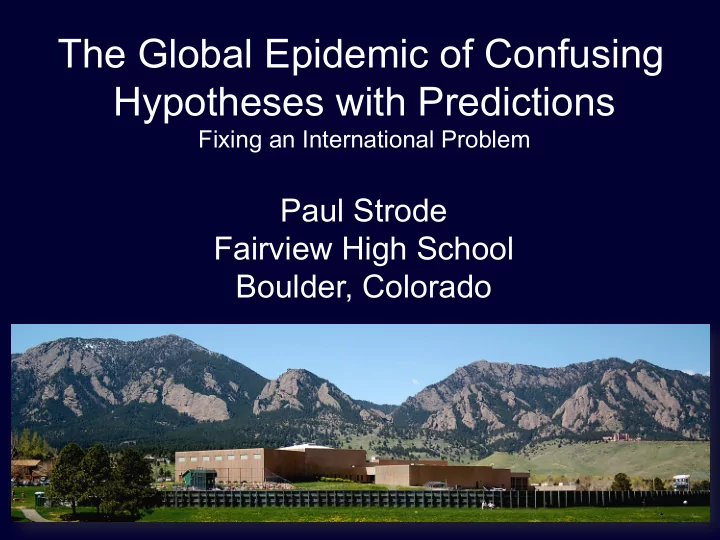
The Global Epidemic of Confusing Hypotheses with Predictions Fixing - - PowerPoint PPT Presentation

the global epidemic of confusing hypotheses with
SMART_READER_LITE
LIVE PREVIEW

The Global Epidemic of Confusing Hypotheses with Predictions Fixing - - PowerPoint PPT Presentation

The Global Epidemic of Confusing Hypotheses with Predictions Fixing an International Problem Paul Strode Fairview High School Boulder, Colorado The Scientific Hypothesis Survey: Write the definition of a hypothesis in science. A


slide-1
SLIDE 1

The Global Epidemic of Confusing Hypotheses with Predictions

Fixing an International Problem

Paul Strode Fairview High School Boulder, Colorado

slide-2
SLIDE 2

The Scientific Hypothesis

Survey:

  • Write the definition of a hypothesis in science.
  • A farmer observes that one edge of his onion

field produces taller plants and larger onions. This same edge borders a prairie that the farmer has been slowly restoring over the last 10 years. Every two years the farmer initiates a controlled burn in the prairie to clear out invasive species. Each year he burns the prairie, it grows back greener than in the years he doesnt burn it.

  • Write a hypothesis about this observation that

the farmer could test with an experiment:

slide-3
SLIDE 3

Hypothesis vs. Prediction

Oxford English Dictionary: Hypothesis - In the sciences, a provisional supposition from which to draw conclusions that shall be in accordance with known facts, and which serves as a starting-point for further investigation. Prediction - The action of predicting future events; an instance of this, a prophecy, a forecast.

We routinely use the term hypothesis when we mean

  • prediction. This unacceptable substitution dilutes the power of

the scientific method to the extent that invoking the scientific method has become largely meaningless Guy McPherson, American Biology Teacher, April 2001

slide-4
SLIDE 4

Hypothesis vs. Prediction

How textbooks define the hypothesis: Wilbraham A.C. et al. (Pearson Prentice Hall 2008) Chemistry: the Molecular Nature of Matter and Change Hypothesis - A proposed explanation for an observation. (p. 22) Serway and Faughn (Holt, Reinhalt, and Winston 2009) Physics A reasonable explanation for observations--one that can be tested with additional experiments. (p. 8) He hypothesized instead that all objects fall at the same rate in the absence of air resistance. (p. 8) Campbell and Reece (2008) Biology, 8th Ed.: Hypothesis - A tentative answer to a well-framed question--an explanation on trial. (p. 19)

slide-5
SLIDE 5

Hypothesis vs. Prediction

Hypothesis in science: A tentative, testable, and falsifiable explanation for an

  • bserved phenomenon in nature.
slide-6
SLIDE 6

Hypothesis vs. Prediction

How textbooks sometimes screw it up: Padilla, M.J. (Pearson Education 2009) Earth Science Hypothesis: A possible explanation for a set of observations or answer to a scientific

  • question. (p. 8)

Example: If I add salt to fresh water, then the water will freeze at a lower temperature.(p. 788) Miller, K. R., and J. Levine (Pearson Education 2009) Biology Hypothesis: A scientific explanation for a set of observations that can be tested in ways that support or reject it. (p. 7) Lab Prompt: Form a hypothesis: given the objective of this lab and the materials you have to work with, what kind of change, if any, do you expect to see in the pH of the kimchi over the course of several weeks.(p. 266) McGraw-Hill 2012 Middle School Science Textbook Program: iScience Form a Hypothesis: Use your data to form a hypothesis relating the amount of light to the rate of photosynthesis. State your hypotheses in this form: if . . . then . . . because.

slide-7
SLIDE 7

Using Hypotheses and Predictions in the Scientific Process (from Campbell Biology 2008)

Example: Observation: flashlight doesnt work. 1. Explanation (hypothesis): the batteries are dead. 2. Explanation (hypothesis): the bulb is burned out. Prediction #1 (with methods): replacing the batteries will make the flashlight work. If the dead battery hypothesis is correct, and I replace the batteries with new

  • nes, then the flashlight should work.

Flashlight works! Test of hypothesis #1 supports/does not falsify the hypothesis. The above hypothesis is both testable and falsifiable.

slide-8
SLIDE 8

Hypothesis testing is natural behavior

Playing with electricity (from Paul Strodes childhood) Problem (engineering): Battery operated car does not go fast enough. Engineering goal: Make car go faster. Hypothesis: Electricity is more powerful than batteries. Prediction (with methods): Powering car with electricity will make it go faster.

If electricity is more powerful than batteries, and I replace the batteries with electricity from an outlet, then my car will go faster.

slide-9
SLIDE 9

Examples of How We Get it Wrong

Cold Hands and Loss of Fine Motor Skills Observation: When our hands are cold, we lose our fine motor skills. Teacher: So breaking toothpicks requires fine motor skills, doesnt it? Lets do an experiment with toothpicks where we break them with our hands at two different temperatures and see what happens. Now everyone write a problem statement and hypothesis.

slide-10
SLIDE 10

Examples of How We Get it Wrong

Typical Problem Statement: What is the effect of temperature on how many toothpicks I can break in one minute? Example hypothesis: I can break more toothpicks with my hand when it is warm than I can when my hand is cold.

  • No. This is simply a prediction, not a hypothesis in the

scientific sense. This phrasing shifts students mindsets away from investigating cause and toward simply confirming an

  • bservation.
slide-11
SLIDE 11

Examples of How We Get it Wrong

Example hypothesis 2: If I break toothpicks for one minute with my warm hand and then with my cold hand, then I will break more toothpicks with my hand when it is warm.

  • No. This is a method followed by a prediction—there is still

no apparent reason for doing this experiment. What explanation is being tested? This may be the most common wrong way students and their teachers write hypotheses.

slide-12
SLIDE 12

Examples of How We Get it Wrong

Example hypothesis 3: If I break toothpicks for one minute with my warm hand and then for one minute with my hand after soaking it in ice water for five minutes, then I will break more toothpicks with my hand when it is warm BECAUSE low temperatures suppress muscle contractions and thus fine motor skills.

  • Almost. But this form puts the hypothesis being tested,

that cold suppresses muscle contractions, at the end of the statement, in the conclusion, rather than in the beginning where the hypothesis belongs. Also, the use

  • f the word because suggests truth and removes the

necessarily tentative nature of the hypothesis.

slide-13
SLIDE 13

Examples of How We Get it Right!

Example hypothesis 4: If low temperatures suppress muscle contractions and thus fine motor skills, and I break toothpicks for one minute with my warm hand and then for one minute with my hand after soaking it in ice water for five minutes, then I will break more toothpicks with my hand when it is warm.

  • Yes. This begins with the hypothesis that low temperatures

suppress muscle contractions, and beginning with the word if makes the hypothesis tentative. This form also includes how this hypothesis will be tested, and ends with a specific, measurable, predicted outcome of the experiment.

slide-14
SLIDE 14

Examples of How We Get it Right!

If low temperatures suppress muscle contractions and thus fine motor skills, and I break toothpicks for one minute with my warm hand and then for one minute with my hand after soaking it in ice water for five minutes, then I will break more toothpicks with my hand when it is warm.

We call this the RESEARCH HYPOTHESIS

(If hypothesis, and method, then prediction)

  • Young and Strode Why Evolution Works (and Creationism Fails), June 2009
slide-15
SLIDE 15

Examples of How We Get it Right!

Example hypotheses: If low temperatures suppress muscle contractions and thus fine motor skills, and I break toothpicks for one minute with my warm hand and then for one minute with my hand after soaking it in ice water for five minutes, then I will break significantly more toothpicks with my hand when it is warm.

Results: In a class of 30 students, students break an average of 36 toothpicks with warm hands and 22 toothpicks with cold hands. The data can be analyzed with a paired t-Test, or more simply with 95% confidence intervals, and always (5 years so far) show a statistically significant difference between the means.

slide-16
SLIDE 16

The Research Hypothesis Formula Has Been Around for a Long Time

Hasler, Arthur D. 1960. Guideposts of Migrating Fishes. Science 132:785-792.

  • Silver salmon (Oncorhynchus kisutch) are born in the headwaters of Pacific

Northwest streams.

  • Young salmon grow and mature sexually in the Pacific Ocean.
  • By tagging young salmon, biologists discovered that mature salmon actually return

to reproduce in precisely the same headwaters where they were born some years earlier.

  • This discovery raised a very interesting causal question: how do returning salmon

find their home stream? By borrowing explanations from other animal taxa, A. D. Hasler (1960) generated three hypotheses for salmon navigation: (1) salmon use sight; (2) salmon smell chemicals specific to their home stream; and (3) salmon use the Earths magnetic field.

slide-17
SLIDE 17

The Research Hypothesis Formula Has Been Around for a Long Time

Lawson, Antone E. 2004. The Nature And Development of Scientific Reasoning: a Synthetic

  • View. International Journal of Science and Mathematics Education 2:307–338.

Lawson (2004) describes Haslers hypothetico-deductive reasoning:

slide-18
SLIDE 18

Hypothesis and Prediction Confusion

Is it a National, Perhaps International Problem?

  • Students initially explore topics of interest (often unsolved

issues in science).

  • Students then

– develop research questions. – explore background information. – develop a hypothesis that uses the background information as a guide.

  • Students then write research proposals, run and analyze

experiments, and report their results in the form of scientific reports or at school, regional, and international science fairs. Independent Student Research → Science Fair

slide-19
SLIDE 19

The ISEF Hypothesis Study

  • The ISEF Study

– Five years of data collection at the International Science and Engineering Fair – 2006 (Indianapolis), 2008 (Atlanta), 2009 (Reno), 2010 (San Jose), and 2011 (LA) – A total of 1,129 student projects randomly surveyed

  • ver five years

– Excluded any projects with problem statements instead

  • f hypotheses (engineering,

math, computer science, some physics)

slide-20
SLIDE 20
  • The ISEF Study

– Surveyed projects for presence or absence of what students identified as hypothesis statements. – Assessed student understanding of the meaning of the scientific hypothesis versus the meaning of a prediction.

The ISEF Hypothesis Study

slide-21
SLIDE 21

The ISEF Hypothesis Study

slide-22
SLIDE 22

The ISEF Hypothesis Study

slide-23
SLIDE 23

The ISEF Hypothesis Study

Mean percent of projects (n = 5 years) with hypotheses written as predictions and hypotheses written as explanations. Error bars are 95% confidence intervals. Statistics are the results of a students t-Test.

slide-24
SLIDE 24

Examples from Student Projects

1. How would YOU categorize each of these? Prediction only -- Prediction (with methods) -- Hypothesis only -- Hypothesis and Prediction -- Research Hypothesis (Hypothesis, Methods, Prediction) 2. Does the student understand the meaning of hypothesis, or confuse it with prediction?

  • If a plant receives fertilizer, then they will grow to be bigger than a

plant that doesnt receive fertilizer.

  • The hypothesis of this study was that cattle presence would have

an adverse impact on the terrestrial salamander population.

  • It is hypothesized that in the early time intervals of data

collection, the cells fed with TGF Beta will at first be suppressed by the hormone.

slide-25
SLIDE 25

Examples from Student Projects

1. How would YOU categorize each of these? Prediction only -- Prediction (with methods) -- Hypothesis only -- Hypothesis and Prediction -- Research Hypothesis (Hypothesis, Methods, Prediction) 2. Does the student understand the meaning of hypothesis, or confuse it with prediction?

  • Ground level ozone will be higher in areas of Fairfield, Iowa,

with more traffic.

  • Earthworm activity will alter the chemical trajectory of leaf litter

from background fungal dominated decay paths.

  • If pH is a factor in the decomposition of H2O2, then lowering

the pH will inhibit the rate.

slide-26
SLIDE 26

Examples from Student Projects

1. How would YOU categorize each of these? Prediction only -- Prediction (with methods) -- Hypothesis only -- Hypothesis and Prediction -- Research Hypothesis (Hypothesis, Methods, Prediction) 2. Does the student understand the meaning of hypothesis, or confuse it with prediction?

  • It is hypothesized that if the bridges structural width is

changed from 40 mm to 30 mm to 20 mm, then the structural efficiency will increase respectively.

  • Dye affects the efficiency of a solar cell by being able to

absorb more light into the solar cell as opposed to no dye. Thus, the cell with no dye should not be able to conduct electricity.

slide-27
SLIDE 27

Examples from Student Projects

1. How would YOU categorize each of these? Prediction only -- Prediction (with methods) -- Hypothesis only -- Hypothesis and Prediction -- Research Hypothesis (Hypothesis, Methods, Prediction) 2. Does the student understand the meaning of hypothesis, or confuse it with prediction?

  • Because a prescribed burn is lower in intensity than a wildfire,

prescribed burns can significantly reduce mercury emissions from a subsequent fire.

  • It is hypothesized that the structural and functional integrity of

the system as a whole is dependent on nerve activity.

slide-28
SLIDE 28

Examples from Student Projects

1. How would YOU categorize each of these? Prediction only -- Prediction (with methods) -- Hypothesis only -- Hypothesis and Prediction -- Research Hypothesis (Hypothesis, Methods, Prediction) 2. Does the student understand the meaning of hypothesis, or confuse it with prediction?

  • If parthenolide is a substrate specific inhibitor in signal

transduction, and I examine the effects of parthenolide on the secretion of 5-HT through two independent pathways using a platelet-based model, then parthenolide should inhibit the secretion of 5-HT only through the PKC pathway.

slide-29
SLIDE 29

Research Hypothesis If parthenolide is a substrate specific inhibitor in signal transduction, and I examine the effects of parthenolide

  • n the secretion of 5-HT through two independent

pathways using a platelet-based model, then parthenolide should inhibit the secretion of 5-HT only through the PKC pathway.

Examples from Student Projects

slide-30
SLIDE 30

Hypothesis If parthenolide is a substrate specific inhibitor in signal transduction, and I examine the effects of parthenolide

  • n the secretion of 5-HT through two independent

pathways using a platelet-based model, then parthenolide should inhibit the secretion of 5-HT only through the PKC pathway.

Examples from Student Projects

slide-31
SLIDE 31

Methods If parthenolide inhibits 5-HT secretion from dense platelet granules through the inactivation of the PKC pathway, and I examine the effects of parthenolide on the secretion of 5-HT through two independent pathways using a platelet-based model, then parthenolide should inhibit the secretion of 5-HT only through the PKC pathway.

Examples from Student Projects

slide-32
SLIDE 32

Prediction If parthenolide inhibits 5-HT secretion from dense platelet granules through the inactivation of the PKC pathway, and I examine the effects of parthenolide on the secretion of 5-HT through two independent pathways using a platelet-based model, then parthenolide should inhibit the secretion of 5-HT only through the PKC pathway.

Examples from Student Projects

slide-33
SLIDE 33

Research Hypothesis If parthenolide is a substrate specific inhibitor in signal transduction, and I examine the effects of parthenolide

  • n the secretion of 5-HT through two independent

pathways using a platelet-based model, then parthenolide should inhibit the secretion of 5-HT only through the PKC pathway.

Examples from Student Projects

slide-34
SLIDE 34

What is the source of this problem?

Misuse of the Term Hypothesis in Textbooks

Level Course Title Authors Publisher Year Place Hypothesis D Example Hyp Example Hyp Prediction De Def H, P, or E Example H o Prompt H or P Middle School Earth Science Earth Science Feather, R. Jr Glencoe/McGr 1999 Columbus, Oh A prediction a You might hyp State a hypot None P P P Fail Middle School Earth Science Earth Science Feather, R. Jr Glencoe/McGr 2008 Columbus, Oh An educated g You might hyp State a hypot None EG P P Fail Middle School Earth Science Earth Science Todd, R. W. Holt, Rinehart 2001 Austin, Texas Sometimes ca The bones co None None EG H N Middle School Earth Science Earth Science Padilla, M. J. Pearson Educa 2001 Upper Saddle A possible exp If I add salt to How do you th None H P P Fail Middle School Earth Science Earth Science Padilla, M. J. Pearson Educa 2009 Upper Saddle A possible exp If I add salt to Which do you Making a forec H P P Fail Middle School Earth Science Earth Science Tarbuck, E. J. Pearson Prent 2009 Boston, Masse A possible exp Hypothesizing None None H P N Fail Middle School Life Science Life Science Todd, R. W. Holt, Rinehart 2001 Austin, Texas A possible exp The deformitie None A statement of H H N Middle School Life Science Life Science Padilla, M. J. Pearson Educa 2009 Upper Saddle A possible exp If I add salt to Write a hypot A forecast of H P H Fail Middle School Life Science Life Science Padilla, M. J. Pearson Educa 2001 Upper Saddle A possible exp If fertilizer is a None None H P N Fail Middle School Life Science Life Science Daniel, L. Glencoe/McGr 1999 Columbus, Oh A prediction t The doctor hy State a hypot None P H P Fail Middle School Physical Scien Physical Scien Frank, D. V., e Pearson Educa 2009 Upper Saddle A possible ans Changing the Write a hypot Making a forec H H P Fail Middle School Physical Scien CPO Science: Hsu, T. C., et CPO Science 2007 Nashua, New A possible exp Suppose heat In Investigatio None H P P Fail Middle School Physical Scien Energy, Mach Toler, D. J. Carolina Biolog 2006 Burlington, No None None None None N N N Middle School Physical Scien SEPUP Issues Nagle, B. Lab-Aids, Inc. 2007 Ronkonkoma, A tentative th None None None H N N Middle School Physical Scien Physical Scien Todd, R. W. Holt, Rinehart 2001 Austin, Texas A possible exp A propulsion s Form a hypoth Scientists usu H P H Fail Middle School Physical Scien Physical Scien Padilla, M. J. Prentice-Hall, 2001 Upper Saddle A possible exp The distance Write a hypot You might ma H H P Fail Middle School Physical Scien Physical Scien McLaughlin, C Glencoe/McGr 1999 Columbus, Oh A testable pre The farther so Hypothesize w None P H P Fail High School A Biology Biology: Conc Campbell, N., Peason Benjam 2009 San Francisco, A proposed ex The batteries None None H H N High School A Physics Physics Cutnell, J. D., John Wiley an 2009 Hoboken, New None None None None N N N High School A Physics Physics Giancoli, D. C. Pearson Educa 2009 Upper Saddle None None None None N N N High School Astronomy Astronomy Tod Chaisson, E. a Pearson Addis 2008 San Francisco, One possible e Earth, the cau None None H H N High School Astronomy Explorations: Arny, T. T., a McGraw-Hill 2008 New York, New An idea about The Earth is s None None H H N High School Biology Biology: Cycle Parke, H. M. a AGS Publishing 2006 Circle Pines, M An educated g None Write a hypot None EG N N High School Biology Biology: Cycle DeSalle, R. an Holt, Rinehart 2008 Austin, Texas A possible exp The geese we Form a testab None H H N High School Biology Biology: Explo Campbell, N., Peason Educa 2004 Upper Saddle A suggested a The batteries None None H H N High School Biology Modern Biolog Postlethwait, Holt, Rinehart 2009 Austin, Texas A proposed ex Owls hunt by None A statement t H H N High School Biology Biology Miller, K. R., a Peason Educa 2010 Upper Saddle A scientific ex Marsh grass g Form a hypoth None H H P Fail High School Chemistry Chemistry: Ma Buthelezi, T., Glencoe/McGr 2008 Columbus, Oh A testable exp The calculatio Write a hypot None H P P Fail High School Chemistry Chemistry Wilbraham, A. Pearson Prent 2008 Upper Saddle A proposed ex The batteries None None H H N High School Chemistry Chemistry Bell, J., et al.

  • W. H. Freema

2005 New York, New None None None None N N N High School Environmental Environment: Withgott, J., a Peason Benjam 2008 San Francisco, A statement t Agricultural fertilizer runnin Specific state H H N High School Environmental Environmental Botkin, D. B., John Wiley an 2009 Hoboken, New A statement t None None None H N N High School Environmental Environmental Cunningham, W McGraw-Hill 2008 New York, New A testable exp The flashlight None None H H N High School General Scien BSCS Science Resch, B, and BSCS 2006 Colorado Sprin A testable sta None Write a statem None EG N P Fail High School General Scien BSCS Science Resch, B, and BSCS 2008 Colorado Sprin A statement t None As a team, de None H N P Fail High School General Scien General Scien Marshall, R. H AGS Publishing 2004 Circle Pines, M A testable exp None None None H N N High School Geology Essentials of G Marshak, S. W. W. Norton 2007 New York, New A possible exp The features None None H H N High School Geology Earth: An Intr Tarbuck, E. J. Pearson Educa 2008 Upper Saddle A tentative (or Glacial ice can None None H H N High School Geology Earth Science Tarbuck, E. J. Pearson Educa 2009 Upper Saddle A tentative (or The bodies of None None H H N High School Marine Biology Marine Scienc Green, T. F. Amsco School 2004 New York, New A possible solu If food is pres None None H P N Fail High School Marine Biology Marine Biology Castro, P. and McGraw-Hill 2007 New York, New A statement t All fishes have None None H H N High School Physical Scien Conceptual Ph Hewitt, P. G., Pearson Addis 2010 San Francisco, An educated g Heavy objects None Consequences EG H N High School Physical Scien Introductory P Haber-Schaim Science Curric 2005 Belmont, Mass None None None None N N N High School Physical Scien Physical Scien Wysession, M Pearson Educa 2009 Upper Saddle A proposed an Speed affects None None EG H N High School Physical Scien CPO Science: Hsu, T. C., et CPO Science 2009 Nashua, New A possible exp Suppose heat In Investigatio None H P H Fail High School Physics Conceptual Ph Hewitt, P. G.Pearson Educa 2009 Upper Saddle An educated g No material ob None None EG H N High School Physics Physics Matte Trefil, J., and John Wiley an 2004 Hoboken, New A tentative, e When I drop a None The use of hy EG H N High School Physics Physics: Princ Zitzewitz, P. W Glencoe/McGr 2009 Columbus, Oh An educated g None None None EG N N High School Physics Physics Serway, R. A. Holt, Rinehart 2009 Austin, Texas A reasonable He hypothesiz None None H H N High School Physics Essentials of P Cutnell, J. D., John Wiley an 2006 Hoboken, New None None None None N N N High School Physics The Physics o Griffith, W. T. McGraw-Hill 2007 New York, New An educated g The coffee po None None EG H N High School Physics Physics for th Tsokos, K. A. Cambridge Un 2008 Cambridge, UK None None None None N N N College Biology Biology: The U Starr, C., et a Brooks/Cole, C 2009 Belmont, Calif A testable ans Smoking cigar None A statement of H H N College Biology Biology Campbell, N., Peason Benjam 2008 San Francisco, A tentative an The batteries None None H H N College Biology Biological Scie Freeman, S. Peason Benjam 2008 San Francisco, A proposed ex Long necks en None Something tha H H N College Biology Life Lewis, R., et a McGraw-Hill 2007 New York, New Based on som Elephants com None None P H N Fail College Chemistry Chemistry: Pri Masterson, W Brooks/Cole C 2009 Belmont, Calif None None None None N N N College Chemistry Chemistry: St Spencer, J. N. John Wiley an 2008 Hoboken, New None None None None N N N College Chemistry Chemistry: Th Brown, T. L., Pearson Educa 2009 Upper Saddle A tentative ex None None None H N N College Chemistry Chemistry Zumdahl, S. S Brooks/Cole C 2010 Belmont, Calif A possible exp None None None H N N College Chemistry Introductory C Zumdahl, S. S Houghton Miff 2008 Boston, Masse A possible exp The disease is None None H H N College Physics Physics: a Str Knight, R. D. Pearson Addis 2008 San Francisco, None None None None N N N College Physics University Phy Young, H. D., Pearson Addis 2008 San Francisco, None None None None N N N College Physics Fundamentals Walker, J. John Wiley an 2008 Hoboken, New None None None None N N N College Plant BiologyIntroductory P Stern, K. R., e McGraw-Hill 2008 New York, New A tentative, u All ripe citrus None None H H N College Plant BiologyIntroduction t Nabors, M. W. Pearson Benja 2004 San Francisco, A tentative an Leaves enable None None H H N

Analyzed all 66 science textbook used in Boulder Valley School District middle and high schools. Books were grouped by middle level (gray), high school (pink), and college (blue). If at least one of the three categories (hypothesis definition, hypothesis example, lab prompt for students to write a hypothesis) was or prompted a prediction, the book failed in its teaching of correct hypothesis writing.

Middle School Textbooks: 13 of 17 (76%) Failed High School Textbooks: 6 of 35 (17%) Failed College Textbooks: 1 of 14 (7%) Failed

slide-35
SLIDE 35

How big is this problem?

Use and Misuse of the Term Hypothesis in Scientific Papers

slide-36
SLIDE 36

Hypothesis Prediction How big is this problem?

Use and Misuse of the Term Hypothesis in Scientific Papers

slide-37
SLIDE 37

How big is this problem?

Use and Misuse of the Term Hypothesis in Scientific Papers

slide-38
SLIDE 38

If testosterone organizes human aggressive behavior, and we examine the relationship between 2D:4D and scores on the four subscales of the aggression questionnaire, then digit ratio will correlate with the most sexually dimorphic forms of trait aggression. How big is this problem?

Use and Misuse of the Term Hypothesis in Scientific Papers

slide-39
SLIDE 39

How big is this problem?

Use and Misuse of the Term Hypothesis in Scientific Papers

slide-40
SLIDE 40

How big is this problem?

Use and Misuse of the Term Hypothesis in Scientific Papers

slide-41
SLIDE 41

Practicing Hypothesis Writing

If we could only get our students to write good research questions…

  • 1. Are brightly colored leaves in the fall a warning to potential

herbivores?

  • 2. Are brightly colored leaves in the fall evidence of

sunscreen against damaging radiation?

  • 3. Why do some bird species arrive at their breeding grounds

at the same time every spring, regardless of spring conditions?

  • 4. Does temperature affect the rate of cellular respiration?

(think of yeast)

  • 5. Can plasmids transform phenotype in E. coli?
slide-42
SLIDE 42

Take Home Messages

  • 1. As science teachers, we are in the business of teaching

the process of science, which begins with correct hypothesis writing and testing.

  • 2. Hypothesis writing can be challenging, but is an essential

tool for keeping students (and scientists!) focused on exactly what they are doing and why they are doing it.

  • 3. Misuse of hypothesis is a problem throughout the

profession.

  • 4. Help students start their scientific thinking with good

research questions.

slide-43
SLIDE 43

Acknowledgments: Haydee Ayi-Bonte Kristin Donley Helen Petach Boulder Valley School District Paul K. Strode paul.strode@bvsd.org http://www.fairviewhs.org/staff/paul-strode