the gen enetic im improvement of of table grapes in in Chil ile - - PowerPoint PPT Presentation

the gen enetic im improvement of of table grapes in in
SMART_READER_LITE
LIVE PREVIEW

the gen enetic im improvement of of table grapes in in Chil ile - - PowerPoint PPT Presentation

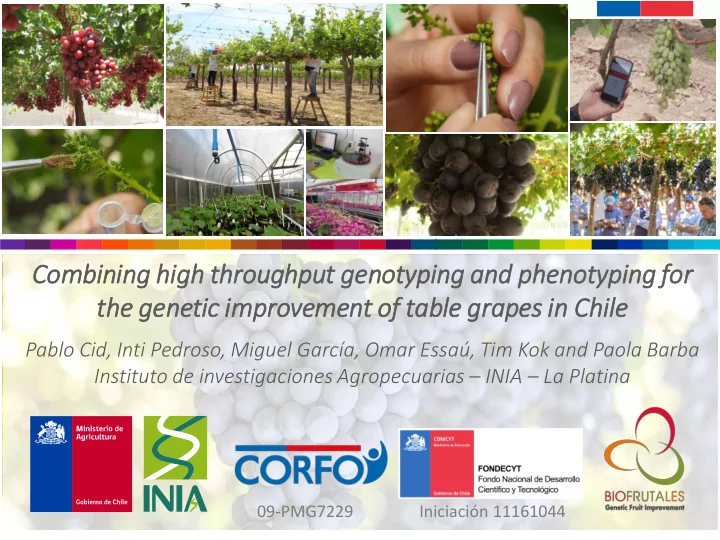
Com ombinin ing hig high throughput gen genotypin ing and and ph phenotypin ing for or the gen enetic im improvement of of table grapes in in Chil ile Pablo Cid, Inti Pedroso, Miguel Garca, Omar Essa, Tim Kok and Paola Barba


slide-1
SLIDE 1

Com

  • mbinin

ing hig high throughput gen genotypin ing and and ph phenotypin ing for

  • r

the gen enetic im improvement of

  • f table grapes in

in Chil ile

Pablo Cid, Inti Pedroso, Miguel García, Omar Essaú, Tim Kok and Paola Barba Instituto de investigaciones Agropecuarias – INIA – La Platina

09-PMG7229 Iniciación 11161044

slide-2
SLIDE 2

Uquillas, Carolina, et al. "‘Iniagrape-one’, a New Chilean Table Grape Cultivar." HortScience 48.4 (2013): 501-503.

slide-3
SLIDE 3

Seedling Field Phenotyping

7 5+

12 Hectáreas de vides en distintas etapas de crecimiento La Pintana, Santiago Last season

New plants to evaluate

slide-4
SLIDE 4

Berry Analyzer

Development of agro-informatic solutions using Open Source software

  • Kernel (~database) design. Software architecture adapted to grapevine

breeding process.

  • Tool development for data handling
  • Vine Tracker
  • Berry Analyzer

Vine Tracker Data Analysis Data Consult

slide-5
SLIDE 5

Maturity assessment (16 ° Brix)

Vine Tracker

Our own mobile app for field data

slide-6
SLIDE 6

Maturity assessment (16 ° Brix) Harvest characterization

Vine Tracker

Our own mobile app for field data

slide-7
SLIDE 7

Maturity assessment (16 ° Brix) Harvest characterization Selection

Vine Tracker

Our own mobile app for field data

slide-8
SLIDE 8

Vine Tracker

Our own mobile app for field data

Pros: ✓ Standardization

  • Better quality
  • Lower error
  • Faster

✓ Real time data synchronization

  • Team work over the field

✓ Real time data processing

  • Accuracy
  • Saves time
  • Rapid response
slide-9
SLIDE 9

Berry Analyzer

Algoritm collection for trait quantification based on laboratory images

Pros: ✓ Reduce subjective evaluation ✓ Increases precision of data ✓ Faster results ✓ Wider window opportunity for decision making ✓ Tool available at:

https://berry- analyzer.agroinformatica.cl/

slide-10
SLIDE 10

https://berry-analyzer.agroinformatica.cl/

Correlation on berry size phenotype Berry Analyzer vs caliper

Caliper (mm) Caliper (mm) Berry Analyzer (mm) Berry Analyzer (mm)

Equatorial diameter Polar diameter R2 0.973 R2 0.938

slide-11
SLIDE 11

https://berry-analyzer.agroinformatica.cl/

R2 0.930

Correlation on rachis size phenotype Rachis area vs rachis weight

slide-12
SLIDE 12

https://berry-analyzer.agroinformatica.cl/

Correlation on cluster size phenotype Cluster area vs cluster weight

R2 0.930

slide-13
SLIDE 13

High throughput color phenotyping

6.807 colors 102.595 colors

slide-14
SLIDE 14

‘Crimson’ CLUSTER at harvest

  • Green
  • Yellow
  • Red
  • Dark blue

High throughput color phenotyping: Define chromatic profiles

slide-15
SLIDE 15

17.7% 54.7% Green Red 20.7% 6.9% Yelllow Blue

Chromatic profile of ‘Crimson’ BUNCH at harvest

slide-16
SLIDE 16

Chromatic profile of ‘Crimson’ RACHIS at harvest

97.7% 0.4% 1.9% Green Red Brown

slide-17
SLIDE 17

Chromatic profile of ‘Crimson’ RACHIS after 30 days cold storage

34.5% 3.6% 59.9% Green Red Brown

slide-18
SLIDE 18

Chromatic profile of ‘Iniagrape-one’ RACHIS at harvest

91.7% 5.6% 2.8% Green Red Brown

slide-19
SLIDE 19

Chromatic profile of ‘Iniagrape-one’ RACHIS after 30 days cold storage

78.0% 9.3% 12.8% Green Red Brown

slide-20
SLIDE 20

Phenotype – genotype association (GWAS)

  • Phenotype
  • Germplasm collection: one season, one location, one to three

plants per genotype, six clusters per plant (harvest and postharvest), ten berries per cluster.

  • Breeding program families: one season, one location, one plant

per genotype, four to six clusters per plant (harvest and postharvest), ten berries por cluster.

  • 88.143 image-derived data points acquired during the last

season (finished in May!).

  • Covariates such as seed dry weight, soluble solids content, etc
slide-21
SLIDE 21

Phenotype – genotype association (GWAS)

  • Genotyping by sequencing 850 samples from

germplasm collection and breeding families. 60k quality SNPs markers

  • Work in progress…. Association mapping of

500 samples and 30k SNPs using linear mixed model with two first eigenvalues from PCA and Kinship matrix

slide-22
SLIDE 22

Selección 23 progeny ‘Flame’ progeny ‘Italia’ progeny INIA germoplasm collection PCA2 PCA1

slide-23
SLIDE 23

FONDECYT de iniciación

  • Mapeo asociativo. Manhattan plots, tabla de

heredabilidades

Marcador VvAGL11

GWAS: Validation LMM using seed dry weight

slide-24
SLIDE 24

Acknowledgments

  • Pablo Cid
  • Inti Pedroso
  • Felipe Belemmi
  • Miguel Angel García

INIA Collaborators

  • Bruno Defilippi
  • Humberto Prieto
  • Patricio Hinrichsen

09-PMG7229 Iniciación 11161044