The Future of Software Privacy concerns commerce, security, - - PowerPoint PPT Presentation

the future of software
SMART_READER_LITE
LIVE PREVIEW

The Future of Software Privacy concerns commerce, security, - - PowerPoint PPT Presentation

The Future of Software Privacy concerns commerce, security, cryptography, www.digicash.com www.hotmail.com and other free email sites Why is the best software designed in the US, will this continue to be the case? 1992, The


slide-1
SLIDE 1

Duke CPS 108

  • 32. 1

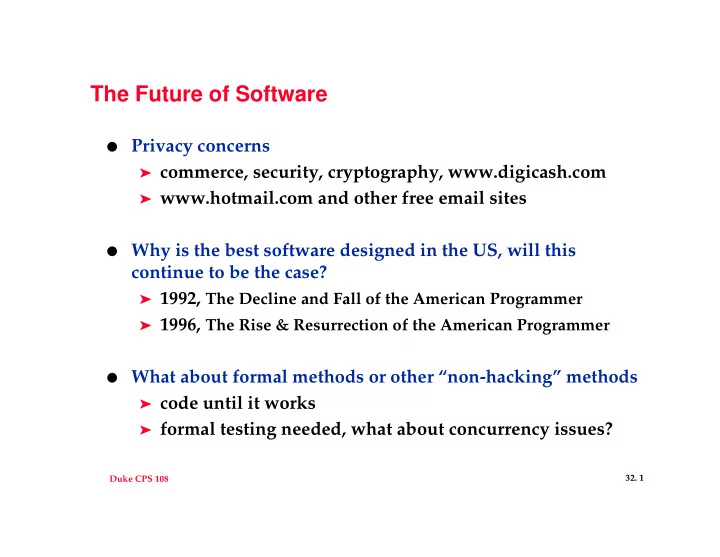
The Future of Software

  • Privacy concerns

➤ commerce, security, cryptography, www.digicash.com ➤ www.hotmail.com and other free email sites

  • Why is the best software designed in the US, will this

continue to be the case?

➤ 1992, The Decline and Fall of the American Programmer ➤ 1996, The Rise & Resurrection of the American Programmer

  • What about formal methods or other “non-hacking” methods

➤ code until it works ➤ formal testing needed, what about concurrency issues?

slide-2
SLIDE 2

Duke CPS 108

  • 32. 2

What is a pattern?

  • “… a three part rule, which expresses a relation between a

certain context, a problem, and a solution. The pattern is, in short, at the same time a thing, … , and the rule which tells us how to create that thing, and when we must create it.”

Christopher Alexander

➤ name

factory, aka virtual constructor

➤ problem delegate creation responsibility: Hyperwag ➤ solution createFoo() method returns aFoo, bFoo,... ➤ consequences potentially lots of subclassing, ...

  • more a recipe than a plan, micro-architecture, frameworks,

language idioms made abstract, less than a principle but more than a heuristic

  • patterns capture important practice in a form that makes the

practice accessible

slide-3
SLIDE 3

Duke CPS 108

  • 32. 3

Patterns are discovered, not invented

  • You encounter the same “pattern” in developing solutions to

programming or design problems

➤ develop the pattern into an appropriate form that makes it

accessible to others

➤ fit the pattern into a language of other, related patterns

  • Patterns transcend programming languages, but not (always)

programming paradigms

➤ OO folk started the patterns movement ➤ language idioms, programming templates, programming

patterns, case studies

slide-4
SLIDE 4

Duke CPS 108

  • 32. 4

Pattern/Programming Interlude

  • Microsoft interview question (1998)
  • Dutch National Flag problem (1976)
  • Remove Zeros (AP 1987)
  • Quicksort partition (1961, 1986)
  • Run-length encoding (SIGCSE 1998)

3 5 3 5 8 7 8 8 3 8 5 7 2 5 1 0 4 8 2 8 1 5 4 3 4 1 0 9 8 5 6 4 9 3 8 6 1 5

11 3 5 3 2 6 2 6 5 3 5 3 5 3 10

slide-5
SLIDE 5

Duke CPS 108

  • 32. 5

One loop for linear structures

  • Algorithmically, a problem may seem to call for multiple

loops to match intuition on how control structures are used to program a solution to the problem, but data is stored sequentially, e.g., in an array or file. Programming based on control leads to more problems than programming based on structure. Therefore, use the structure of the data to guide the programmed solution: one loop for sequential data with appropriately guarded conditionals to implement the control Consequences: one loop really means loop according to structure, do not add loops for control: what does the code look like for run-length encoding example? What about efficiency?

slide-6
SLIDE 6

Duke CPS 108

  • 32. 6

Coding Pattern

  • Name:

➤ one loop for linear structures

  • Problem:

➤ Sequential data, e.g., in an array or a file, must be

processed to perform some algorithmic task. At first it may seem that multiple (nested) loops are needed, but developing such loops correctly is often hard in practice.

  • Solution:

➤ Let the structure of the data guide the coding solution. Use

  • ne loop with guarded/if statements when processing one-

dimensional, linear/sequential data

  • Consequences:

➤ Code is simpler to reason about, facilitates develop of loop

invariants, possibly leads to (slightly?) less efficient code

slide-7
SLIDE 7

Duke CPS 108

  • 32. 7

Design patterns you shouldn’t miss

  • Iterator

➤ useful in many contexts, see previous examples, integral to

both C++ and Java

  • Factory

➤ essential for developing OO programs/classes, e.g., create

iterator from a Java 1.2 List? list.iterator()

  • Composite

➤ essential in GUI/Widget programming, widgets contain

collections of other widgets

  • Adapter/Façade

➤ replug-and-play, hide details

  • Observer/Observable, Publish/Subscribe, MVC

➤ separate the model from the view, smart updates

slide-8
SLIDE 8

Duke CPS 108

  • 32. 8

More Design Patterns

  • Command

➤ encapsulate a request as an object, supports undo, re-

usable commands (compare anonymous inner class)

  • Mediator

➤ define a class that encapsulates how other objects interact,

promote loose coupling since other objects interact with mediator instead of with each other: Gui, App, Controller

  • Singleton

➤ a class has a single instance, enforce this via design rather

than convention

  • Proxy

➤ provide a surrogate/placeholder for ease of use, different

control: smart stack-based pointer for iterators in C++