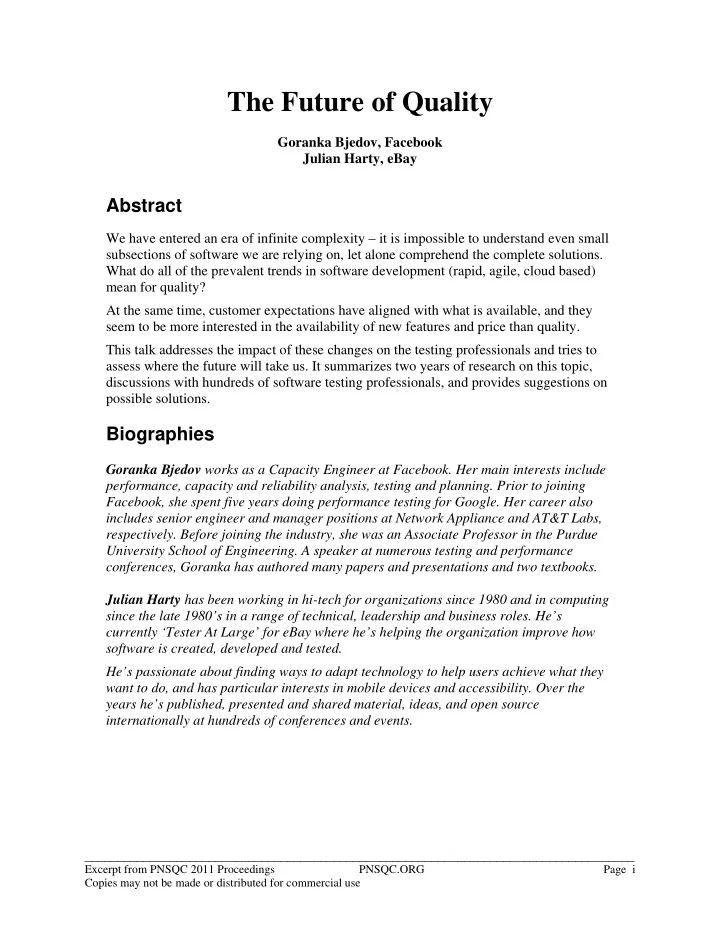
The Future of Quality Goranka Bjedov, Facebook Julian Harty, eBay - - PDF document

the future of quality
SMART_READER_LITE
LIVE PREVIEW

The Future of Quality Goranka Bjedov, Facebook Julian Harty, eBay - - PDF document

The Future of Quality Goranka Bjedov, Facebook Julian Harty, eBay Abstract We have entered an era of infinite complexity it is impossible to understand even small subsections of software we are relying on, let alone comprehend the complete


slide-1
SLIDE 1

The Future of Quality

Goranka Bjedov, Facebook Julian Harty, eBay

Abstract

We have entered an era of infinite complexity – it is impossible to understand even small subsections of software we are relying on, let alone comprehend the complete solutions. What do all of the prevalent trends in software development (rapid, agile, cloud based) mean for quality? At the same time, customer expectations have aligned with what is available, and they seem to be more interested in the availability of new features and price than quality. This talk addresses the impact of these changes on the testing professionals and tries to assess where the future will take us. It summarizes two years of research on this topic, discussions with hundreds of software testing professionals, and provides suggestions on possible solutions.

Biographies

Goranka Bjedov works as a Capacity Engineer at Facebook. Her main interests include performance, capacity and reliability analysis, testing and planning. Prior to joining Facebook, she spent five years doing performance testing for Google. Her career also includes senior engineer and manager positions at Network Appliance and AT&T Labs,

  • respectively. Before joining the industry, she was an Associate Professor in the Purdue

University School of Engineering. A speaker at numerous testing and performance conferences, Goranka has authored many papers and presentations and two textbooks. Julian Harty has been working in hi-tech for organizations since 1980 and in computing since the late 1980’s in a range of technical, leadership and business roles. He’s currently ‘Tester At Large’ for eBay where he’s helping the organization improve how software is created, developed and tested. He’s passionate about finding ways to adapt technology to help users achieve what they want to do, and has particular interests in mobile devices and accessibility. Over the years he’s published, presented and shared material, ideas, and open source internationally at hundreds of conferences and events.

____________________________________________________________________________________ Copies may not be made or distributed for commercial use Excerpt from PNSQC 2011 Proceedings PNSQC.ORG Page i

slide-2
SLIDE 2

The Future of Quality

1

Introduction

2

The Past

3

Testing for Quality

4

Testing for Productivity

5

The Future

Agenda

____________________________________________________________________________________ Excerpt from PNSQC 2011 Proceedings PNSQC.ORG Page Copies may not be made or distributed for commercial use 1

slide-3
SLIDE 3

My Background

eBay – Tester At Large responsible for improving the efficiency and effectiveness of testing Google – Senior QA Engineer, on Mobile Applications, AdSense, Chrome OS, collaborated with Goranka for 4 years Commercetest, et al – Performance and Security

  • testing. Due diligence. CTO for several companies

DunsGate – Ran European engineering for scalable $100m online business for 11 years Royal Air Force – Avionics engineer

History of This Presentation

2008 – General discontent with work/field/practice… Sep 2009 – Moved to London (hoping for a change) Nov 2009 – Realization: Quality is Dead Dec 2009 – Goranka invited by Ross Collard to present at “Leadership Summit” at StarEast and StarWest 2010 2010 – Five months of time available for research Aug 2010 – Goranka started at Facebook in a different role; Julian started at eBay 2011 – a year later: some things are more clear…

____________________________________________________________________________________ Excerpt from PNSQC 2011 Proceedings PNSQC.ORG Page Copies may not be made or distributed for commercial use 2

slide-4
SLIDE 4

1

Introduction

2

The Past

3

Testing for Quality

4

Testing for Productivity

5

The Future

Agenda Definitions

Testing – What is testing? Is it different from checking (Michael Bolton) Quality – I like Jerry Weinberg’s definition: “It is a value to somebody.” What is the responsibility of a test person? – This is, in my opinion, where we really went wrong. Other Engineering Fields – Are there similarities? Differences? What happens when: Value of quality << Price of quality

____________________________________________________________________________________ Excerpt from PNSQC 2011 Proceedings PNSQC.ORG Page Copies may not be made or distributed for commercial use 3

slide-5
SLIDE 5

The Past

Packaged Software – testing/bug fixing cycle follows development which was preceded by design. Cost of a Bug – bugs found and fixed in design are cheaper then those found and fixed in development, which in turn are cheaper then those fixed in the field. Test Team Contribution – finding bugs. Systems – relatively simple. Code – relatively simple and traceable. Development/Testing Tools – very primitive.

Testing Roles

Advocate for the Customer – it is our job to make sure nothing escapes. Quality Consultant – it is our job to provide information

  • n the quality of the software.

Quality Control – it is our job to stop bad products from being released.

____________________________________________________________________________________ Excerpt from PNSQC 2011 Proceedings PNSQC.ORG Page Copies may not be made or distributed for commercial use 4

slide-6
SLIDE 6

1

Introduction

2

The Past

3

Testing for Quality

4

Testing for Productivity

5

The Future

Agenda Testing For Quality

To understand product quality, you must test the product with that purpose in mind. Problems:

  • Medium and large tests
  • Hard to design and write well
  • Difficult to debug
  • Tests are more flaky as the system complexity grows
  • Take long time to run
  • Require (smart) people for analysis [expensive]
  • Find real and superficial bugs?

Result: We may get a high-quality product…sometimes. Result: We get an expensive product…almost always.

____________________________________________________________________________________ Excerpt from PNSQC 2011 Proceedings PNSQC.ORG Page Copies may not be made or distributed for commercial use 5

slide-7
SLIDE 7

When is Quality Important?

Easy to state:

  • When a field/industry is highly regulated (maybe drug

manufacturing?)

  • When human lives are at stake (hospital equipment,

planes, cars?)

  • When security is at stake
  • When money is exchanging hands (isn’t that what SOX

compliance is all about?)

  • Take long time to run

Let’s take a look at some of these…

Value of Quality

Glaxo case:

http://www.boston.com/business/healthcare/articles/2010/10/27/ glaxosmithkline_to_pay_750m_fine_in_fraud_case/

…GlaxoSmithKline PLC agreed to pay $750 million to settle civil and criminal charges… The settlement, one of the largest ever in a health care fraud case, burnished the reputation of the US attorney’s

  • ffice in Boston as the premier federal office for

investigating health care fraud. It has been responsible for recovering about $6 billion in health care fines and claims in the past decade, about 25 percent of all recoveries nationally.

____________________________________________________________________________________ Excerpt from PNSQC 2011 Proceedings PNSQC.ORG Page Copies may not be made or distributed for commercial use 6

slide-8
SLIDE 8

Value of Quality, cont.

Airspeed inconsistency: http://en.wikipedia.org/wiki/Air_France_Flight_447 Do A330 aircraft have issues: http://www.spiegel.de/international/world/0,1518,7661 48,00.html Not just aircraft: http://blogs.crikey.com.au/planetalking/2010/11/17/the

  • anatomy-of-the-airbus-a380-qf32-near-disaster/

Quote: Rolls-Royce had designed and was introducing a fix for the oil leak issues for this into the engines at its own speed. Qantas was left in the dark.

Value of Quality, cont.

____________________________________________________________________________________ Excerpt from PNSQC 2011 Proceedings PNSQC.ORG Page Copies may not be made or distributed for commercial use 7

slide-9
SLIDE 9

Value of Quality, cont.

John Viega: "The Myths of Security" chapter 28, "When Will We Get Rid of All the Security Vulnerabilities?" 2005 to today, average of 7000 vulnerabilities publicly disclosed Quote: "But, if you're any other company (well, except for maybe a big financial company or a government agency), the cost of "doing it right" is far higher than the cost of only responding when someone does find a problem, and other companies are unlikely to be risking brand damage."

Some Entertainment

Cable bill - $16.4 million: http://www.daytondailynews.com/business/time-warner- charges-wright-patt-engineer-16-4-million-for-cable- 1117224.html While the dollar amount of DeVirgilio's billing ordeal makes it among the more egregious in recent memory, the kings of all billing mishaps have to be… Jon Seale, received notice that he owed a 17-figure sum that totaled almost 2,000 times the national debt: 23 quadrillion, 148 trillion, 855 billion, 308 million, 184 thousand and 500

  • dollars. The other, Josh Muszynski, was charged 23

quadrillion after buying a pack of cigarettes at a gas station.

____________________________________________________________________________________ Excerpt from PNSQC 2011 Proceedings PNSQC.ORG Page Copies may not be made or distributed for commercial use 8

slide-10
SLIDE 10

1

Introduction

2

The Past

3

Testing for Quality

4

Testing for Productivity

5

The Future

Agenda Productivity Testing

My Definition: Productivity testing is all testing that is focused on faster development. Its main purpose is preventing developers from checking in bad code, and allowing for changes to the code with certain "peace of mind". Typical examples: Unit tests, micro-benchmarks, "sanity" tests, etc. Typical characteristics: small, fast, cheap to write and maintain, analysis-free (when they fail, it is clear where and why), perfect for automation, fantastic for gaming the system, managers love them (code coverage, metrics), "technical" (are we using mocks, fakes, doubles, or something else?)

____________________________________________________________________________________ Excerpt from PNSQC 2011 Proceedings PNSQC.ORG Page Copies may not be made or distributed for commercial use 9

slide-11
SLIDE 11

Productivity Testing, cont.

Extremely Popular:

  • search for software testing framework: ~7.3 million

results (October 2011)

  • offers: for Java, for C, for C++ in search box
  • language based
  • automated testing conference: ~4.1 million results

Advantages:

  • quick to write
  • easy to maintain
  • fantastic for generating metrics

But, what do they really do?

Testing By Developers Exposed

http://www.exampler.com/ease-and-joy.html Quote: "The lore of testing is full of people who spent weeks improving test automation libraries without ever, you know, quite getting around to automating any tests. The trick is to make improvements in small steps while simultaneously continuing to frequently deliver the business value that makes the project worth funding. There's a real skill to moving gradually and continuously and simultaneously toward several larger goals."

____________________________________________________________________________________ Excerpt from PNSQC 2011 Proceedings PNSQC.ORG Page Copies may not be made or distributed for commercial use 10

slide-12
SLIDE 12

It is Usually Done Badly

Check any talks/papers/references. People talk about:

  • Number of tests (Relevance?)
  • Coverage
  • Execution time (Fast = Good)
  • Automated generation of tests/data
  • Testing tools/harnesses/frameworks etc.

e.g. http://www.gtac.biz/agenda Interestingly, I cannot find any meaningful information

  • n:
  • What do your tests do?
  • Who analyzes them?
  • Do they save or waste money?

Over-confidence in the test results

  • Automation as servant, not master, of our software

delivery:

  • Inaccurate results
  • “Beware of Automation Bias” by M.L. Cumming[1]
  • Automated tests and checks miss more than they find

[1] http://citeseerx.ist.psu.edu/viewdoc/download?doi=10.1.1.91.2634&rep=rep1&type=pdf

____________________________________________________________________________________ Excerpt from PNSQC 2011 Proceedings PNSQC.ORG Page Copies may not be made or distributed for commercial use 11

slide-13
SLIDE 13

What we think we are testing

What our automated test actually interacts with…

____________________________________________________________________________________ Excerpt from PNSQC 2011 Proceedings PNSQC.ORG Page Copies may not be made or distributed for commercial use 12

slide-14
SLIDE 14

(Some of the) things our automated tests may miss…

Promotion s Navigation History Layout, Rendering & Formatting Problem JavaScript CSS and HTML

Beware of poor-quality automated 'tests'

1.AssertTrue(true);

  • 2. No/Inadequate/Too many Asserts
  • 3. Poor code design
  • 4. Falsehoods (False positives / negatives)

____________________________________________________________________________________ Excerpt from PNSQC 2011 Proceedings PNSQC.ORG Page Copies may not be made or distributed for commercial use 13

slide-15
SLIDE 15

1

Introduction

2

The Past

3

Testing for Quality

4

Testing for Productivity

5

The Future

Agenda To Summarize

  • 1. We want it free, we want it now. We can compromise
  • n how good it needs to be.
  • 2. Cloud services are allowing for “instant” fixes. The

cost of fix once software is deployed is NOT the order

  • f magnitude higher than before.
  • 3. Paradoxically, this makes fixing bugs only when

encountered (by customers/developers) a reasonable strategy

  • 4. This is happening in many aspects of our lives, not

just software.

  • 5. System complexity allows for plausible deniability.
  • 6. As the demand for quality products drops, the price

goes up steeply.

____________________________________________________________________________________ Excerpt from PNSQC 2011 Proceedings PNSQC.ORG Page Copies may not be made or distributed for commercial use 14

slide-16
SLIDE 16

The dissolution of monasteries

  • "All That Testing Is Getting in the Way of Quality“

James Whittaker Keynote @StarWest October 05, 2011

  • Google has dissolved the Quality Engineering
  • rganization
  • No ‘testers’ at Facebook & other hi-tech companies
  • My work focuses on better software creation practices,

not on testing what is created

  • Disruptive Technologies as applied to software testing

Pool of Test People has Expanded

uTest and the like: crowdsourced testing Google: dogfooding with in-app bug reporting from users Security bugs – https://www.facebook.com/whitehat/bounty/

http://googleonlinesecurity.blogspot.com/2010/11/rewarding- web-application-security.html [~ $380,000 paid in 5 years?]

Hardware testing: search for Google Cr-48 and free Find a bug: get a job? Impossible? Not Just People: automated systems http://cacm.acm.org/magazines/2010/2/69354-a-few- billion-lines-of-code-later/fulltext

____________________________________________________________________________________ Excerpt from PNSQC 2011 Proceedings PNSQC.ORG Page Copies may not be made or distributed for commercial use 15

slide-17
SLIDE 17

Ways we can improve Value

Opensource our testing

  • 1. Share data, methods & results
  • 2. Collaboration
  • 3. Weekend Testing
  • 4. Swiss Testing Days
  • 5. Peer workshops (LAWST)
  • 6. Pairing

Where We Can Offer Value

  • 1. We can reduce development time (and costs) by writing

productivity tests

  • 2. We can bring in quality by adding smart system tests in

the right places

  • 3. Think performance, scalability, usability, accessibility
  • 4. Apply questioning and investigative skills to the business
  • 5. We can address difficult testing problems e.g. large-

scale data, testing in production

  • 6. We can reduce number of machines needed in data

centers

  • 7. We must start calculating and communicating the value
  • f our work (dollar amounts)
  • 8. We must stop being the cost center

____________________________________________________________________________________ Excerpt from PNSQC 2011 Proceedings PNSQC.ORG Page Copies may not be made or distributed for commercial use 16

slide-18
SLIDE 18

Q&A

julianharty@gmail.com jharty@ebay.com

____________________________________________________________________________________ Excerpt from PNSQC 2011 Proceedings PNSQC.ORG Page Copies may not be made or distributed for commercial use 17