The Future of Britain and Europe Professor Simon Hix Professor of - - PowerPoint PPT Presentation

the future of britain and europe
SMART_READER_LITE
LIVE PREVIEW

The Future of Britain and Europe Professor Simon Hix Professor of - - PowerPoint PPT Presentation

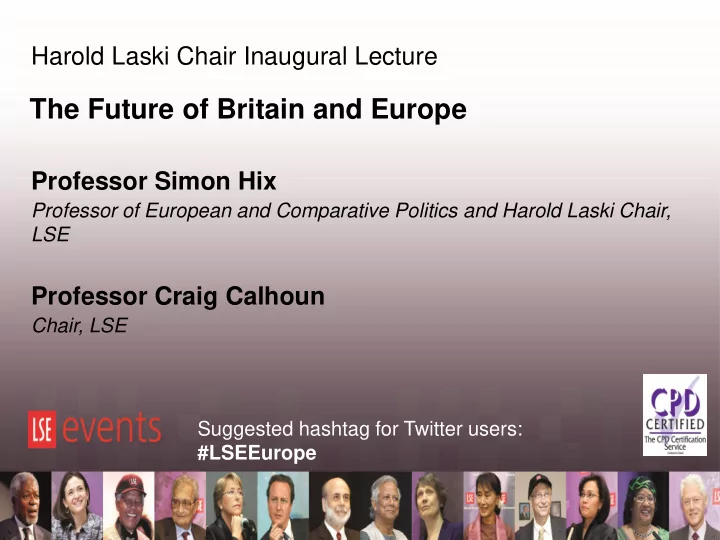
Harold Laski Chair Inaugural Lecture The Future of Britain and Europe Professor Simon Hix Professor of European and Comparative Politics and Harold Laski Chair, LSE Professor Craig Calhoun Chair, LSE Suggested hashtag for Twitter users:


slide-1
SLIDE 1

The Future of Britain and Europe

Suggested hashtag for Twitter users: #LSEEurope

Harold Laski Chair Inaugural Lecture Professor Simon Hix

Professor of European and Comparative Politics and Harold Laski Chair, LSE

Professor Craig Calhoun

Chair, LSE

slide-2
SLIDE 2

The Future of Britain and Europe

Simon Hix #LSEEurope

slide-3
SLIDE 3

Harold Laski on the (de)centralisation of power

When Laski was in the United States (1915-1920) he was opposed to the centralisation of power in Washington, as he believed that the only way to achieve socialism in America was to start in Massachusetts Back in Britain (in the 1920s) he was opposed to devolving powers to Scotland and Wales, and a “federal Britain”, because he believed the only way to achieve socialism in Britain was to dictate it from Westminster and Whitehall => Laski’s views on the hierarchical organisation of the state were endogenous to his political preferences

slide-4
SLIDE 4

Outline: a series of questions

  • 1. Is Britain part of Europe?
  • 2. Where is the EU heading?
  • 3. Can there be a “new relationship” for Britain?
  • 4. Will we vote to leave?
slide-5
SLIDE 5

British condescension …

“The future treaty which you are discussing has no chance of being agreed; if it was agreed, it would have no chance of being ratified; and if it were ratified, it would have no chance of being applied. And if it was applied, it would be totally unacceptable to Britain. You speak of agriculture, which we don't like, of power

  • ver customs, which we take exception to, and

institutions which frighten us. Monsieur le president, messieurs, au revoir et bonne chance.” Russell Bretherton, British Foreign Office representative at a meeting of Spaak Committee, November 1955

slide-6
SLIDE 6

Anglo- Saxons not Europeans?

UK identity in 2014

slide-7
SLIDE 7

A different value set?

slide-8
SLIDE 8

A different economic model?

slide-9
SLIDE 9

Low trade dependence?

Source: Eurostat

slide-10
SLIDE 10

Most sceptical of the late joiners

20 30 40 50 60 70 80 90

Oct-73 Feb-75 Jun-76 Oct-77 Feb-79 Jun-80 Oct-81 Feb-83 Jun-84 Oct-85 Feb-87 Jun-88 Oct-89 Feb-91 Jun-92 Oct-93 Feb-95 Jun-96 Oct-97 Feb-99 Jun-00 Oct-01 Feb-03 Jun-04 Oct-05 Feb-07 Jun-08 Oct-09 Feb-11

% who think EU membership is a "good thing"

EU UK Ire Den

Source: Eurobarometer

slide-11
SLIDE 11

Growing support for a different EU

0% 10% 20% 30% 40% 50% 60% 70% 80% 90% 100% 1992 1993 1994 1995 1996 1997 1998 1999 2000 2001 2002 2003 2004 2005 2006 2007 2009 2013 2024 Leave the EU Stay in EU but reduce its powers Leave things as they are Stay in EU and increase its ppwers Work for a single European government

Source: British Social Attitudes surveys

slide-12
SLIDE 12

Where the EU is heading

A Micro-Economic Union to Macro-Economic Union

1980s-2000s: Building a “Micro-Economic Union”

single market: free movement of goods, services, capital, labour common regulations: environment, social, consumers, competition etc.

2000s+: Towards a “Macro-Economic Union” (in Eurozone+)

19 members of the Euro + 8 expecting to join (exc. UK & Swed.) Emerging Eurozone+ architecture:

European Stability Mechanism (ESM) – “bailout” fund Fiscal Compact Treaty – EU26, except UK & Czech Republic Euro-Plus Pact – coordination of national macroeconomic policies Banking Union – common governance of banks ECB as “lender of last resort”
slide-13
SLIDE 13

“Britain is isolated in Europe”

Nigel Lawson, May 2013

Source: Iain Begg (2015) Could it be ‘Brexpulsion’ rather than ‘Brexit’?, SIEPS.

slide-14
SLIDE 14

UK isolation in the EU Council

Source: www.VoteWatch.eu

slide-15
SLIDE 15

Although we seem to be successful

Source: Robert Thompson, DEU

20 25 30 35 40 45 50 Bulgaria Romania EU Commission Latvia France Slovenia Greece Lithuania Italy Estonia Malta Spain Netherlands Hungary EU Average Poland Belgium Germany Portugal European Parliament Cyprus Luxembourg Finland Austria Sweden Slovakia United Kingdom Czech Republic Ireland Denmark Average distance from

  • utcome
  • n

0-100 policy scale

Figure. 1. Average distance from EU policy

  • utcomes
slide-16
SLIDE 16

UK isolated from emerging democratic politics in the EU

New Lisbon Treaty Rules for “Electing” Com Pres:

“Taking into account the elections to the European Parliament and after having held the appropriate consultations, the European Council, acting by a qualified majority, shall propose to the European Parliament a candidate for President of the

  • Commission. This candidate shall be elected by the European Parliament by a

majority of its component members.

=> UK government: European Council (still) chooses Com Pres Everyone else: Commission President now “elected” by EP

  • > May 2014: Spitzenkandidaten before EP elections

but no British candidate ! Cons ran a “non of the above” campaign (because not in EPP) Lab refused to support Martin Schultz Lib Dems refused to campaign for Guy Verhofstadt

slide-17
SLIDE 17

UK press ignored SKs until after election!

Number of articles in British press citing each SK candidate

slide-18
SLIDE 18

Contrast between Germany and UK

Number of articles in German and British press citing both “Juncker” and “Schulz”, weekly from 31 March 2014.

slide-19
SLIDE 19

TV debates and public awareness of candidates

slide-20
SLIDE 20

Options on the table

A new UK-EU relationship

“Mind the Gap” – safeguards for UK, e.g. UK Protocol “Widen the Channel” – more UK “opt-outs”

Leave the EU

Norway – join European Economic Area (“Puerto Rico” of the EU!) Switzerland – bilateral agreements with the EU

slide-21
SLIDE 21

Norwegian and Swiss Options?

House of Commons Foreign Affairs Committee (2013) Future of the European Union, 11 June 2013, HC 87-I

“Our witnesses and interlocutors also brought home to us the essential similarity between the positions of Norway and Switzerland: namely, that both are in practice obliged to adopt EU legislation over which they have had no effective say. … On our visits to Oslo and Berne, we gained the impression that both Norway and Switzerland were prepared to accept what they acknowledge to be a ‘democratic deficit’ … as the ‘price’ for their continued access to (parts of) the Single Market …. However, our interlocutors in both Berne and Oslo largely advised the UK to remain inside the EU, as a way of retaining influence over the legislation that it would be obliged to adopt if it remained part of the Single Market.”

slide-22
SLIDE 22

What does Cameron want?

European Council, 25 June 2015

Sovereignty: UK opt-out from “ever closer union”, more protection against deeper integration (e.g. red cards for national parliaments), and cutting EU red tape (e.g. Working Time Directive) Fairness: protection for the City of London in the single market, against deeper integration in the Eurozone Immigration: reform of free movement of people, especially limits on access to benefits (esp. housing benefit, in-work benefits) Growth and jobs: A “reform agenda” for the single market, swift agreement on the TTIP trade deal with the US => a “UK Protocol” + reform of 2003 Free Movement Directive

slide-23
SLIDE 23

Red lines for “swing voters”

slide-24
SLIDE 24

Public Opinion on Remain/Leave

YouGov EU Referendum Tracker

slide-25
SLIDE 25

Party support & support for leaving EU

Data: British Elections Study 2015, Wave 6, May 2015

slide-26
SLIDE 26

Predictors of support for leaving

Data: British Elections Study 2015, Wave 6

  • v. Centre
  • v. Still studying
  • v. 66+
  • v. >£100k
slide-27
SLIDE 27

Support for leaving by region

Data: British Elections Study 2015, Wave 6

slide-28
SLIDE 28

1975 Referendum

  • n staying in

the EC

67% Yes 33% No

slide-29
SLIDE 29

In Sum

Britain has always been an outlier & UK public has (mistakenly) seen European integration as an economic project rather than a political one This is now even more acute, with deeper economic union in the Eurozone & emerging “democratic politics” in Europe Choices for Britain: 1) Leave now, and negotiate partial access to the single market e.g. Canada to the EU’s USA? 2) Stay in, and take a lead on developing a two-tier framework: federal core + confederal periphery (in single market) 3) Stay in, and re-engage: Re-engage in the EU Council Cons rejoin EPP, Lab play role in choice of SD Spitzenkandidaten Join EU migrant burden-sharing scheme (and, in time, join Euro?)

My preference: 3 > 1 = 2

slide-30
SLIDE 30

The Future of Britain and Europe

Suggested hashtag for Twitter users: #LSEEurope

Harold Laski Chair Inaugural Lecture Professor Simon Hix

Professor of European and Comparative Politics and Harold Laski Chair, LSE

Professor Craig Calhoun

Chair, LSE