SLIDE 1
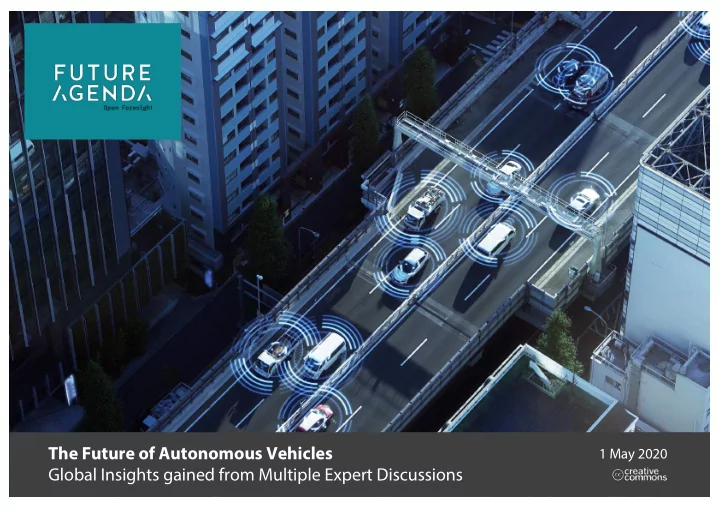
The Future of Autonomous Vehicles Global Insights gained from Multiple Expert Discussions
1 May 2020
SLIDE 2 Contents
This document provides an overview of the key insights on the future of AV. Based on insight from multiple expert discussions, it shares different views and highlights the core areas of progress, and associated implications, that we can anticipate by 2030.
- CONTEXT
- WHERE WE HAVE COME FROM
- THE WAY FORWARD
- CERTAINTIES AND UNCERTAINTIES
- RESEARCH INSIGHTS
- CONCLUSIONS
- MORE INFORMATION
SLIDE 3
CONTEXT
SLIDE 4
A Wicked Problem
The future of autonomous vehicles is considered to be a complex ‘wicked’ problem. To address it, we need to understand and challenge many different expert perspectives.
A wicked problem is a social or cultural problem that is difficult or impossible to solve for as many as four reasons: 1. Incomplete or contradictory knowledge, 2. The number of people and opinions involved, 3. The large economic burden, and 4. The interconnected nature of this with other problems.
SLIDE 5 Global Insights
This project has identified where and what the key opportunities are by collectively challenging and sharing the future of AVs plus the key drivers of change across a number of pivotal locations.
Review existing research Map the emerging landscape Explore gaps via global dialogue Identify the key priority
Prepare and share global report Support hosts with implications
SLIDE 6 Expert Dialogue
We held eight expert workshops plus six extra discussions which have identified major challenges, new opportunities and emerging issues for the next decade.
C Top 3 Challenges O Top 3 Opportunities F Top 3 Future Issues Melbourne 13 JUN 2019 C Data Sharing More Congestions Security Systems O Full Truck Automation First / Last Mile Robo-taxi Model F Reimagining Planning Safety of AV ROI Wellington 11 JUN 2019 C Data Sharing Security Systems Common Standards O Rethinking Planning Remote Support Centres First / Last Mile F Social Equity AV is Public Transport MaaS Dubai 17 OCT 2019 C Impact of Regulation Cyber Security Social Impact O Public Transport Systems Automated Freight Controlled Environments F Data Sharing Rethinking Transport Planning Robo-taxi Fleets Frankfurt 22 MAY 2019 C Common Standards Inadequate Harmonisation More Congestion O Truck Automation Incentives for Collaboration First / Last Mile F Communication between Systems Acceptance of Accidents Cyber Security Risks Singapore 07 JUN 2019 C Data Sharing Inadequate Harmonisation Security Systems O Robo Taxis Truck Automation Urban Delivery F Environmental Impact Insurance and Liability Less vs More Congestion Top 25 AV Ready Nations KPMG https://home.kpmg/content/dam/kpmg/nl/pdf/2019/sector/autonomous-vehicles-readiness-index-2019.pdf
Future of Autonomous Vehicles Key Insights
Los Angeles 28 MAR 2019 C Inadequate Harmonisation Rethinking Planning Common Standards O Mobility as a Service Public Private Partnerships First / Last Mile F Deeper Collaboration Social Impact Data Connectivity Road Deaths per 100,000 Citizens (WHO, 2018)
TOTAL China 18.2 UAE 18.1 USA 12.4 New Zealand 7.8 Canada 5.8 UK 3.1 Germany 4.1 Japan 4.1 Singapore 3.6 Sweden 2.8
Singapore (ITS) 20 OCT 2019 C Cyber-Security Impact of Regulation Crash Avoidance O Automated Freight Controlled Environments Public Transport Systems F Rethinking Planning Social Impact Data Sharing Silicon Valley 11 FEB 2020 C Crash Avoidance Cyber-Security Common Standards O AV Certification Rethinking Planning Intelligent Infrastructure F Regulation AI / HD Mapping Automated Freight London 05 JUL 2019 Shanghai 06 JUL 2018 Tokyo 30 APR 2019 Gothenburg 30 SEP 2019 Toronto 04 NOV 2019 Austin 24 OCT 2019
SLIDE 7
Our Hosts and Partners
Leading organisations involved in the hosting of events included a broad mix of transport agencies, universities, consultancies, trade bodies and logistics companies.
SLIDE 8
WHERE WE HAVE COME FROM
SLIDE 9 AV Development Timeline
The possibility of developing an autonomous vehicle has been explored for many years. Since 1939, projects have been building momentum towards today’s intensive activity.
- Future of Autonomous Vehicles
- Google
Lyft Uber Volvo Baidu Tesla
2000 1999 1998 1997 1996 1995 1995 1994 1991 1987 1980 1977 1968 1967 1963 1953 1945 1939 2003 2004 2005 2007 2008 2009 2010 2011 2012 2013 2014 2015 2016 2017 2018 2019
SLIDE 10
THE WAY FORWARD
SLIDE 11
Realistic Expectations
After a reset in 2019, more realistic ambitions for autonomy are providing greater focus for OEMs and big tech as well as guiding investor expectations on timelines and impact.
SLIDE 12
CERTAINTIES AND UNCERTAINTIES
SLIDE 13 What We Know While there are multiple debates, we see five main issues on which many agree. These are close to ‘certainties’ upon which assumptions and scenarios can be based.
1 AVs will Initially be Expensive:
With all the up-front investment as well as the additional technology that will be embedded within the vehicles and the wider intelligent infrastructure, the price of AVs will be significantly higher than today’s cars and trucks. Over time, costs will reduce but there will continue to be a premium. Fleet operations will thus dominate the early years as the economics rely on Return on Investment.
2 High Utilisation is Critical:
For the target cost-per-mile to be viable, AV fleet business models assume high daily use of vehicles – potentially up to 24/7. Each AV will drive between 100,000 and 300,000km a year and so will more follow a consumer product lifecycle than a traditional long-term transportation model. Updates and upgrades will be frequent.
3 China and the US in the Front Seat:
Given the size of the domestic market, technology development already underway, the level of investment underway, government support and proactive regulation, alongside the US, China and Chinese companies will also play a major role in the field. In the US the regulatory environment enables private funding to drive early deployment. A China discussion highlighted that the central government had given Shanghai alone $50bn to invest to be a world leader EV and AV.
4 Monitoring is Assumed:
While highly automated and able to eventually operate autonomously, all AVs will be monitored by both people and machines. Human supervision, either in the vehicle or remotely, will be required by regulators and expected by users in the early years and, over time, as trust builds some of this will be undertaken by machines.
5 Autonomous Vehicles will Look Different:
Although much of the testing is taking place with adapted conventional cars and trucks, when they are deployed at scale by fleets AVs will be distinctive. Autonomous trucks will eventually be cab-less while autonomous cars will be designed for multiple person shared
- ccupancy. Prototypes such as Volvo Truck’s Vera and Cruise’s Origin are good examples. For privately-owned passenger cars, coming
in significant volumes after 2030, interiors are also likely to evolve substantially.
SLIDE 14 Initial Questions An initial perspective mapped the autonomous vehicle landscape and identified twelve key questions to explore via the research project.
1. Where will be the key hot-spots for AV development and deployment? 2. Which sociopolitical forces may accelerate the adoption of full Level 4/5 automation? 3. Where is advanced regulation most likely to act as a catalyst for AV deployment? 4. What level of safety (crashes) is acceptable for the full launch of AV in the next decade? 5. Will AV increase or decrease total traffic flow and congestion? 6. Will automated mobility services replace, reduce or extend the reach of public transport? 7. Of all the technologies in the mix, which ones are in greatest need of further development before the benefits of AV can be realised? 8. What are the distinct benefits from AV that are not already coming from current and future-connected ADAS? 9. How important will international standards and commonly shared technologies be for AV adoption - or will it be more regional?
- 10. Which will be the pivotal organisations, cities and governments that control adoption
rates?
- 11. Who will lead on integrating all the varied systems needed to enable AV to operate?
- 12. Who will customers trust more to deliver a safe, reliable and comfortable AV experience?
SLIDE 15 Further Exploration In the interim report we identified an additional 12 questions from the first tranche
- f workshops that we then sought to addresses in the second half of the project.
1. What lessons can be learned from other sectors – for example, mobile and healthcare? 2. How much will AVs be tied to EVs, and therefore intertwined with charging infrastructure roll-out etc.? 3. Will air-taxis have impact beyond a few niche locations? 4. How will drones used for parcel delivery integrate with drones for other purposes? 5. How will planning evolve to become a public/private partnership? 6. Will private companies contribute to the cost of the infrastructure, and will public sector agencies allow for this? 7. Will the growth of AVs mean more open/liveable/walkable urban public spaces? 8. How will cities adapt today’s public transport systems in an era in which automated MaaS overlaps their mission? 9. How will designers overcome resistance to sharing rides with strangers?
- 10. For what types of routes and freight will Level 4 truck automation happen first?
- 11. How will supply chain approaches be transformed by Level 4 truck automation?
- 12. What effect will growth in AV urban/suburban parcel/grocery/food delivery have on
- ther road users?
SLIDE 16
RESEARCH INSIGHTS
SLIDE 17
Six Macro Themes
From the discussions, a number of key issues were prioritised, debated and explored in depth Within these, there are six pivotal high-level macro drivers of change are focus of greatest debate.
SLIDE 18 Priority Areas for Focus
Underlying and connected to these six, there are another additional fourteen priority topics
- f focus. Together these 20 areas can all be considered pivotal for the future of AVs.
SLIDE 19
Systemic Considerations
SLIDE 20
Regulation and Liability
The regions that gain most will be those where regulation acts as a catalyst for AV deployment. Successfully addressing reporting requirements and liability will be critical for adoption.
SLIDE 21
Common Standards
International standards and commonly shared technologies may be essential for driving global rather than regional AV adoption. Without them, a more fragmented approach will be taken.
SLIDE 22
Improved Safety
Reducing accidents and road deaths is the political priority behind support for AV. While many benefits can be gained from ADAS, the promise of further major safety improvements is pivotal.
SLIDE 23
Environmental and Social Impact
Ensuring that autonomous vehicles are cleaner than alternative options may be a pre-requisite in many regions, while the benefit of AVs for wider society is a crucial issue for public endorsement.
SLIDE 24
More Congestion
Decreasing congestion on the roads is a core ambition for AV advocates, but many recognise that, with mixed fleets operating for several years, we may initially see an increase in urban traffic.
SLIDE 25
Less Parking
Effective deployment of AVs could mean not only fewer vehicles on the streets, but also that parking spaces are removed enabling narrower roadways and more pedestrian space.
SLIDE 26
Rethinking Planning
Poor coordination between transit systems, urban planning and solutions may delay AV benefits. For full impact it will be necessary to take a more flexible approach to planning .
SLIDE 27
Moving People
SLIDE 28
Public Transport Systems
Autonomous buses, shuttles and new mobility solutions to fill transport gaps are introduced. Security, flexibility, reach, interconnectivity and funding are the primary issues for many cities.
SLIDE 29
Resistance to Sharing
Public support for ridesharing will require a re-evaluation of vehicle design for small groups. Concerns about privacy and safety mean strangers may be unwilling to travel together.
SLIDE 30
Robo-Taxi Fleets
Robo-taxis are the way forward for passenger transport in suburbs and cities. As part of ‘Mobility as a Service’ robo-taxis change travel patterns, car ownership, and have to integrate with public transport.
SLIDE 31
First and Last Mile
Improving the inefficient first and last mile has health, energy and efficiency benefits. In urban environments, scooters, bikes and small autonomous robots all have a role to play.
SLIDE 32
Air Taxis
Several major cities will support the introduction of air-taxis - initially to allow the elite to bypass increasing congestion on the streets, but later for wider citizen use.
SLIDE 33
Goods Transport
SLIDE 34
Drones for Goods
Investment in timely drone delivery services accelerates deployment in multiple locations. Concerns about safety and collisions are overcome with automated UAV air traffic control.
SLIDE 35
Urban Delivery
Small, slow-moving, autonomous robots offer attractive ROI and act as an accelerator of deployment. They enable safe, clean, convenient and low-cost delivery and help to raise public confidence in AV.
SLIDE 36
Automated Freight
Driverless expressway trucks will transform long-haul journeys and the wider logistics sector. As safety goals are met and costs are reduced, regulatory support evolves with deployment.
SLIDE 37
Truck Platoons
As the first level of deployed automation, truck platoons help build wider momentum while delivering tangible improvements in efficiency, cost of transportation, energy use and safety.
SLIDE 38
Controlled Environments
Automation within controlled environments continues to expand steadily. AVs within airports, port terminals and logistics facilities start to venture onto the open road.
SLIDE 39
Data and Security
SLIDE 40
Data Sharing
Better, deeper and more secure, data sharing is pivotal to enabling the full AV ambition. Mobility brands agree protocols for V2X interaction and support the use of shared data sets.
SLIDE 41
Cyber Security
With a rising threat of hacks, denial of service, vandalism and theft of data, organisations seek to protect AV through building common approaches for broader, closed but collaborative systems.
SLIDE 42
Remote Support Centres
Manned support centres initially provide oversight, support and emergency response for all AVs. In the absence of drivers, public transport vehicles require clear remote human supervision.
SLIDE 43
CONCLUSIONS
SLIDE 44
Nine Thoughts
We can see nine core issues as significant for the next decade. All are intricately inter-connected but collectively define the highly ‘wicked’ problem to address.
1. Fleets are now driving progress: In terms of the dominant business models, momentum is clearly behind both robo-taxis and truck fleets. 2. Automated trucks are coming: Freight has much to gain in terms of efficiency; this has regulatory momentum and wide industry support. 3. Safety is a pre-requisite: Expectations are high, but as many advances are already in process, improvements look likely. 4. Congestion is a conundrum: While the aim is for less congestion and the role of connectivity is pivotal, user behaviour and Transportation Network Company (TNC) strategies could initially mean more congestion. 5. Multiple options for the last mile: There are many alternatives in the mix, all bridging different needs and location gaps. 6. First vs widespread deployment: Where and why we see initial AV services may not necessarily align with where mass impact will occur. 7. Deeper collaboration will be needed: Moving from partnerships to long-term multi-party collaboration is seen as a critical enabler. 8. Technical standards may not be pivotal: Although comprehensive technical standards are advocated, they are not essential for AV; in some regions, safety standards will support regulation. 9. Regulators are influencing deployment: Proactive regulation is attracting companies, but the balance of light vs. heavy regulatory approaches may impact this.
SLIDE 45
MORE INFORMATION
SLIDE 46 More Information If you would like additional details on this project, how it was undertaken or any of the insights shared in this report, please contact either of the authors.
Tim is a recognised expert in innovation, growth and futures. A leader in collaborative programs, for over 20 years he has helped leading organizations explore new fields and identify new areas for potential growth. https://uk.linkedin.com/in/innovationstrategy tim.jones@futureagenda.org +44 7801 755 054
Richard Bishop
With over 25 years in this domain, Richard brings a unique perspective to the automated vehicles arena worldwide focusing on partnership development, applications, industry analysis and business strategy. https://www.linkedin.com/in/richardbishopconsulting/ richard@richardbishopconsulting.com +1 443 695 3717
Project Website: www.futureautonomous.org
SLIDE 47
Future Agenda, 84 Brook Street, London W1K 5EH +44 203 0088 141 www.futureagenda.org | @futureagenda