The Fiber Optic Subsystem Components on Express Logistics Carrier - - PowerPoint PPT Presentation

the fiber optic subsystem components on express logistics
SMART_READER_LITE
LIVE PREVIEW

The Fiber Optic Subsystem Components on Express Logistics Carrier - - PowerPoint PPT Presentation

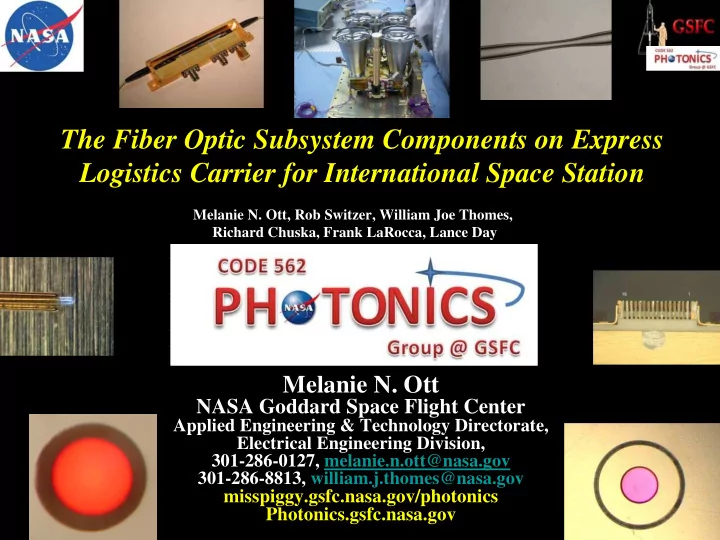
The Fiber Optic Subsystem Components on Express Logistics Carrier for International Space Station Melanie N. Ott, Rob Switzer, William Joe Thomes, Richard Chuska, Frank LaRocca, Lance Day Melanie N. Ott NASA Goddard Space Flight Center Applied


slide-1
SLIDE 1

Melanie N. Ott

NASA Goddard Space Flight Center

Applied Engineering & Technology Directorate, Electrical Engineering Division, 301-286-0127, melanie.n.ott@nasa.gov 301-286-8813, william.j.thomes@nasa.gov

misspiggy.gsfc.nasa.gov/photonics Photonics.gsfc.nasa.gov

The Fiber Optic Subsystem Components on Express Logistics Carrier for International Space Station

Melanie N. Ott, Rob Switzer, William Joe Thomes, Richard Chuska, Frank LaRocca, Lance Day

slide-2
SLIDE 2

Project Dates Design Qualification

Performance over Harsh Environment

Manufacturing Integration Failure Analysis ICESAT, GLAS, 1997 - 2005 X X GSE Prototype ISS 1998 - 2008 Vendor/ Flight ISS - HDTV 2003 X X FLIGHT Fiber Optic Data Bus 1997 -2000 X X Messenger – MLA, 2001 - 2004 X X FLIGHT X Sandia National Labs (DOE) 1998 -2008 FLIGHT Vendor/ Flight ISS-Express Logistics Career 2006 -2009 X X FLIGHT X Air Force Research Lab 2003, 2008 X Shuttle Return To Flight 2004 -2005 FLIGHT Lunar Orbiter Laser Altimeter 2003 -2008 X X FLIGHT X Prototype Mars Science Lab ChemCam 2005 -2008 X X FLIGHT X Vendor Laser Ranging, LRO 2005 - 2008 X X FLIGHT X Prototype Fiber Laser IIP/IRAD 2003 - 2006 X X QUAL James Webb Space Telescope OSIM Cryo 2008-2009 X X Cryo-Qual X Joint Dark Energy Mission 2009 X X Langley Research Center 2009 X X X

Thirteen Years of Service from the Photonics Group for Photonics & Optical Fiber Components and Assemblies Code 562, Electrical Engineering Division of AETD, NASA GSFC

slide-3
SLIDE 3

Summary of Specialties

  • Space Flight Packaging for Assemblies.
  • Manufacturing of Custom Assemblies and Arrays.
  • Environmental Screening, Selection and Qualification of

Optoelectronic Parts; High Power Laser Diode Arrays, Laser Diodes, Pin Diodes, Transceivers, Modulators

  • Optical Fiber Insitu Radiation Testing over Temperature

for a Comprehensive Dose Rate/Total Dose/Temperature Model.

  • Failure Analysis for Electrical and Optical Components.
  • Design, development for risk mitigation of failure modes.
  • High Power terminations for space flight instruments and

power transfer systems (fiber laser power stage).

  • Flight integration.
slide-4
SLIDE 4

Outline

  • International Space Station/ GSFC Transceiver Requirements
  • Transceiver Requirement Issues/ Resolution

– Extinction Ratio, System Requirements

  • Harness Diagram
  • Integration, Issues and Resolution
  • Attenuator Data
  • Connector Anomalies
  • Other Topics Related

NEPP Radiation Database Complete Small Form Factor Interconnects

  • Conclusions
slide-5
SLIDE 5

Express Logistics Carrier (ELC modules) “Smart Warehouse for Station

slide-6
SLIDE 6

Express Logistics Carrier for ISS; Communications System Assemblies

GSFC Photonics Group – Flight Control Unit Transceiver Assemblies (Space Photonics) SPI- FCU Transceivers GSFC Photonics Group - Harnessing

slide-7
SLIDE 7

Subsystem Components

Component Manufacturer Part Number/ Identifer Transceivers for FCU Space Photonics HMP1-TRX Transceiver Interconnection Diamond AVIM Transceiver Optical Fiber Nufern FUD-2940 Transceiver Cable W.L Gore Flexlite, simplex FON1435 ExPCA Interconnection Sabritec SSQ22680 ExPCA Termini ITT Canon SSQ21636-NRP-F-16 (S,P) Harness Optical Cable BICC SSQ21654-NFOC-2FFF-1GRP-1 (Obsolete) Attenuator GSFC/Diamond Cleanable AVIM Adapter Attenuator Interconnection Diamond AVIM EVA Connector Circular Amphenol SSQ21635 EVA Termini ITT Canon SSQ21635-NZGC-F-16 (SB,PB) ISS-UMA Connector ISS Supplied ISS Supplied

Express Pallet ISS UMA Flight Control Unit (FCU) ExPCA Interconnection EVA Interconnection

slide-8
SLIDE 8

Extinction Ratio Definitions, For System Level Requirements

P1 = power high, P0 = power low Extinction Ratio (%) ISS Specification, Re (%) = (P0

/P1 ) * 100%; Extinction Ratio (dB); Re (dB) = 10*log(P1 /P0 ) Extinction Ratio (industry) Re = P1 /P0

Extinction Ratio % dB Ratio Larger 5 % 13 dB 20 10 % 10 dB 10 15 % 8.2 dB 6.7 25 % 6 dB 4 40 % 4 dB 2.5 Smaller 60 % 2.2 dB 1.7

slide-9
SLIDE 9

Space Station HDRL Requirements

Requirement Rate Wavelength BER Extinction Ratio ISS SSP 50184 125 Mbps 1270 – 1380 nm 10-9 5% (13 dB) TX 10% (10 dB) RX GSFC 125 Mbps 1290 – 1390 nm 10-9 5% (20) 13 dB Requirement Optical output TX Typical TX Range RX GSFC

  • 7 dBm to 0 dBm

200 uW - 1 mW

  • 4 dBm

400 uW

  • 36 dBm to 1 dBm

250 nW – 1.25 mW

slide-10
SLIDE 10

Space Photonics Transceivers

Specification Optical Output, TX Range, RX Re

SPI

FCU @28°C 3.0 dBm (2 mW) FCU @66°C

  • 1.5 dBm (700 uW)

FCU @-18°C 5 dBm (~3.2 mW) GSFC

  • 7 dBm to 0 dBm

200 uW to 1 mW (-4 dBm typical)

  • 36 dBm to 1 dBm

250 nW to 1.25 mW Was 13 dB Now 8.2 dB

GSFC Thermal Requirement -20°C to +60°C

ISS simulator testing proved GSFC could use 15 % (8.2 dB) for Extinction Ratio SPI TX/RX worked in simulator to higher than 40% Re or less than 4 dB Re.

slide-11
SLIDE 11

Harnessing Diagram for Express Logistics Carrier on ISS

UMA Connector ExPCA Connector

slide-12
SLIDE 12

Attenuator Cryogenic Validation Test

Cryogenic Insertion Loss Data vs Time at Cryogenic Thermal Couple Data from Cryogenic Test. 24 hour cryogenic test @ 93K (-180°C) for validation of attenuator Macor components inside of a Diamond AVIM “Cleanable” Adapter

slide-13
SLIDE 13

Attenuator Random Vibration Test

Horizontal Axis, Vertical Axis Insertion Loss Monitoring during random vibration testing of Attenuator 1 @ 20Grms

slide-14
SLIDE 14

Last assemblies to integrate into the harnessing were the optical fiber assemblies, reason = risk mitigation. Schedule constraints led to integration at the International Space Station Processing Facility at Kennedy Space Center. Lesson Learned= Integrate sooner.

Integration of the ELC assemblies at KSC International Space Station Facility

slide-15
SLIDE 15

ISS Connector/Pin Anomaly

ExPCA Location

slide-16
SLIDE 16

ExPCA Connector Anomaly Investigation

SSQ21636-NRP-F-16 Mated Pair Pin: SSQ21636-NRP-F-16P Socket: SSQ21636-NRP-F-16S

X-Ray Image Gap between Ceramic and Metal Shell Socket does not engage the entire pin, leaving joint vulnerable

Why did the pins break off?

slide-17
SLIDE 17

SSQ21635 & SSQ21636 Termini Designed to make breakage more likely at ceramic/metal shell interface

Shorter Version NZGC-F-16-PB (SB) Longer Version NRP-F-16P (S)

slide-18
SLIDE 18

Component Evaluations for Small Form Factor Applications results available http://photonics.gsfc.nasa.gov

For future transceiver applications, a preliminary technology validation of the Diamond DMI (Mini AVIM)the following tests were conducted: Pull Force Data, Thermal Testing, Vibration Testing Meeting with Diamond in Mid Oct to discuss next generation enhancements

Space Version Rugged Version Standard Version Rugged Version

slide-19
SLIDE 19

Surface Images of Pin

Side view of ceramic pin near crack region Side view of ceramic pin near crack region Higher magnification of rough area Side view of ceramic pin away from tapered region

slide-20
SLIDE 20

Thermal Validation Testing of the Diamond DMI Connectors

Ruggedized and Space Version

slide-21
SLIDE 21

Vibration Validation Testing

Four Tests Conducted with insitu monitoring: 10 grms, 14 grms, 20 grms, 35 grms Random Vibration conducted for 3 mins per axis, for each of x, y, z axis configuration

Frequency (Hz) Level 20 0.052 g2/Hz 20-50 +6 dB/octave 50-800 0.32 g2/Hz 800-2000

  • 6 dB/octave

2000 0.052 g2/Hz Overall 20.0 grms Frequency (Hz) Level 20 0.026 g2/Hz 20-50 +6 dB/octave 50-800 0.16 g2/Hz 800-2000

  • 6 dB/octave

2000 0.026 g2/Hz Overall 14.1 grms Frequency (Hz) Level 20 0.013 g2/Hz 20-50 +6 dB/octave 50-800 0.08 g2/Hz 800-2000

  • 6 dB/octave

2000 0.013 g2/Hz Overall 9.8 grms Frequency (Hz) Level 20 0.156 g2/Hz 20-50 +6 dB/octave 50-800 0.96 g2/Hz 800-2000

  • 6 dB/octave

2000 0.156 g2/Hz Overall 34.63 grms

slide-22
SLIDE 22

Vibration Validation Testing

X & Y configurations for the DMI connectors during Random vibration

slide-23
SLIDE 23

Vibration Validation Testing Results for the DMI (Mini AVIM System) for 10 grms

slide-24
SLIDE 24

Diamond DMI Small Form Factor Conclusions

Thermal Cycling resulted in less than 0.25 dB max change in Insertion Loss for all types during cycling – nominal as compared to the AVIM. Vibration Testing results conclusion; no significant changes – nominal as compared to AVIM.

slide-25
SLIDE 25

MTP Connector Used for Flight Transceivers (Multimode Comm)

slide-26
SLIDE 26

For more information please visit the URL

http://photonics.gsfc.nasa.gov

Special thanks to NASA GSFC Electrical Engineering Division, 560 Applied Engineering Technologies Directorate, 500 for funds support.

Thank you very much for the invitation!

Conclusion

ISS SSP 50184 HRDL optical fiber communication subsystem, has system level requirements that were changed to accommodate large loss optical fiber links previously installed. SSQ22680 design is difficult to implement, no metal shell over socket/pin combination to protect weak part of pin. Additions to ISS are planned for future. AVIM still used for interconnection in space flight applications without incident. Stay tuned for more data available on the small form factor DMI or Mini AVIM.