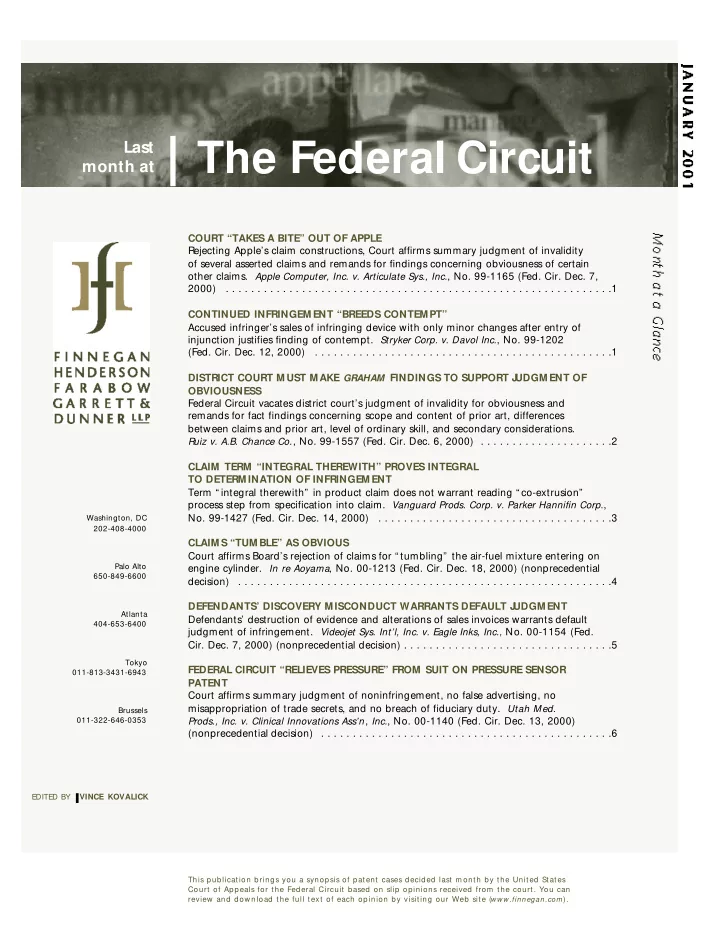
The Federal Circuit month at COURT TAKES A BITE OUT OF APPLE - - PDF document

the federal circuit
SMART_READER_LITE
LIVE PREVIEW

The Federal Circuit month at COURT TAKES A BITE OUT OF APPLE - - PDF document

Last The Federal Circuit month at COURT TAKES A BITE OUT OF APPLE Rejecting Apples claim constructions, Court affirms summary judgment of invalidity of several asserted claims and remands for findings concerning obviousness of certain


slide-1
SLIDE 1

EDITED BY VINCE KOVALICK This publication brings you a synopsis of patent cases decided last m onth by the United States Court of Appeals for the Federal Circuit based on slip opinions received from the court. You can review and dow nload the full text of each opinion by visiting our Web site (www.finnegan.com). Washington, DC 202-408-4000 Palo Alto 650-849-6600 Atlanta 404-653-6400 Tokyo 011-813-3431-6943 Brussels 011-322-646-0353

COURT “TAKES A BITE” OUT OF APPLE Rejecting Apple’s claim constructions, Court affirms summary judgment of invalidity

  • f several asserted claims and remands for findings concerning obviousness of certain
  • ther claims. Apple Computer, Inc. v. Articulate Sys., Inc., No. 99-1165 (Fed. Cir. Dec. 7,

2000) . . . . . . . . . . . . . . . . . . . . . . . . . . . . . . . . . . . . . . . . . . . . . . . . . . . . . . . . . . . . .1 CONTINUED INFRINGEM ENT “BREEDS CONTEM PT” Accused infringer’s sales of infringing device with only minor changes after entry of injunction justifies finding of contempt. Stryker Corp. v. Davol Inc., No. 99-1202 (Fed. Cir. Dec. 12, 2000) . . . . . . . . . . . . . . . . . . . . . . . . . . . . . . . . . . . . . . . . . . . . . . .1 DISTRICT COURT M UST M AKE GRAHAM FINDINGS TO SUPPORT J UDGM ENT OF OBVIOUSNESS Federal Circuit vacates district court’s judgment of invalidity for obviousness and remands for fact findings concerning scope and content of prior art, differences between claims and prior art, level of ordinary skill, and secondary considerations. Ruiz v. A.B. Chance Co., No. 99-1557 (Fed. Cir. Dec. 6, 2000) . . . . . . . . . . . . . . . . . . . . .2 CLAIM TERM “INTEGRAL THEREWITH” PROVES INTEGRAL TO DETERM INATION OF INFRINGEM ENT Term “ integral therewith” in product claim does not warrant reading “ co-extrusion” process step from specification into claim. Vanguard Prods. Corp. v. Parker Hannifin Corp.,

  • No. 99-1427 (Fed. Cir. Dec. 14, 2000) . . . . . . . . . . . . . . . . . . . . . . . . . . . . . . . . . . . . .3

CLAIM S “TUM BLE” AS OBVIOUS Court affirms Board’s rejection of claims for “ tumbling” the air-fuel mixture entering on engine cylinder. In re Aoyama, No. 00-1213 (Fed. Cir. Dec. 18, 2000) (nonprecedential decision) . . . . . . . . . . . . . . . . . . . . . . . . . . . . . . . . . . . . . . . . . . . . . . . . . . . . . . . . . . .4 DEFENDANTS’ DISCOVERY M ISCONDUCT WARRANTS DEFAULT J UDGM ENT Defendants’ destruction of evidence and alterations of sales invoices warrants default judgment of infringement. Videojet Sys. Int’l, Inc. v. E

agle Inks, Inc., No. 00-1154 (Fed.

  • Cir. Dec. 7, 2000) (nonprecedential decision) . . . . . . . . . . . . . . . . . . . . . . . . . . . . . . . . .5

FEDERAL CIRCUIT “RELIEVES PRESSURE” FROM SUIT ON PRESSURE SENSOR PATENT Court affirms summary judgment of noninfringement, no false advertising, no misappropriation of trade secrets, and no breach of fiduciary duty. Utah Med.

Prods., Inc. v. Clinical Innovations Ass’n, Inc., No. 00-1140 (Fed. Cir. Dec. 13, 2000) (nonprecedential decision) . . . . . . . . . . . . . . . . . . . . . . . . . . . . . . . . . . . . . . . . . . . . . .6

The Federal Circuit

Last month at

slide-2
SLIDE 2

Court “Takes a Bite” Out of Apple

Lawrence F. Galvin

[J udges: Archer (author), Newman, and Clevenger] In Apple Computer, Inc. v. Articulate Systems,

Inc., No. 99-1165 (Fed. Cir. Dec. 7, 2000), the

Federal Circuit affirmed a district court’s claim construction and part of its SJ

  • f invalidity for

anticipation of certain asserted claims, but reversed the judgment with respect to other claims and remanded for findings concerning

  • bviousness. The Court also found no error

with the district court’s conclusion that Apple Computers, Inc. (“ Apple” ) had conducted an adequate pretrial investigation. Apple owns several patents directed to the generation of multiple, simultaneously active windows (“ floating windows” ) in graphical user interfaces for computers. In a lawsuit filed in the United States District Court for the Northern District of California, Apple asserted four of these patents, including U.S. Patent No. 5,469,540 (“ the ‘540 patent” ), against the PowerSecretary computer-dictation software product developed by Articulate Systems, Inc. (“ Articulate” ). After a series of SJ motions by Articulate, the lawsuit was narrowed to ten claims of the ’540 patent, including two inde- pendent claims, asserted against the Microsoft Windows-version of PowerSecretary. Articulate then moved for SJ

  • f invalidity of

the asserted claims of the ’540 patent, arguing that nine of the claims were anticipated by the prior art and that the remaining claim was obvi-

  • us in light of the prior art. After a Markman

hearing, the district court granted Articulate’s SJ motion, but found all ten asserted claims invalid as anticipated by the prior art. The district court refused to find the case exceptional, how- ever, or to grant attorney fees to Articulate. On appeal, Apple argued that the district court’s judgment was based on an improper claim construction of several key claim terms, including the term “ window.” The Federal Circuit rejected each of Apple’s allegations of error concerning the independent claims and affirmed the district court’s claim constructions. Having done so, the Federal Circuit affirmed the district court’s finding that the two asserted independent claims of the ‘540 patent were invalid as anticipated. However, because the district court had failed to separately consider the dependent claims, the Federal Circuit con- ducted an analysis of these eight claims, broken down into three groups. First, the Federal Circuit found ample evi- dence to affirm the finding that five of the dependent claims were invalid as anticipated. Second, because the district court had read a key limitation out of two of the other depend- ent claims, the Federal Circuit provided a prop- er claim interpretation, determined that these claims were not anticipated by the prior art, and remanded the question of obviousness of these two claims back to the district court. Third, regarding the dependent claim for which Articulate had argued obviousness in lieu of anticipation, the Federal Circuit reversed the finding of anticipation due to the absence of factual support, and vacated and remanded for additional findings concerning obviousness. Finally, the Federal Circuit affirmed that Apple’s diligent policing of its intellectual prop- erty, coupled with the existence of a presuit investigation opinion that Apple offered for in camera inspection warranted a finding that the case was not exceptional as argued by Articulate.

Continued Infringement “Breeds Contempt”

Gregory A. Chopskie

[J udges: M ayer (author), Newman, and Schall] In Stryker Corp. v. Davol Inc., No. 99-1202 (Fed. Cir. Dec. 12, 2000), the Federal Circuit affirmed a district court’s grant of SJ

  • f infringe-

ment and award of contempt damages against Davol Inc. (“ Davol” ) for its continued infringe- ment after issuance of a permanent injunction. Stryker Corp. (“ Stryker” ) charged Davol with the infringement of Stryker’s U.S. Patent

  • No. 5,484,402 (“ the ‘402 patent” ) that claims

a surgical irrigation system. Davol counter-

page 01

L A ST M O N T H AT T H E F E D E R A L C I R C U I T

F I N N EG A N H EN D ERSO N FA RA B O W G A RRET T D U N N ER L L P

.

slide-3
SLIDE 3

2 0 0 1

JA N U A RY 02

page F I N N EG A N H EN D ERSO N FA RA B O W G A RRET T D U N N ER LL P

.

claimed that Stryker infringed two patents

  • wned by Davol, U.S. Patent Nos. 5,391,145

(“ the ‘145 patent” ) and 5,586,977 (“ the ‘977 patent” ), also related to surgical irrigation tech-

  • nology. The district court granted Stryker’s

motion for SJ

  • f noninfringement of both Davol
  • patents. A jury then held that the asserted

claims of Stryker’s ‘402 patent were willfully infringed and not invalid. The district court denied Davol’s motion for J MOL, entered a per- manent injunction, and awarded enhanced damages but denied attorney fees. Within a week after the district court had entered the injunction, Davol began selling a modified product. After Davol was unable to show cause why it should not be held in con- tempt of court, the district court awarded addi- tional enhanced damages. Davol appealed the district court’s rulings and Stryker cross- appealed the denial of attorney fees. On appeal, the Federal Circuit rejected Davol’s argument that Stryker’s product infringed the ‘145 patent because it could be modified into an infringing form and affirmed the SJ

  • f noninfringement given the absence of

evidence that the accused device is presently capable of permitting the claimed functions and affidavit testimony to the contrary. With respect to the ‘977 patent, the Federal Circuit affirmed the district court’s finding that Stryker’s product lacked a critical limitation of the asserted claims both literally and equiva- lently. In reviewing the district court’s denial of Davol’s motion for J MOL, the Federal Circuit first reviewed and affirmed the district court’s claim construction of Stryker’s ‘402 patent

  • claims. Furthermore, the Federal Circuit

affirmed the district court’s judgment that the asserted claims were not invalid as anticipated, holding that Davol had failed to produce clear and convincing evidence that the prior art con- tained each of the claimed limitations. The Federal Circuit also affirmed the judgment of wilfulness, finding that the jury could reason- ably have found that Davol did not reasonably rely on its opinion of counsel, that Davol did not follow those opinions, and that the designs for the accused devices were finalized prior to

  • btaining an opinion of counsel. Moreover, the

Federal Circuit found no abuse of discretion in the district court’s decision to award enhanced damages to Stryker, but to deny Stryker’s attor- ney fees. Finally, the Federal Circuit held that the district court appropriately considered postinjunction infringement in a contempt pro- ceeding, agreeing that Davol’s modified device did not raise substantial open issues of infringe- ment.

District Court Must Make Graham Findings to Support J udgment of Obviousness

Vince Kovalick

[J udges: M ichel (author), Newman, and Rader] In Ruiz v. A.B. Chance Co., No. 99-1557 (Fed. Cir. Dec. 6, 2000), the Federal Circuit vacated a judgment of invalidity based on obvi-

  • usness given the district court’s failure to make

the requisite factual findings set forth in

Graham v. J

  • hn Deere Co., 383 U.S. 1 (1966).

The Federal Circuit affirmed, however, the dis- trict court’s finding of infringement, its refusal to award attorney fees and costs, and its grant

  • f SJ
  • n several nonpatent claims.

A.B. Chance Company (“ Chance” ) owns U.S. Patent Nos. 5,139,368 (“ the ‘368 patent” ) and 5,171,107 (“ the ‘107 patent” ) that cover methods for underpinning or stabilizing resi- dential and commercial foundations using screw anchors and metal brackets. A screw anchor consists of an elongated shaft present- ing an earth-penetrating tip and a transversely extending load-bearing member. The ‘107 patent is a continuation of the ‘368 patent, which in turn is a continuation-in-part of U.S. Patent No. 5,011,336 (“ the ‘336 patent” ). In April 1989, Richard Ruiz incorporated Foundation Anchoring Systems, Inc. (a/k/a “ Fasteel” ) to provide building stabilization serv- ices using Chance’s products and methods. Chance and Ruiz entered into a Distributorship Agreement (“ Agreement” ), whereby Chance

slide-4
SLIDE 4

appointed Fasteel to act as an authorized, nonexclusive distributor. The Agreement con- tained a “ best efforts” clause. In 1993, Ruiz incorporated Foundation Technology, Inc. (“ FTI” ). At first, FTI sold only Chance products, but by 1997, it was also the distributor for foundation repair parts from

  • ther manufacturers.

In 1995, Ruiz and another gentleman established R.J . Enterprises, LLC (“ RJ ” ), to sell Ram J ack products, which were competitive with Chance’s products. Ruiz also set up Advanced Building Technology, Inc. (“ ABT” ) to sell Ram J ack products. According to Ruiz, FTI

  • r ABT would distribute Ram J

ack products in locations where Ruiz was distributing Chance products, and RJ would service those areas where Ruiz did not distribute Chance products. In 1996, Chance became aware that Ruiz, through one of his companies, had offered Ram J ack products to a dealer in Chance territory for which Ruiz was responsible. Chance requested that Ruiz stop the activity, but Ruiz refused, arguing discrimination. Ruiz is Hispanic. In February 1997, Chance terminated Fasteel’s dis- tributorship because Fasteel was selling com - petitor underpinnings. When Ruiz began to market other screw anchors, Chance alleged that Ruiz’s activities infringed Chance’s patents. Ruiz and Fasteel then filed suit against Chance alleging that Chance’s termination of the Agreement consti- tuted discrimination under 42 U.S.C. § 1981. Ruiz and Fasteel sought a declaration of nonin- fringement and invalidity of three of Chance’s patents, including the ‘368 and ‘107 patents. Chance counterclaimed, alleging infringement

  • f these three patents.

After a Markman hearing and bench trial, the district court found that Ruiz and Fasteel had infringed claims 1-4 and claims 6-8 of the ‘368 and ‘107 patents, but entered judgment for Ruiz and Fasteel after finding that these claims were invalid for obviousness. The district court’s opinions, however, did not mention

Graham nor did they provide an analysis of

what was disclosed in the prior art or the testi- mony presented by the parties. On appeal, the Federal Circuit concluded that the fact that the district court had not mentioned Graham was not dispositive, but the fact that the district court had failed to base its

  • bviousness inquiry on the explicit findings

relating to the Graham factors required that the judgment be vacated and the case remanded for such findings. In particular, the Federal Circuit urged the district court to make findings as to the scope and content of the prior art, the differences between the claimed invention and the prior art, any reasons or motivation to com - bine the prior art, and whether any secondary considerations rebut a prima facie case of obvi-

  • usness. The Federal Circuit also hinted that

the district court should make a finding con- cerning the level of ordinary skill in the art, although this was not fatal to the district court’s ruling. The Federal Circuit made short shrift of Ruiz’s contentions concerning infringement, finding that because in Fasteel’s method metal brackets are in existence and available for use by the installer, they are “ provided” within the meaning of the asserted claims. Thus, the Court affirmed the SJ

  • f infringement.

As to Ruiz’s claims of discrimination in viola- tion of section 1981, the Federal Circuit agreed that Chance offered a legitimate, nondiscrimi- natory reason for terminating the Agreement; namely, that Ruiz was not using his best efforts to support Chance’s business in accordance with the Agreement, as exemplified by Ruiz’s involvement with Ram J

  • ack. The Court found

no evidence to create a genuine issue of materi- al fact that Chance personnel had ever made any comments or engaged in any conduct that could be perceived as evincing hostility toward Ruiz based on his Hispanic background. The Federal Circuit also agreed that no substantial evidence supported any of the remaining con- tract issues.

Claim Term “Integral Therewith” Proves Integral to Determination

  • f Infringement

J

  • sé A. Duthil

[J udges: Newman (author), Friedman, and M ayer (dissenting)] In Vanguard Products Corp. v. Parker Hannifin

Corp., No. 99-1427 (Fed. Cir. Dec. 14, 2000),

the Federal Circuit affirmed a district court’s decision to enter judgment, based on a jury verdict, holding Parker Hannifin Corp.

page 03

L A ST M O N T H AT T H E F E D E R A L C I R C U I T

F I N N EG A N H EN D ERSO N FA RA B O W G A RRET T D U N N ER L L P

.

slide-5
SLIDE 5

2 0 0 1

JA N U A RY 04

page F I N N EG A N H EN D ERSO N FA RA B O W G A RRET T D U N N ER LL P

.

(“ Parker” ) liable for willful infringement and U.S. Patent No. 4,968,854 (“ the ‘854 patent” ) not invalid. Vanguard Products Corp. (“ Vanguard” ) charged Parker with infringement of the ‘854 patent that relates to an electromagnetic inter- ference shielding gasket. Claim 1 describes the gasket as having two elastomeric layers—a thick inner layer and a thin metal-filled outer layer “ integral therewith.” The specification describes a manufacturing process for the shielding gasket using co-extrusion. As a result, the principle issue on appeal was whether the term “ integral therewith” in claim 1 requires the electromagnetic interference shielding gas

  • ket to be manufactured by co-extrusion.

The district court had ruled that the claimed gasket shield is not limited to manufac- ture by co-extrusion and instructed the jury that “ integral” is used in the claim language in its ordinary sense to mean formed as a unit with another part, and therefore, “ integral therewith” means that the outer layer of the gasket is formed as a unit and in direct contact with the inner layer of the gasket. Parker argued on appeal that such an interpretation reads claim 1 on the prior art and violates the written description requirement of 35 U.S.C. § 112, ¶ 1. Parker also claimed that the district court had improperly relied on the dictionary definition of “ integral” to broaden the scope of claim 1. In addition, Parker argued that the prosecution history demonstrates that the inventors had expressly disclaimed a claim scope beyond products made by a co-extrusion process and, therefore, limited claim 1 to prod- ucts made with this process. Parker specifically asserted that the inventors had argued the ben- efits of co-extruded layers in overcoming the prior art. The Federal Circuit rejected Parker’s argu- ments and concluded that, even though the inventors had extolled the advantages of the manufacture of the gasket, the E xaminer and the inventors treated the product claims as directed to the product. As such, the term “ integral” described the relationship between the elastomeric layers and not any part of the process used to join them. Furthermore, the Federal Circuit concluded that, since claim 10

  • f the ‘854 patent specifically recites a gasket

manufactured by the co-extrusion process, this method of manufacturing the gasket should not be used to limit claim 1. J udge Mayer dissented, concluding that Vanguard had limited its claim scope to a con- figuration that is formed as a simple step during prosecution to avoid prior art.

Claims “Tumble” as Obvious

Bureden J . Warren

[J udges: M ichel (author), Lourie, and Clevenger] In In re Aoyama, No. 00-1213 (Fed. Cir.

  • Dec. 18, 2000) (nonprecedential decision), the

Federal Circuit held that the Board had not erred in concluding that certain application claims were unpatentable as obvious in view of U.S. Patent No. 5,119,785 to Saito et al. (“ Saito” ), and U.S. Patent No. 5,009,200 to van Basshuysen et al. (“ van Basshuysen” ). The Court also held that the Board had not erred in concluding that another claim was unpatentable for obviousness-type double patenting based upon the features recited in Aoyama’s U.S. Patent No. 5,462,027 (“ the ‘027 patent” ) in view of Saito and van Basshuysen. Tateo Aoyama’s patent application is direct - ed to an intake system for an internal combus- tion engine having three intake valves per cylin-

  • der. The application discloses that combustion

efficiency may be increased by directing the air- fuel mixture entering the cylinder through the three valves such that it circulates within the cylinder in a tumbling pattern. This tumbling promotes even distribution of the mixture with- in the cylinder and faster flame propagation upon ignition, and is achieved by inclining the center-intake valve at a different angle from the side-intake valves, located to either side of the center-intake valve. Before the Board, Aoyama did not dispute that the combination of the Saito and van Basshuysen references disclose all but one limi- tation of certain claims. The undisclosed limita- tion is the inclination, at different angles, of the two siamesed intake ports, one of which sup- plies the center-intake valve and the other of

slide-6
SLIDE 6

which supplies one of the two side-intake valves. In rejecting the claims as obvious under 35 U.S.C. § 103, the Board held that one of

  • rdinary skill would have found it obvious to

incorporate into van Basshuysen’s port arrange- ment the improvement taught by Saito, i.e., to incline van Basshuysen’s ports at an angle to the horizontal, in order to achieve tumbling. The Board concluded that Aoyama’s inclination

  • f the siamesed ports at different angles was a

matter of routine design choice. On appeal, Aoyama argued that one of

  • rdinary skill in the art would not have been

motivated to combine the two references because inclining van Basshuysen’s center- intake valve and its port in order to produce “ tumble,” as claimed in Saito, would result in the siamesed ports having slightly different lengths because of their different angles of incli- nation, and would adversely affect system tun- ing. The Federal Circuit found, however, that the Board’s factual findings underlying its find- ing of obviousness were supported by substan- tial evidence. Further, the Court found that contrary to the suggestion of Aoyama, van Basshuysen contains no indication, even by implication, that the small difference in the length of the siamesed intake ports in Aoyama’s claimed induction system would have any effect upon tuning. Therefore, the Court affirmed the Board’s rejection of the claims. Because the Court affirmed the section 103 rejection of claims 27 and 51, it only consid- ered the double-patenting rejection of claim

  • 52. The Court found that Aoyama had admit -

ted in his appeal brief that claims 51 and 52 do in fact add to Claim 27 the features recited in the ‘027 patent. Therefore, the Court conclud- ed that because the limitations by which claim 52 differs from claims 27 and 51 were disclosed in the ‘027 patent, claim 52 would have been

  • bvious over the ‘027 patent in view of van

Basshuysen and Saito. Thus, the Court affirmed the Board’s obviousness-type, double-patenting rejection of claim 52.

Defendants’ Discovery Misconduct Warrants Default J udgment

J

  • seph E

. Palys

[J udges: M ayer, Lourie, and Byrson (per curiam)] In Videojet Systems International, Inc. v. E

agle Inks, Inc., No. 00-1154 (Fed. Cir. Dec. 7, 2000)

(nonprecedential decision), the Federal Circuit affirmed a default judgment against Defendants E agle Inks, Inc. (“ E agle” ) and Frank M. Quaglia, J r., based on their misconduct during discovery with Videojet Systems International, Inc. (“ Videojet” ). The Court held that the Defendants’ alteration of product formulas and sales invoices, coupled with the destruction of evidence, warranted such an extreme sanction. Videojet filed suit in the Northern District of Illinois against E agle and Quaglia, a former vice president of manufacturing for Videojet, assert- ing infringement of U.S. Patent Nos. 4,567,213 and 4,756,758. These two patents relate to inks used in inkjet printers. Eagle counter- claimed, asserting trade secret misappropria- tion, and moved for SJ based on information that allegedly showed public knowledge of the

  • nly formulas ever used in the accused prod-
  • ucts. The district court denied the motion, and
  • rdered E

agle to submit to discovery. During discovery, Videojet found that E agle, after the infringement suit was filed, had altered its prod- uct formulas, destroyed evidence of actual for- mulas used in its inks, changed invoices reflect- ing its sales, and destroyed evidence associated with these acts. Quaglia admitted to the latter act himself. Videojet moved for sanctions, including a default judgment, while Eagle asserted nonin- fringement and patent invalidity in several SJ

  • motions. The district court granted a default

judgment, and E agle appealed. On appeal, E agle argued that: (1) the dis- trict court had abused its discretion by impos- ing such “ disproportionate” sanctions; (2) E agle

page 05

L A ST M O N T H AT T H E F E D E R A L C I R C U I T

F I N N EG A N H EN D ERSO N FA RA B O W G A RRET T D U N N ER L L P

.

slide-7
SLIDE 7

2 0 0 1

JA N U A RY 06

page F I N N EG A N H EN D ERSO N FA RA B O W G A RRET T D U N N ER LL P

.

should not have been held liable for Videojet’s legally insufficient claims of reconstruction and contributory infringement; (3) public policy dis- courages enforcement of allegedly invalid patents; and (4) the district court had erred in dismissing Eagle’s unrelated trade secret misap- propriation counterclaim. As to Eagle’s first argument, the Federal Circuit ruled that default judgment is an option “ readily available” for use, and a district court is not required to impose less harsh sanctions when the conduct of a party warrants the use

  • f such an option. As to Eagle’s second argu-

ment, the Federal Circuit held that although Eagle may have had a legitimate defense with regard to the infringement and invalidity of Videojet’s patents, allowing E agle to win the case on the merits would not serve the purpose

  • f deterring similar litigation misconduct. With

respect to public policy, the Court further ruled that although the interest of the public discour- ages enforcement of invalid patents, there is also an equal interest in protecting the integrity

  • f the judicial process. Finally, as to Eagle’s last

argument, the Court determined that Videojet’s defense to Eagle’s counterclaim was prejudiced by the destruction of the sales invoices. These invoices may have provided relevant product distribution information during the time of Videojet’s alleged misappropriation. Accordingly, the Federal Circuit determined that the district court had not abused its discre- tion in dismissing the counterclaim and affirmed the default judgment for Videojet.

Federal Circuit “Relieves Pressure” from Suit on Pressure Sensor Patent

Shawn B. Cage

[J udges: M ichel (author), Lourie, and Rader] In Utah Medical Products, Inc. v. Clinical

Innovations Association , Inc., No. 00-1140 (Fed.

  • Cir. Dec. 13, 2000) (nonprecedential decision),

the Federal Circuit affirmed the district court’s decision granting SJ

  • f noninfringement on all

claims in favor of Clinical Innovations Association, Inc. (“ Clinical” ). Utah Medical Products, Inc. (“ Utah Medical” ) sued Clinical for infringement of claims 1, 18, and 33 of U.S. Patent No. 4,966,161 (“ the ‘161 patent” ); false advertis- ing; misappropriation of trade secrets; and breach of fiduciary duty. The ‘161 patent cov- ers a catheter device for measuring intracom - partmental fluid pressure within the human body using a pressure transducer located out - side the body. Measuring intracompartmental fluid pressure is accomplished by the nesting of two cylindrical chambers in the interior of the distal end of the catheter. The distal end of the first chamber (“ chamber 1” ) is open to the body cavity, and the distal end of the second chamber (“ chamber 2” ) is open to the proximal end of chamber 1. Because chamber 1 is short in length and large in diameter and chamber 2 is a lumen with a diameter smaller than cham - ber 1 but at a length substantially that of the catheter, when the chambers are sufficiently pressurized a liquid-air interface is formed. The liquid-air interface is realized when bodily fluid enters and partially fills chamber 1, but does not completely fill chamber 1 or enter chamber

  • 2. Accordingly, the pressure inside the body

cavity may be determined by measuring the air pressure in chamber 2. Clinical manufactures a catheter device used to measure intrauterine pressure, which, according to Utah Medical, allegedly infringes claims 1, 18, and 33 of the ‘161 patent. Claims 1 and 18 include the limitation of a first cham- ber into which bodily fluid enters and forms a “ liquid column.” The district court held that the liquid column limitation must be construed in the context of the structural limitation of chamber 1 because the claims specify that the liquid column be formed within chamber 1. Moreover, relying on a dictionary definition of “ column,” the district court concluded that the “ liquid column” limitation requires an “ uninter- rupted cylindrical mass of liquid that is con- strained by the walls of the first chamber.” The Federal Circuit agreed with this construction, rejecting Utah Medical’s contention that the liq- uid column need not necessarily be cylindrical in shape.

slide-8
SLIDE 8

The Federal Circuit then found that the catheter of Clinical does not contain a continu- um of liquid constrained by a chamber and that no liquid column is formed because the uterine fluid contacting the balloon is not constrained in any way by the structure of the catheter, and affirmed the SJ

  • f noninfringement of claims 1

and 18. Claim 33 includes a limitation requiring that a second lumen be contained within the catheter and running parallel to the lumen that comprises chamber 2. The second lumen contains open- ings that allow uterine fluid to enter from the side of the distal end to the catheter and to flow through the second lumen out of the patient’s body to the proximal end of the catheter. Claim 33 further includes a limitation requiring a seal that is permanently fixed in the opening at the distal end of the catheter that isolates chamber 2 from chamber 1. Because of this seal, the sec-

  • nd chamber is not utilized for pressure measure-

ment. Utah Medical argued that the small annular gap between the catheter housing and balloon

  • f Clinical satisfies the seal limitation because it

restricts the flow of fluid. However, the Federal Circuit ruled that because fluid will flow through this gap, as a matter of law, the catheter of Clinical does not meet the “ seal” limitation liter- ally or under the DOE . Utah Medical also sued under a claim of false advertising, alleging that Clinical’s description of their catheter as “ sensor tipped” in promotional materials was misleading. Utah Medical’s own expert, however, had admitted to a lack of knowledge regarding the interpretation of the term “ sensor-tipped” as it relates to intrauterine

  • catheters. As such, the Federal Circuit agreed

that SJ was proper because Utah Medical could not prove the literal falsity of the accused adver- tisements. Likewise, because Utah Medical had present- ed no evidence that certain documents allegedly taken by a co-Defendant and given to Clinical contained information that constituted a trade secret, the Federal Circuit ruled that SJ against Utah Medical’s charge of misappropriation of trade secrets was proper. Finally, as to Utah Medical’s claim for breach

  • f fiduciary duty for failure to sign a nondisclo-

sure agreement, the Court agreed that even if the claim had been timely, which it was not, Utah Medical had failed to produce any evidence

  • f harm suffered because of the breach.

page 07 F I N N EG A N H EN D ERSO N FA RA B O W G A RRET T D U N N ER L L P

. DISCLAIMER:

The case summaries reflect the understanding

  • f the authors only and are not meant to con-

vey legal opinions or advice of any kind. The firm disclaims any liability for any errors or

  • missions in these summaries. This promotion-

al newsletter does not establish any form of attorney-client relationship with our firm or with any of our attorneys.

In Last M onth at the Federal Circuit , certain terms, titles, and names of feder- al agencies that are frequently referred to in text, appear in abbreviated forms

  • r as acronyms. These abbreviated forms and acronyms are listed below.

ALJ Administrative Law J udge APJ Administrative Patent J udge Board Board of Patent Appeals and Interferences Commissioner Commissioner of Patents and Trademarks CIP Continuation-in-Part DJ Declaratory J udgment DOE Doctrine of Equivalents ITC International Trade Commission J M OL J udgment as a Matter of Law MPEP Manual of Patent Examining Procedure PCT Patent Cooperation Treaty PTO United States Patent and Trademark Office SM Special M aster SJ Summary J udgment